

A stack isn't four boxes — it's at least seven decisions: what renders the page, what runs the business logic, where the data lives, how it ships, how you find out when it breaks, which AI model does what, and what it all costs. None of it is exotic on its own. What's easy to miss is how many of these layers now have a genuinely different current-in-2026 answer than they did two years ago.
Why Next.js 16 and React 19 Changed the Default Build, Not Just the Version Number
Turbopack becoming the default bundler is the actual headline of the Next.js 16 line, not a minor footnote. According to Vercel's own security and update notes, the framework is on active-LTS patch 16.2.x and has already shipped point releases past 16.2.11, built on React 19, with Next.js being patched roughly every few weeks under a preannounced security-release model. That cadence matters more to a startup than the exact patch digit: a team on a legacy 14.x app is now several security releases behind and should treat the jump to 16 as a two-step migration through 15 first, not a single leap.
Tailwind CSS has followed the same "config file disappears into CSS" direction. Tailwind's v4 line, now at 4.3.x per the framework's own blog, replaced tailwind.config.js with @theme directives written directly in CSS — one less translation step between what the browser reads and what the build tool reads.
The Backend API Layer Is Where Most 2026 Stacks Actually Diverge
Next.js API routes handle a lot, but almost every real SaaS still runs a separate backend service for anything long-running, queue-based, or shared across multiple frontends — and that's where three genuinely different choices sit: Fastify 5, NestJS, and Express 5. Fastify's own release history shows it's on an actively maintained v5 line (current npm releases well past 5.6, targeting Node.js 20 and above), and a single controlled benchmark from HireNodeJS — 4-core VM, 100 concurrent connections, plain JSON serialization — found Fastify handling noticeably more requests per second than Express 5 or Koa under those specific conditions. That's one benchmark, not a universal law, so treat the shape of the gap as directional rather than a guarantee for your own workload.
For the API contract itself, tRPC 11 paired with Zod stays the common pattern when both frontend and backend are TypeScript — you get compile-time errors when a field is renamed on one side and not the other, instead of finding out in production. For authentication, Clerk and Supabase Auth are the two most common defaults for a small team: Clerk if you want prebuilt UI components and organization/session management out of the box, Supabase Auth if you'd rather keep auth in the same project as your database and skip a third vendor entirely.
Postgres 18 Is Current — and Postgres 19 Is Already in Public Beta
PostgreSQL 18 has been the stable major release since September 2025, and the official PostgreSQL announcement credits it with a new I/O subsystem that can cut storage-read time substantially and with retaining planner statistics across a major-version upgrade. Worth flagging directly since it came up in review: PostgreSQL 19 Beta 2 is real and already out — the PostgreSQL project's own release-notes page carries a standing banner announcing it, dated July 16, 2026. Beta isn't production-ready, but a startup planning next year's upgrade path should know it's already on the horizon, not speculative.
Drizzle ORM and Supabase remain reasonable defaults for a small team: Drizzle writes queries close to real SQL instead of hiding them behind a heavy abstraction, and Supabase packages Postgres with authentication, storage, and realtime features so a two-person team isn't standing up four separate services in month one.
DevOps: Where the Code Actually Lands
A typical small-team pipeline in 2026 still looks the same shape it did two years ago, just with faster tools underneath: a push to GitHub triggers a GitHub Actions workflow that builds and tests the app, packages the backend into a Docker image for portability, and deploys the frontend to Vercel while the backend and any background workers go to Railway or Fly.io — both of which remain common choices for teams that want container-based deploys without managing raw servers.
Monitoring: Knowing Before Your Users Tell You
This layer doesn't lend itself to a fair chart — there's no honest apples-to-apples number to plot between an error tracker and a product analytics tool, since they answer different questions. Sentry remains the default for error tracking: it catches unhandled exceptions in both the Next.js frontend and the Fastify/NestJS backend and groups them by root cause instead of by individual event. PostHog covers product analytics — session replay, feature flags, and event funnels — and is commonly run self-hosted or on its free tier at early-stage volume. If you're on Supabase, Log Drains let you stream database and API logs to whichever of those tools you're already using, instead of maintaining a fourth dashboard just for logs.
Picking an AI Model Tier Is Now a Pricing Decision, Not Just a Capability One
By August 2026, all three major labs ship a multi-tier lineup rather than one flagship. Anthropic's current lineup is Haiku 4.5, Sonnet 5 (standard $3/$15 per million input/output tokens, at introductory pricing of $2/$10 through August 31, 2026), and Claude Opus 5, which Anthropic launched on July 24, 2026 at the same $5/$25 price as its predecessor Opus 4.8, positioned as approaching Fable 5's frontier intelligence at half the cost. The top-tier Fable 5 remains Anthropic's most capable generally available model. Google's July 21, 2026 release made Gemini 3.6 Flash ($1.50/$7.50) and 3.5 Flash-Lite ($0.30/$2.50) generally available. OpenAI's GPT-5.6 announcement introduced Sol, Terra, and Luna on July 9, 2026 at $5/$30, $2.50/$15, and $1/$6 respectively — and the same announcement page has since been updated to note that, effective July 30, 2026, OpenAI cut Luna's price by 80% (to roughly $0.20/$1.20) and Terra's by 20% (to roughly $2/$12).
The practical takeaway is routing, not "use the top model everywhere": send classification and short extraction to a Haiku- or Luna-tier model, keep everyday coding on Sonnet 5 or Gemini 3.6 Flash, and reserve the $25–$50 tier for the tasks that genuinely need it. Anthropic's own positioning of Opus 5 — near-Fable-5 intelligence at Opus pricing — is aimed at exactly this decision, and GPT-5.6's post-cut pricing has pulled the budget tier even further down.
Communication and Storage: The Layer Nobody Notices Until It's Missing
Two small but non-optional pieces round out the stack. Resend is the common default for transactional email (password resets, receipts, invites) largely because it's built around React Email templates, which fits a Next.js-based frontend naturally. Loops is the more common pick for marketing email at SaaS scale, kept as a separate tool from transactional email so a billing failure notice doesn't get bundled with a newsletter send. For files, most small teams stay inside Supabase Storage rather than standing up S3 separately, until volume or compliance needs force a split.
What an MVP Actually Costs to Run, Stated as an Estimate — Not a Fact
None of the following numbers come from a vendor invoice; they're a rough, order-of-magnitude planning range for a very early-stage SaaS with a few thousand monthly active users, built from each vendor's published free-tier and entry-tier pricing pages rather than measured usage. For a fuller picture of what changes as you scale past this stage, the 2026 hosting spectrum piece covers the jump from flat-rate static hosting to metered, per-second cloud billing.
Put together, a defensible 2026 default reads: Next.js 16 + Tailwind 4.3 for the frontend, Fastify 5 + tRPC 11 for the API, Postgres 18 + Drizzle + Supabase for data, GitHub Actions + Docker + Vercel/Railway for deploy, Sentry + PostHog for monitoring, Resend + Loops for communication, and Sonnet 5 or Gemini 3.6 Flash for everyday AI work, routed up to Opus 5 or Fable 5 only when a task actually needs it. None of it is exotic — what changed is that each of these seven decisions now has a clear, checkable current answer instead of a guess.

How to Build a Real-Time Indexing Pipeline With Redis and PostgreSQL 19
A production-honest walkthrough of a Postgres-to-Redis indexing pipeline, including the 8KB NOTIFY limit, pending-message reclaim, and when to use logical replication instead.
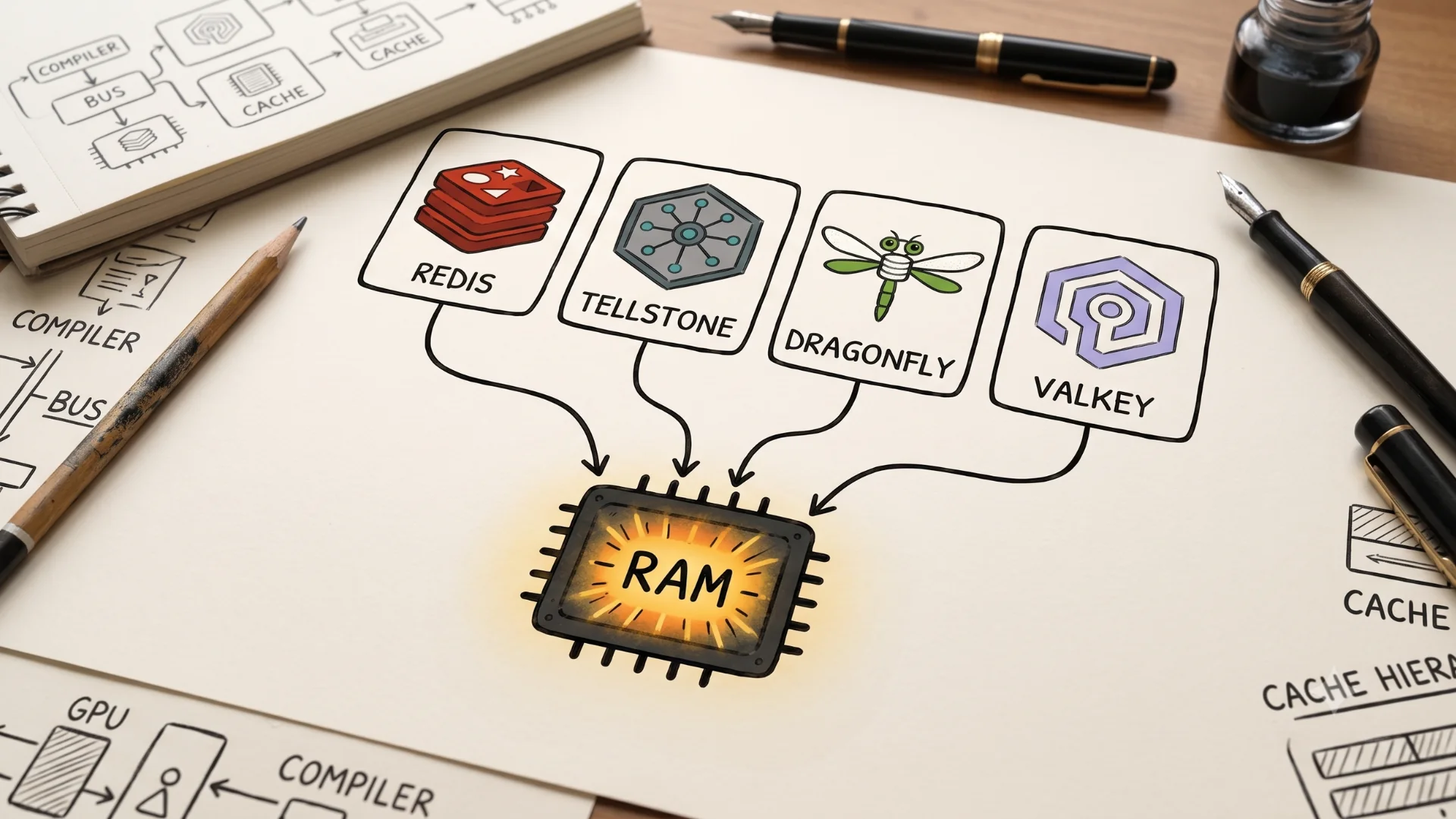
Redis, Valkey, Dragonfly, and Tellstone: One Thread vs. Many, Explained Simply
Redis forked into Valkey in 2024. Dragonfly rebuilt the engine multi-threaded. Tellstone is a tiny Go experiment. Here's what actually differs.

PostgreSQL vs DynamoDB: When to Switch and How Much It Costs at Scale
AWS's own price list shows DynamoDB on-demand costing 26x more than provisioned, and RDS PostgreSQL swinging hard on Multi-AZ and reserved-instance terms.

How Discord's Gateway Handles Millions of Concurrent WebSocket Connections
Discord's gateway scaled past 12 million concurrent WebSocket users with one Erlang process per session. Here's how the real architecture works.
Comments (0)
Please sign in to join the discussion.
No comments yet.
Be the first to share your perspective on this topic.