
Cloudflare's January 16, 2026 announcement that the Astro team would join Cloudflare does not prove that every site should leave Next.js. It does change the technical SEO case for content-heavy sites that depend on fast initial HTML, stable metadata, efficient crawling, and limited JavaScript execution.
The stronger argument is not that Next.js is inherently bad for SEO. Next.js can serve pre-rendered HTML through Static Site Generation and Server-Side Rendering, and its App Router uses Server Components by default. The risk appears when a content site drifts into a client-heavy implementation where article text, links, canonical tags, layout stability, or meaningful interaction depend too much on JavaScript execution.
Cloudflare's Astro acquisition changes the risk profile for content sites
Cloudflare said in its official acquisition announcement that the Astro Technology Company team would join Cloudflare and that Astro would remain open source. The company framed Astro as a framework for high-performance, content-driven websites, while also discussing future alignment with Cloudflare's developer platform.
That matters because framework choice is not only an engineering preference for larger publishers. It becomes an adoption-risk question. Teams that manage editorial pages, documentation hubs, and SEO landing pages need to know whether the framework they choose has an active roadmap, infrastructure backing, and a deployment story that can support long-lived content.
Cloudflare's announcement should still be treated as an official company claim, not as independent proof that Astro is faster in every production environment. The practical implication is narrower but important: Astro now carries less institutional uncertainty for teams that previously saw it as a smaller open-source alternative to React-centered application frameworks.
The SEO issue is JavaScript dependency, not the Next.js name
The framework debate often gets flattened into a misleading claim: Next.js is bad for SEO. That is not what the source material supports. The Next.js rendering guidance describes Static Site Generation and Server-Side Rendering as SEO-friendly strategies because they can provide pre-rendered HTML to crawlers.
The risk is implementation-specific. Google's JavaScript SEO guidance says classical server-rendered pages work well when the HTML response contains the page content. It also explains that app-shell pages may require Google to render JavaScript before the generated content becomes visible, and that rendering can be delayed depending on available resources.
For a content site, this distinction is operational rather than theoretical. If the initial response already contains the article body, internal links, metadata, canonical tags, and meaningful status behavior, crawlers have less work to do. If the page needs JavaScript execution before those signals settle, the site has added an avoidable dependency to the indexing path.
Astro makes static HTML the default instead of an optimization project
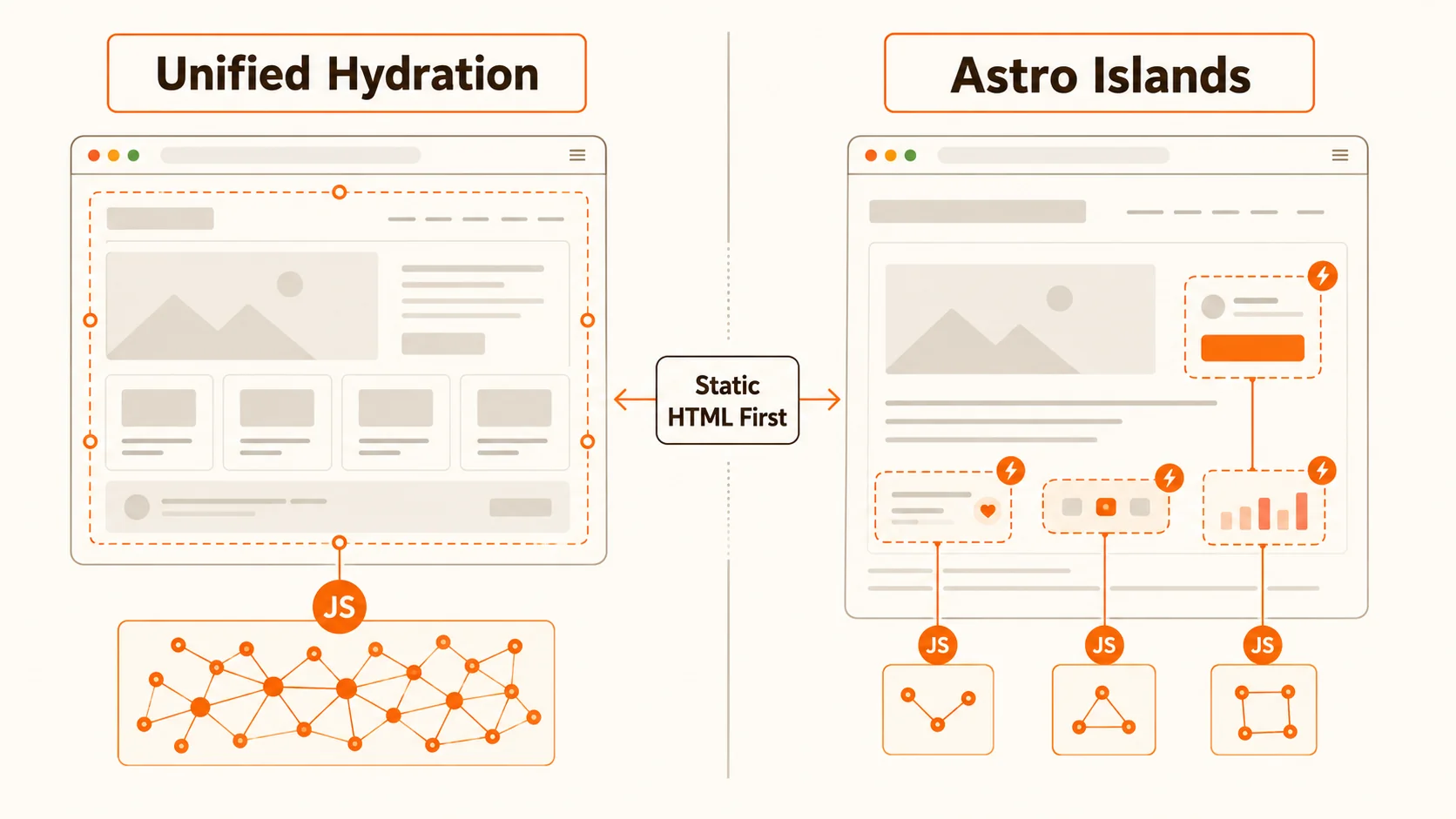
Astro's islands architecture documentation describes a model where most of the page is rendered as static HTML and JavaScript is loaded only for isolated interactive components. Astro components do not ship client-side JavaScript by default; developers opt into hydration with directives such as client:load, client:idle, or client:visible.
Next.js has its own SEO-safe paths. The App Router uses Server Components by default, and a disciplined implementation can keep many content routes lean. The tradeoff appears when teams need state, browser APIs, event handlers, or custom hooks and begin widening "use client" boundaries. The Server and Client Components documentation explains that once a module is marked as client-side, its imports and child components become part of the client bundle.
That is why Astro is attractive for content work. It makes the low-JavaScript path the default. With Next.js, the same outcome is possible, but it requires ongoing architectural discipline around component boundaries, data fetching, and hydration.
Core Web Vitals and crawl budget favor less rendering work
Google's Core Web Vitals guidance uses Largest Contentful Paint, Interaction to Next Paint, and Cumulative Layout Shift to describe loading performance, responsiveness, and visual stability. Good Core Web Vitals do not guarantee rankings, but they are part of Google's page experience systems and they matter to users regardless of ranking.
The crawl side has a similar constraint. Google's crawl-budget documentation says the web is too large for every URL to be crawled constantly, so Google balances crawl capacity and crawl demand. Google also says crawl capacity can rise when a site responds quickly and fall when a site slows down or returns server errors.
Astro's advantage is not magic. It is that content-first static output reduces the amount of browser and crawler work needed before the page's primary value is visible. For a publication with many frequently updated URLs, that can be the difference between framework performance as a permanent maintenance project and framework performance as the default path.
The migration target should be route-by-route, not ideological
A defensible migration strategy does not require replacing every Next.js route. Next.js remains a strong fit for logged-in dashboards, product applications, complex React state, browser-only APIs, and surfaces where the user experience is closer to software than publishing.
The better split is by route purpose. Editorial articles, documentation pages, SEO landing pages, and marketing pages with light widgets are natural Astro candidates because the primary value is content that should be visible in HTML. Logged-in app routes can remain in Next.js where persistent state and complex interactivity justify the client-side cost.
Astro's migration guidance from Next.js supports that route-by-route view. It notes that React components can be reused through Astro's React integration, while also making clear that pages, layouts, and framework-specific conventions still require migration work. That is the honest tradeoff: Astro can reduce SEO and hydration risk for content surfaces, but it is not a no-work drop-in replacement for a complex React application.
The migration case is strongest when a site can measure the problem it is trying to solve. Before moving routes, teams should capture Search Console crawl stats, server logs, Core Web Vitals field data, Lighthouse traces, JavaScript bundle sizes, and indexation patterns for representative templates. Without that baseline, the Astro argument remains architectural and directional rather than proven for the specific site.
That is still enough for many content-heavy teams to act. If the core business depends on pages being crawled, parsed, indexed, and updated efficiently, Astro's static-first model fits the job with fewer moving parts. Next.js remains a strong application framework. Astro is increasingly the cleaner publishing framework.

Zero-Click Search Hit 68% as Publishers Weigh Blocking Google
Google's AI Overviews cut click-through for the top result from 27% to 11%, and llms.txt, the fix marketers pitch, shows no measured citation lift yet.

How Stripe's Idempotency-Key Header Prevents Duplicate Charges
Stripe's 2017 engineering post explains the Idempotency-Key header; the exactly-once guarantee it enables actually lives in a database unique constraint.

WhatsApp's 2.8-Million-Connection Server, Rebuilt in Go and Rust
WhatsApp's real, sourced numbers: 200K to 2.8M connections per server, a three-stage dispatch fix, and a tested Go/Rust/Docker reproduction of the pattern.

Porsche Brings the Manual Gearbox Back to the 911 Carrera S
Porsche's 2027 911 Carrera S MT Package pairs a six-speed manual with 473 hp, starts at $169,450, and weighs just 11 lbs more than the manual Carrera T.
Comments (1)
Please sign in to join the discussion.