
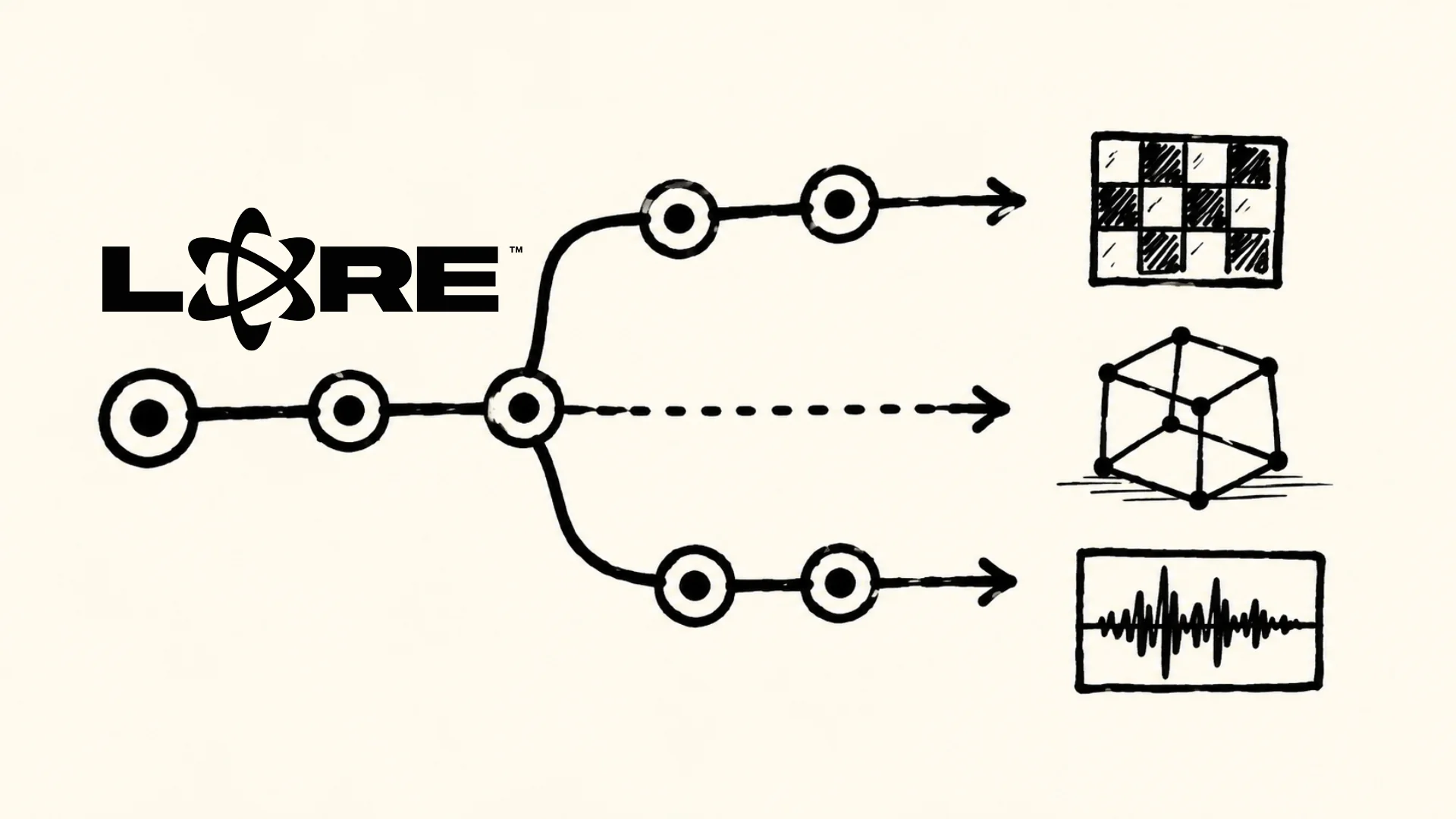
Epic Games has released Lore, a free, open-source version control system built around the textures, meshes, and audio files that strain Git and have kept many studios paying for Perforce.
How Lore Tracks Project History With Merkle Trees And Content Addressing
Lore is built as a centralized, content-addressable system that records every repository state as a Merkle tree linked into an immutable chain of revisions, according to Lore's source code and repository on GitHub. That structure lets the system verify that a file, or an entire revision, hasn't been altered or corrupted, without requiring a full download of the project's history first.
The system also deduplicates data at the content level, storing each unique chunk of a file once no matter how many versions of a project reference it. For source code, that's a problem Git already solves well through line-based diffing. For a multi-gigabyte texture or a 3D scan that changes slightly with each export, it generally isn't — which is the gap Lore's project site points to in describing the system's binary-first storage and on-demand "sparse hydration," where a working copy downloads only the specific files a given task needs rather than an entire asset library.
In practice, that distinction determines whether a new hire's first day involves an hours-long download of every asset a project has ever produced, or an immediate start on just the files their task touches — a real, if unglamorous, cost that grows with every terabyte a studio's art library accumulates.
Exclusive Locks Target The Merge Conflict That Breaks Git For Artists
Git's branching and merging model assumes files can be combined line by line, which works for code but not for a texture or a mesh that two artists have each modified independently. There is no reliable way to merge two such files, so studios have long relied on a different mechanism: one person checks a file out, edits it, and checks it back in before anyone else can touch it. A discussion thread that followed Lore's announcement frames this as the core reason Git and Git LFS fall short for art-heavy teams, and describes Perforce as effective when it works but prone enough to snags that teams often need a dedicated tools engineer just to keep it running.
Lore builds the locking workflow in directly, the same mechanism that makes Perforce usable for art teams today. The underlying trade-off doesn't disappear: only one person can hold a lock on a given file at a time, and async collaboration on that same asset is still effectively impossible. What changes is that the trade-off now comes packaged in a free, MIT-licensed tool instead of a commercial one with its own maintenance overhead — which is the part of the announcement drawing the most attention from developers currently paying for Perforce specifically because of this limitation.
Lore's Trademark Filing Signals A Direct Run At Perforce's Helix Core
Epic Games filed a trademark for "Lore" covering downloadable software platforms for revision control in May 2026, formalizing what the system's design already implied: a challenge to Perforce's Helix Core, the proprietary tool that has long been the standard for AAA game development. Lore itself is released under the MIT license and hosted on GitHub under the EpicGames organization, removing the per-seat licensing cost that makes Perforce a recurring budget line for smaller studios.
That doesn't make adoption automatic. Perforce's hold on the industry rests on years of pipeline integration and staff trained to keep it running. Switching version control systems mid-production is the kind of disruption most studios avoid unless something is actively broken, regardless of what a new tool costs.
Lore Is Pre-1.0, And Its Open-Source Promise Isn't Complete Yet
Lore's own repository describes the project as pre-1.0 and under active development, with interfaces, on-disk formats, and APIs still subject to change — a status that matters for any studio weighing it against a decade-tested system for active production use today.
There is also a gap between Lore's framing as fully open and its current state. The project's own roadmap documentation on GitHub notes that an early desktop client already exists as a binary download but isn't open source yet, because it depends on proprietary components. For most users, that desktop client — not the command line — will be the main way they interact with Lore day to day, which makes the gap more than a technicality.
Early developer reaction mixes relief at having a modern, free alternative to Perforce and Git LFS with skepticism about real-world performance at scale, and some unease about depending on a game engine company for version control infrastructure that has nothing to do with making games.

Cache Invalidation Isn't One Problem: It's Three Layers With Different Guarantees
RFC 9111, Cloudflare's rebuilt purge pipeline, and Facebook's memcache paper show cache invalidation as three layers, each with a trigger and failure mode.

zk-SNARKs vs zk-STARKs: What Benchmark Data Shows About Speed, Size, and Quantum Risk
zk-SNARK and zk-STARK proof size, speed, and quantum-resistance data, and how that tradeoff shapes ZK-Rollups, digital identity, and compliance today.

Session Cookies vs. JWTs in 2026: Why Revocation, Not Statelessness, Is the Real Trade-Off
OWASP calls JWT-based sessions "frowned upon." Here is the real 2026 trade-off between stateful cookies and stateless JWTs, and how to secure each one.

GraphQL's N+1 Problem in NestJS: What DataLoader Fixes and What It Doesn't
A NestJS benchmark shows field resolvers cut throughput 57-74% before DataLoader batching even runs. Here's when to batch and when to just join.
Comments (0)
Please sign in to join the discussion.
No comments yet.
Be the first to share your perspective on this topic.