
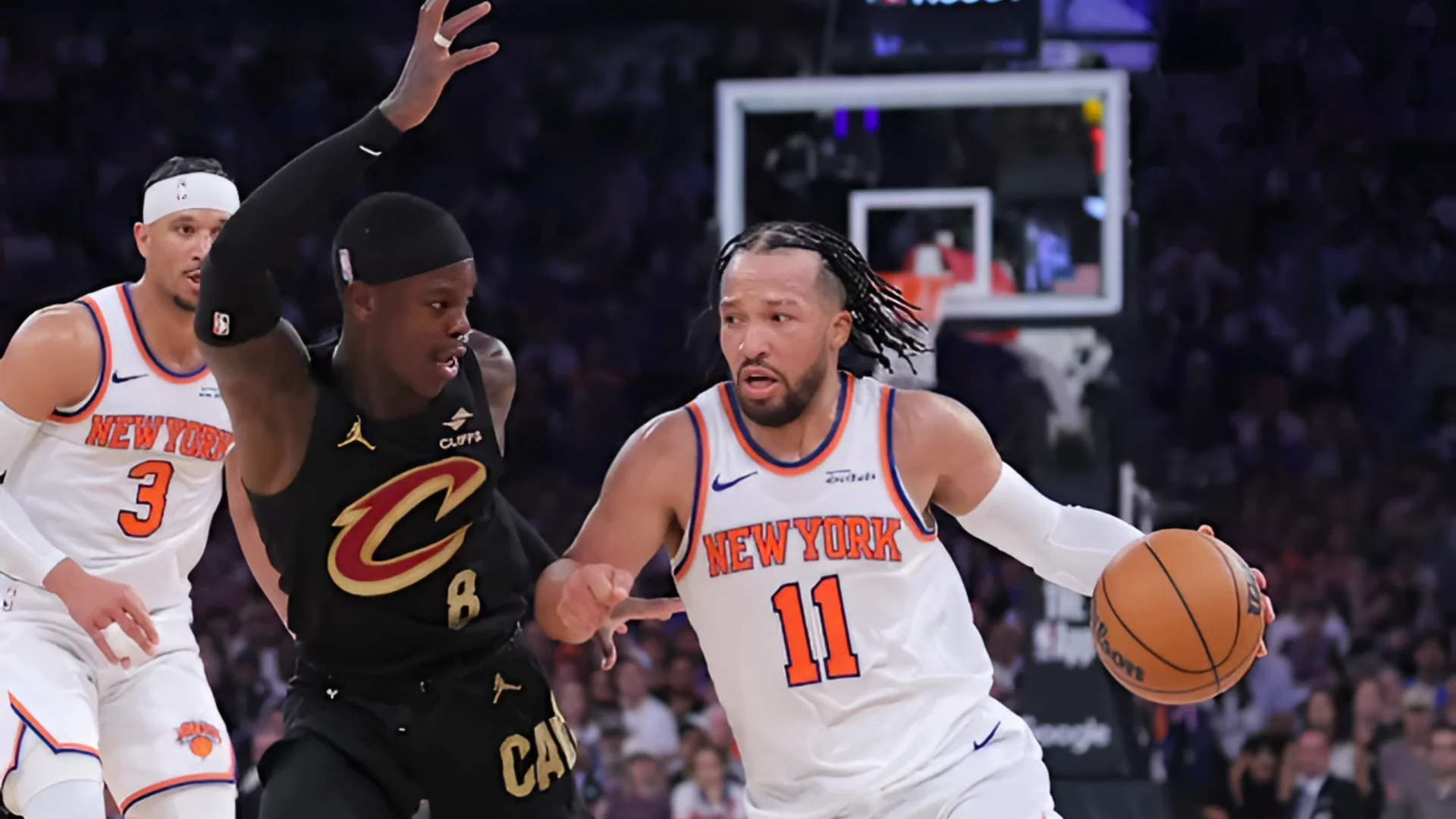
The New York Knicks erased a 22-point fourth-quarter deficit to beat the Cleveland Cavaliers 115-104 in overtime on Tuesday night at Madison Square Garden, taking a 1-0 series lead in the Eastern Conference Finals. The comeback — the largest in Knicks postseason history — was built on a deliberate tactical decision to hunt James Harden on defense and dare Cleveland to stop it.
A 22-Point Hole and the Run That Erased It
For three quarters, Cleveland looked like the sharper team. The Knicks were sluggish coming off a nine-day competitive layoff, shooting 2-of-19 from three in the first half before Cleveland pulled away. The Cavaliers scored 35 points in the third quarter alone — generating that output despite making just four threes — and stretched their lead to a game-high 22 points, 93-71, with 7:52 left in regulation when Donovan Mitchell buried an uncontested three.
What followed was one of the more concentrated individual performances in recent playoff memory. Jalen Brunson scored 11 consecutive Knicks points to open the comeback, trimming the deficit to five and forcing a Cleveland timeout at 3:30. Out of the timeout, the game turned on a sequence of small plays: a Sam Merrill loose-ball foul on a missed free throw gave New York an extra possession; Mikal Bridges converted a step-back three. Bridges hit another corner three moments later to cut the lead to three. Landry Shamet then hit an open three to tie the game at 101. Brunson answered a James Harden floater with a banking floater of his own to make it 103-103. On Cleveland's final possession, under heavy pressure, Harden ran into a shot-clock violation, and the game went to overtime.
New York outscored Cleveland 12-1 in the extra period, opening on a 9-0 run. Brunson targeted Harden on back-to-back possessions to score a floater and create an open baseline look. Evan Mobley missed two three-point attempts for Cleveland. OG Anunoby added a transition layup. Shamet's three with 1:49 remaining extended the lead to 110-101 and effectively ended the contest. The closing run from that 22-point deficit to the final whistle was 44-11.
The chart below shows how New York's scoring run unfolded across the final eight minutes of regulation and overtime — from the game's low point to the finish.
Box Score Performances: Brunson's Floor and Cleveland's Collapse
Brunson finished with 38 points, 5 rebounds, 6 assists, and 3 steals on 15-of-29 shooting in 46 minutes. The volume was high but so was the concentration of impact: the bulk of his most consequential contributions arrived in the game's final eight minutes, when he orchestrated an 18-1 run largely by himself before the rest of New York joined in overtime. Mikal Bridges was the best complementary performer, adding 18 points on 7-of-11 shooting, including two pivotal threes in the comeback sequence. OG Anunoby, returning from a two-game injury absence, scored 13 points and 5 rebounds in 34 minutes. Josh Hart contributed 13 points, 7 rebounds, and 4 assists. Karl-Anthony Towns posted a double-double — 13 points and 13 rebounds — but his 7 turnovers were a significant drain. Landry Shamet provided nine points off the bench on a perfect 3-for-3 from three, including the overtime dagger.
For Cleveland, Donovan Mitchell led with 29 points, 5 rebounds, and 6 steals — a strong individual line made bittersweet by what followed. Evan Mobley recorded 15 points, 14 rebounds, and 3 blocks. The problem was James Harden, who finished 5-of-16 from the field and 1-of-8 from three, with 6 turnovers and what post-game commentary described as apparent defensive fatigue late in the game. Mitchell did not conceal his frustration afterward, telling reporters that the team "blew it" and framing Game 2 as the immediate and only relevant response. Cleveland coach Kenny Atkinson acknowledged that Brunson "obviously took over" and that his group was "dominated in the fourth quarter," while crediting the team's play across the first three periods.
The chart below shows the primary statistical lines for the game's leading performers on each side.
How New York Hunted Harden and What Cleveland Must Answer
The tactical story of this game's fourth quarter was not primarily about Brunson's individual brilliance — it was about a pre-planned scheme that his brilliance executed. New York head coach Mike Brown confirmed post-game that the Knicks had explicitly targeted Harden in the fourth quarter, forcing defensive switches to isolate him on the perimeter and using Brunson's driving ability to collapse Cleveland's rotations. "We were trying to do the same thing with Jalen," Brown said. "Just like we try to figure out how to guard Harden and Mitchell, they have to figure out how to guard Jalen. It was no secret we were attacking Harden."
The approach had two compounding effects. On one end, Brunson created sustained pressure directly at Harden's position, generating foul opportunities, easy floaters, and open threes for cutters and shooters. On the other end, Harden's own offensive efficiency deteriorated under the weight of extended defensive assignments: he finished 1-of-8 from three and committed 6 turnovers across the game, including the shot-clock violation that ended regulation. Whether Harden's struggles were a product of accumulated defensive effort, natural decline in his off-ball movement, or simply New York's pressure will shape how much importance Cleveland's coaching staff places on adjusting his role heading into Game 2.
Kenny Atkinson acknowledged the collapse but framed it partly as misfortune — "we got a little unlucky, quite honestly" — a characterization that understates the systemic nature of what New York exposed. That said, Atkinson's observation that Cleveland played well for three quarters is accurate: the Cavaliers generated 35 third-quarter points without heavy three-point reliance and controlled pace for long stretches. The tactical question for Game 2, scheduled for Thursday, May 21 at Madison Square Garden, is whether Cleveland adjusts its defensive rotations to reduce Harden's exposure in late-game situations, or whether the same switch-heavy scheme leaves the same opening.
The chart below shows the contributions to New York's 44-11 closing run by player during the fourth quarter and overtime, based on sourced play-by-play.
There was also a broader footnote to the night. In the Western Conference Finals, San Antonio defeated Oklahoma City in double overtime in their own Game 1, making this the first time in NBA history that both conference finals opened with overtime games on the same night — though that record is incidental to the story New York wrote in the fourth quarter at the Garden.
Game 2 is scheduled for Thursday, May 21, 2026, at Madison Square Garden.
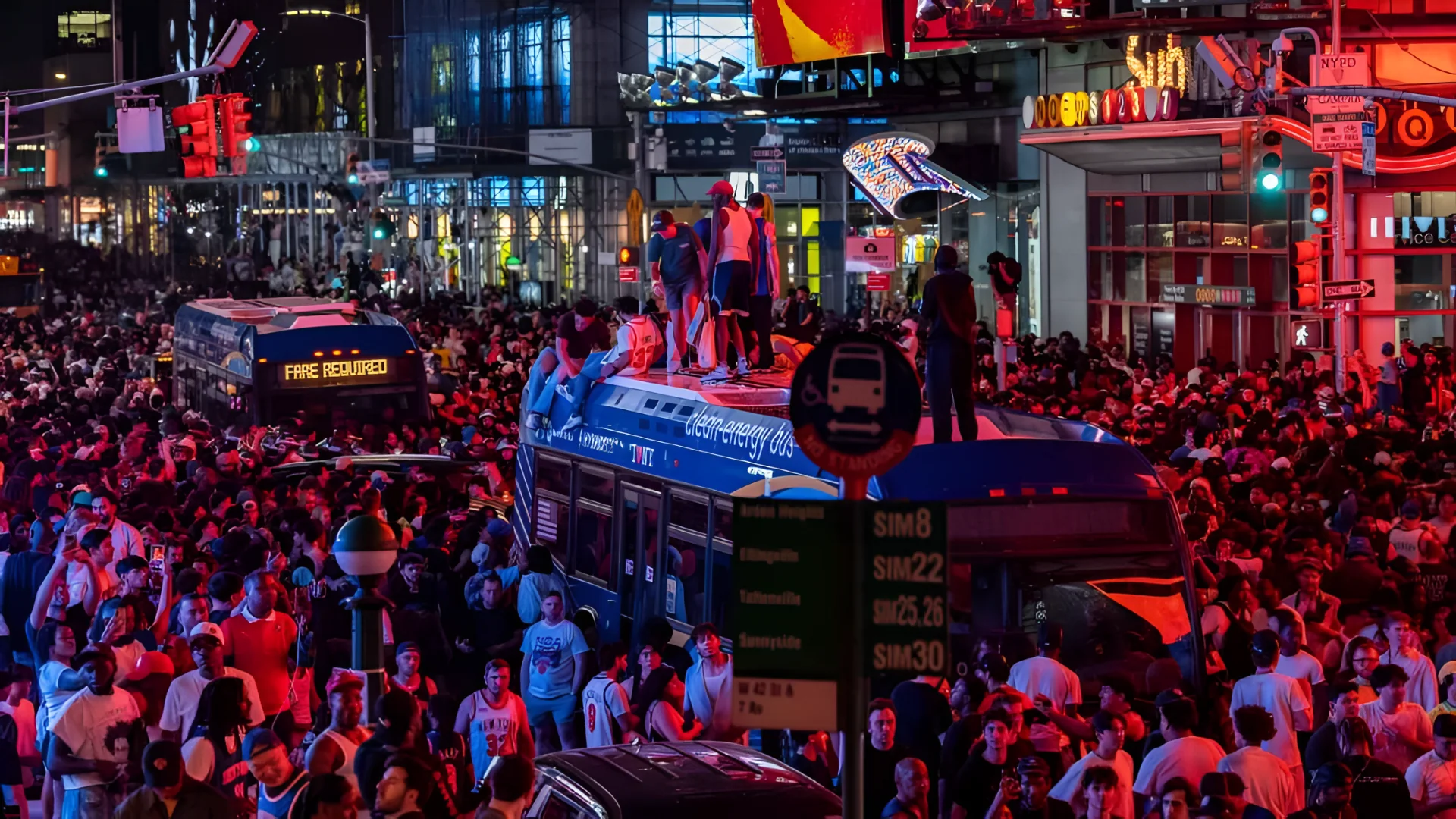
Knicks Win 2026 NBA Title, Parade Set for Thursday
The New York Knicks won the 2026 NBA Championship with a 94-90 Game 5 victory over San Antonio, ending a drought dating to 1973. A ticker-tape parade is set for Thursday, June 18, in Manhattan.
Comments (0)
Please sign in to join the discussion.
No comments yet.
Be the first to share your perspective on this topic.