
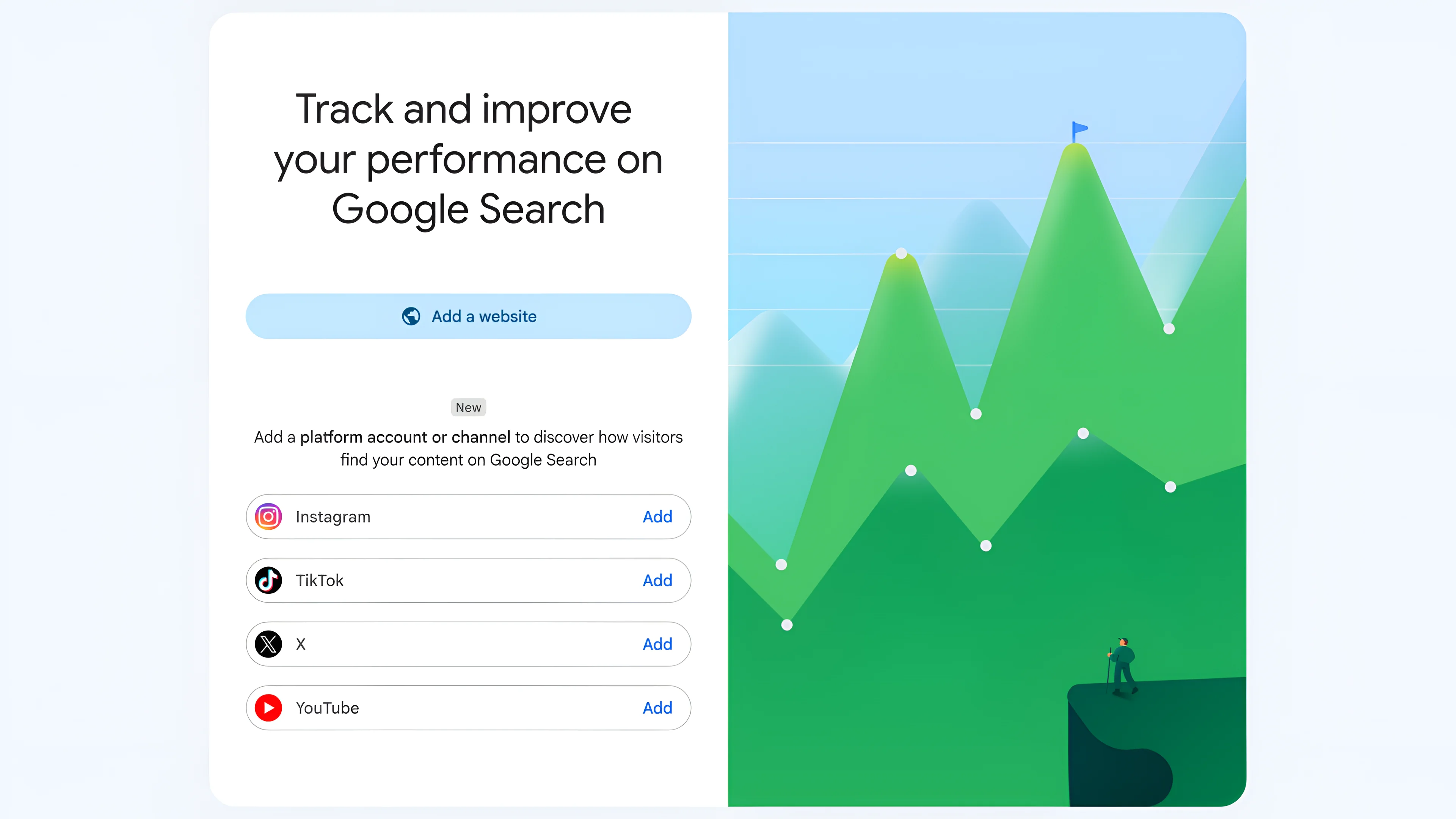
Google has added a new property type to Search Console that lets creators and brands verify Instagram, TikTok, X, and YouTube accounts and see how those posts perform in Google Search and Discover — without needing to own the underlying website.
A New Verification Model, Not Just a New Report
Google announced platform properties in a Search Central Blog post on July 7, 2026, describing the goal as helping site owners and creators understand how their social and video posts are discovered on Search. The mechanism is the notable part. Every prior Search Console property has required proving ownership of a domain, typically through a DNS record or an HTML file on the site itself. Platform properties instead verify an account through direct authorization — a creator signs in and connects their Instagram, TikTok, X, or YouTube account, with no website involved at any step.
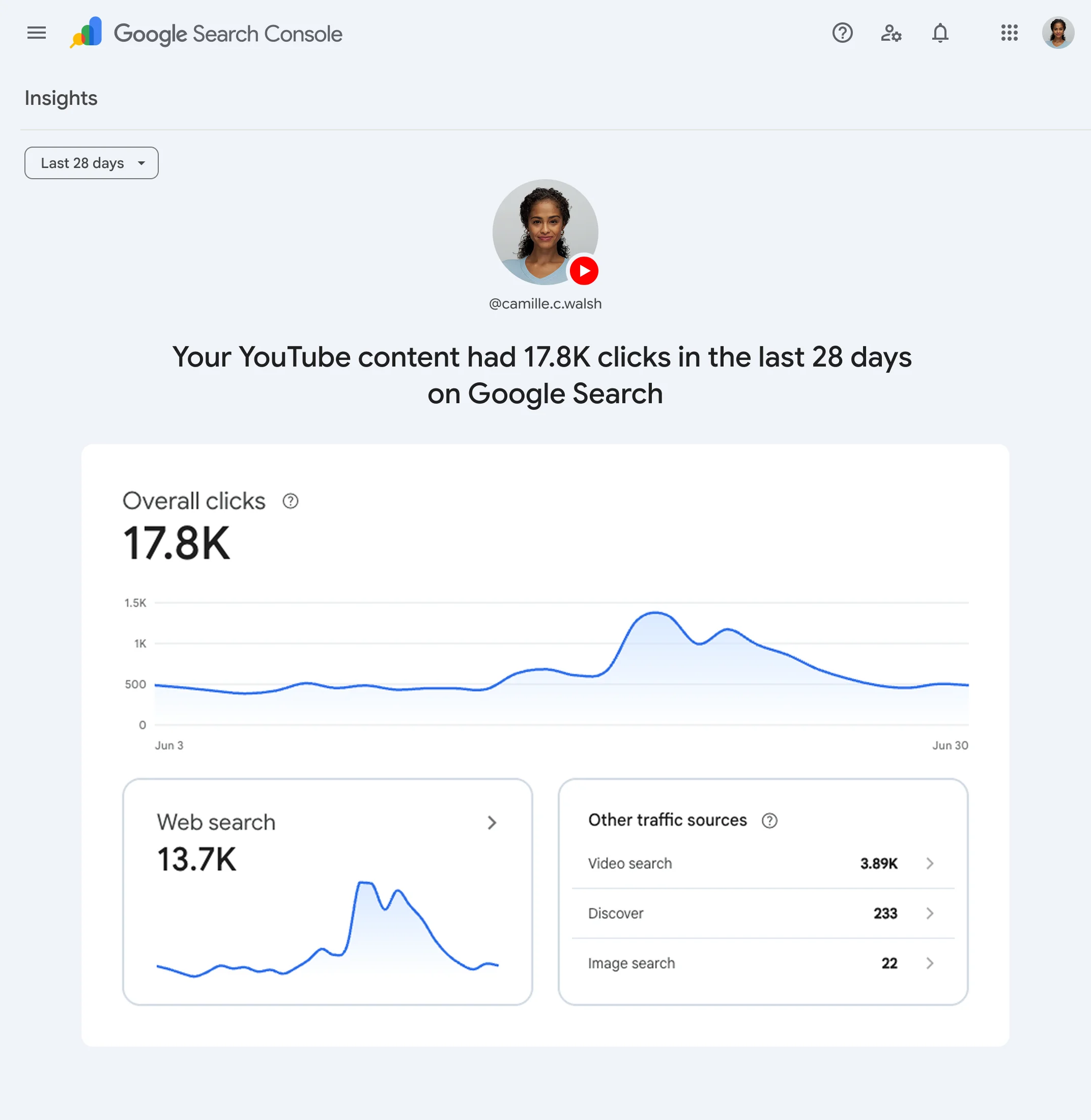
That distinction matters because it opens Search Console to a group who could not use it before: creators whose entire public presence lives on a platform they don't operate. Once a platform property is verified, its data appears in three familiar report surfaces — Performance, for clicks, impressions, and query-level detail per post; Insights, for traffic trends and top-performing content; and Achievements, for milestones such as new click thresholds within a trailing period. The reporting covers Google Search and Discover only; native engagement metrics such as likes, shares, or watch time remain inside each platform's own analytics, since that data does not pass through Google's index.
How This Differs From December's Pilot and June's Search Profiles
Platform properties are not Google's first attempt at surfacing social data inside Search Console. In December 2025, Google introduced social channels inside the Search Console Insights report, a narrower pilot that still required an owned, verified website property to exist in the first place. Platform properties remove that requirement entirely, making the July 2026 launch a more complete version of the same idea rather than a rebrand of it.
It's also worth separating platform properties from Search profiles, a different feature Google launched in June 2026 for qualifying creators. A Search profile is a public-facing page in Google Search that consolidates a creator's content for an audience — a discoverability and branding tool. A platform property is the opposite kind of surface: private analytics for the account holder, with no public output at all. The two features share a launch season and an account-based verification approach, but they solve unrelated problems, and treating them as interchangeable would misread both.
What Remains Unsettled in the Early Rollout
Google has stated that platform properties will become available gradually over the coming weeks, without a completion date or a country-by-country schedule. That gradual rollout showed up immediately in practice. Barry Schwartz of Search Engine Roundtable, who had earlier spotted a help document about the feature that Google briefly published and then pulled, reported on launch day that the option to add a platform property had not yet appeared in his own account — even as an X profile surfaced there on its own, without him completing the verification steps. That is a single practitioner's account, not evidence of a broader pattern, but it is a useful signal that access and behavior may vary meaningfully from one account to the next during the early weeks.
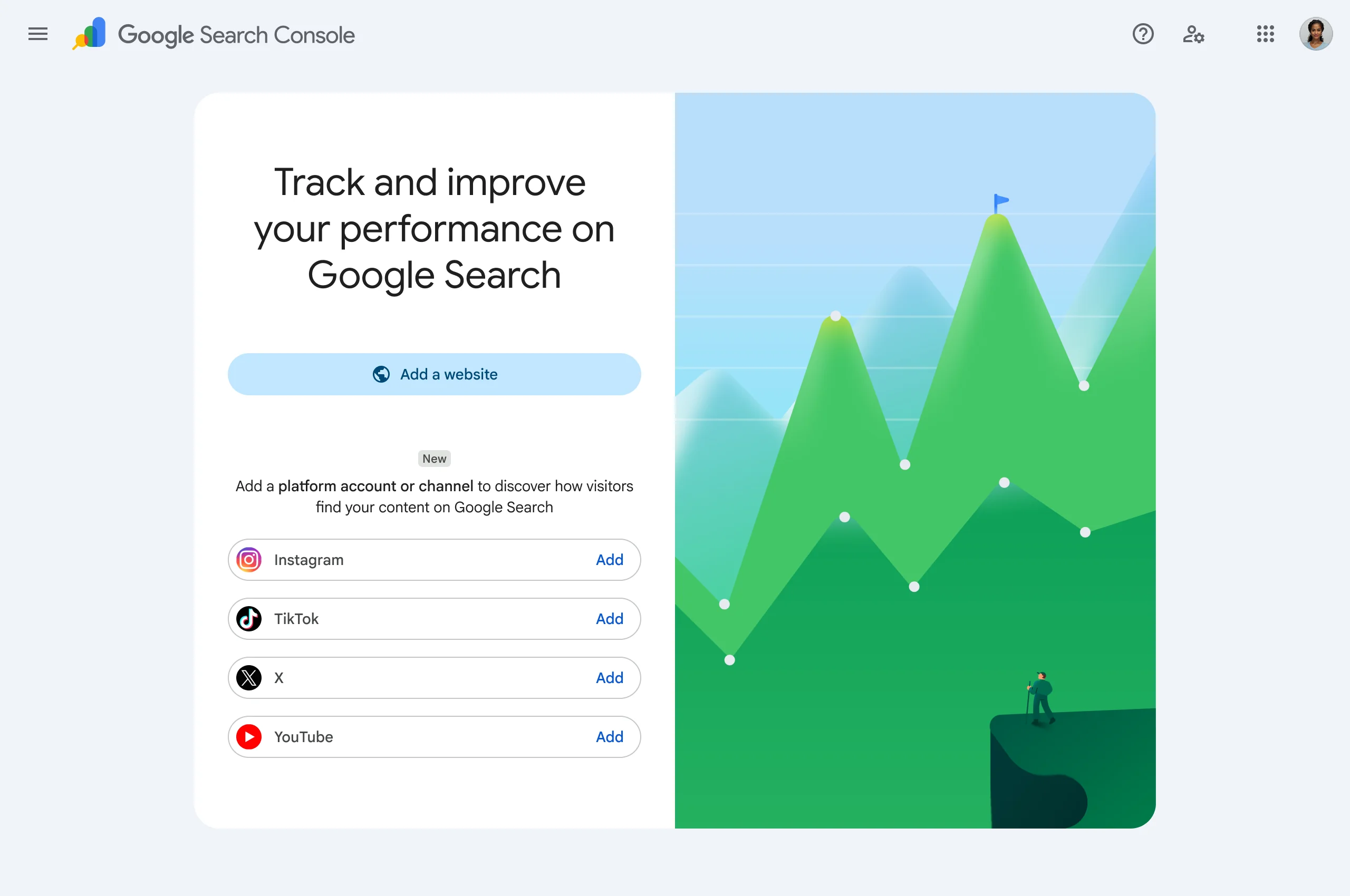
A few other limits are worth noting before drawing conclusions from the new data. Only four platforms are supported at launch — Facebook and LinkedIn are absent, and Google's announcement does not commit to expanding the list on any timeline. Each property must be set up and verified individually, and Google's announcement does not address bulk setup or API access, which matters for agencies managing accounts across several clients. And because the feature is new, there is no established baseline for how its numbers compare to the analytics each platform already provides natively — a gap that will only close as more accounts accumulate a longer reporting history.
For publishers and creators who have leaned on social and video distribution as website referral traffic has become harder to rely on, platform properties give Google's own search-visibility data a place to live for the first time. Whether that data proves reliable enough to inform content decisions, rather than simply confirm what platforms already report, is the open question the next several weeks of rollout should start to answer.

Vint Cerf Steps Down From Google After 20 Years, Says AI Agents Need Formal Protocols
Vint Cerf, co-creator of TCP/IP, is leaving Google after 20 years as chief internet evangelist, arguing AI agents need formal coordination standards now.

Terence Tao Used AI Coding Agents to Revive 24 Dead 1999 Java Applets
Terence Tao's AI coding agents ported 24 defunct Java applets to JavaScript in hours, fixed 2 old bugs, and shipped a 1999 relativity tool.

CoreWeave and Nebius Are Chasing $145 Billion in AI Deals on $16 Billion of Revenue
Microsoft, Meta and Nvidia have committed more than $145 billion to neoclouds CoreWeave and Nebius, whose combined 2026 revenue is projected near $16 billion.
GPT-5.6 Launches in Three Tiers, Narrowing the Gap With Claude Fable 5 at a Fraction of the Cost
OpenAI's GPT-5.6 Sol scores one point behind Claude Fable 5 in intelligence tests, at $1.04 per task versus $2.75, but trails on SWE-Bench Pro coding results.
Comments (0)
Please sign in to join the discussion.
No comments yet.
Be the first to share your perspective on this topic.