
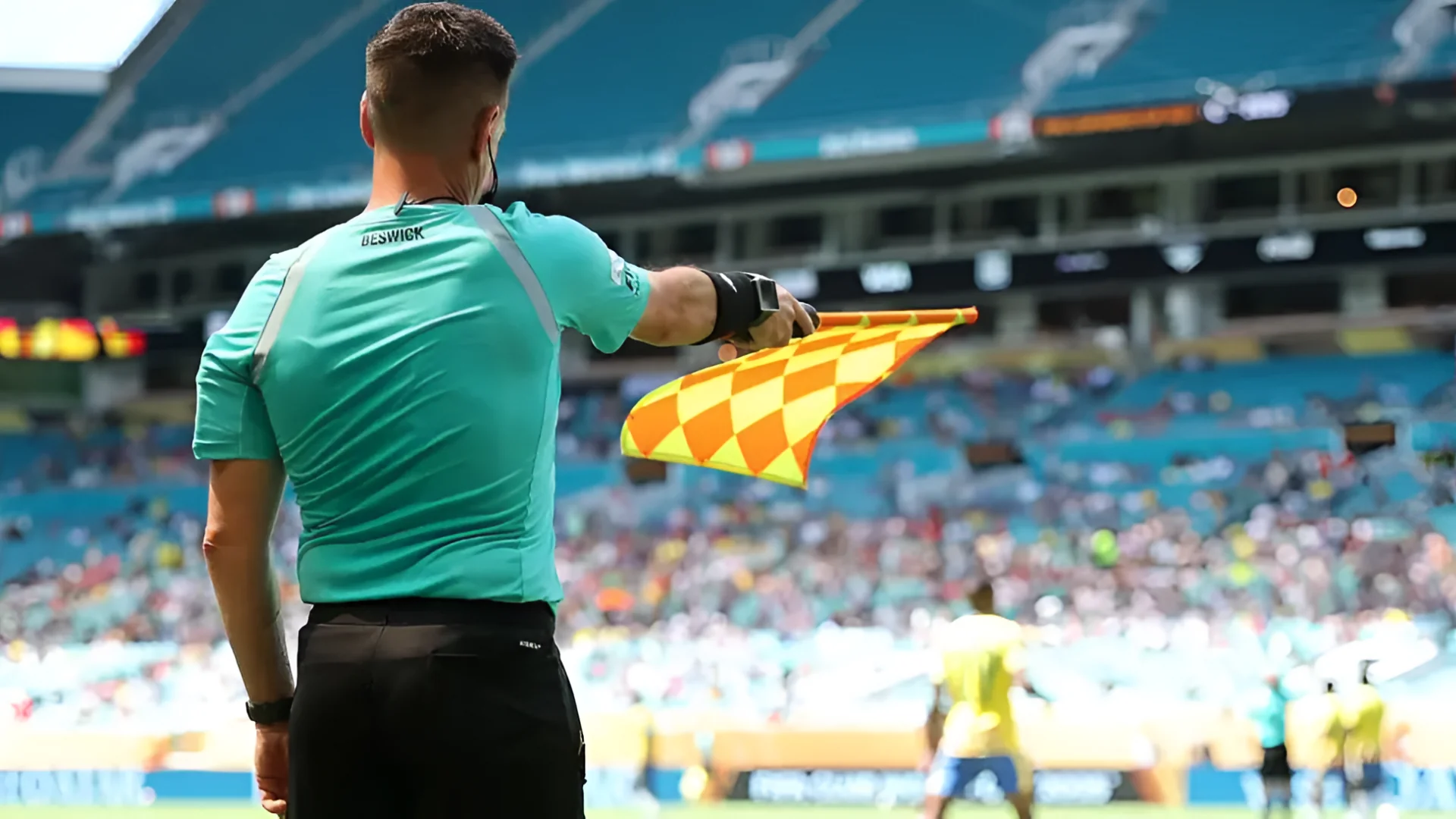
The 2026 FIFA World Cup opens with 48 teams, 104 matches, and a broadcast and officiating infrastructure unlike anything the tournament has deployed before. Across stadiums in the United States, Canada, and Mexico, every close offside call will be processed by a system that knows each player's exact body dimensions — and every viewer at home may catch angles that, until recently, only existed in video games.
The Ball Knows When It Is Kicked
The most operationally significant change to officiating at this tournament begins inside the match ball. FIFA's semi-automated offside system combines player tracking cameras with data from the connected ball to identify the precise kick point, and according to adidas, the sensor transmits data at 500 times per second. Pinpointing that kick-point moment was previously the slowest and most contested part of a VAR offside check.
The semi-automated offside system that debuted at Qatar 2022 uses 12 dedicated tracking cameras per stadium, combined with AI-driven skeletal mapping, to make real-time decisions, and every 2026 venue runs it. What is new this cycle is the layer of personalised player data on top of that infrastructure.
FIFA is taking the technology further at 2026 by creating AI-enabled 3D avatars of all participating players. With 48 teams and 26-man squads, a total of 1,248 players will undergo digital scanning ahead of the competition. Each player steps into a scanning chamber during pre-tournament media shoots — a process that takes approximately one second — and FIFA says the scans capture highly accurate body-part dimensions to enable reliable tracking during fast or obstructed movements.
Where traditional SAOT graphical models did not match the exact size and dimensions of individual players, the personalised 3D avatars allow the system to account for a player's specific limb length and physique. The practical consequence is that a marginal call on a player with long arms or an unusual stride is less likely to produce an error than it would have been under a generic skeleton model.
The updated system tracks up to 10,000 data points per player, and the Trionda official match ball contains a 500Hz motion sensor chip, sending data 500 times per second to the VAR hub to detect the exact moment of impact. Officials still confirm each automated alert before notifying the on-pitch referee — the system flags, humans decide.
The flow below maps how a single offside decision moves from the ball's sensor through tracking cameras to the VAR room and, finally, back to the referee and the stadium screen.
A Camera Count That Would Fill a Super Bowl Production Truck
The officiating upgrade runs in parallel with a separate transformation in how the tournament is filmed and distributed. At every match there will be 45 to 50 cameras focused on the action, including pole cams, cable cams, and 360-degree cameras, plus one new camera that places viewers closer to the action than before: referee-view footage that lets audiences see exactly what the on-pitch official sees.
Inside the stadiums, cable-suspended, gyro-stabilised spider cameras will swoop above the action, and broadcasters expect them to be used more prominently on live play than in previous tournaments — possibly including penalty shootouts. Drones, which captured widespread attention at the Milano-Cortina Winter Olympics, will not be deployed inside stadiums for live play: the unpredictability of football means a drone could be struck by the ball. Their role is instead limited to external aerial and pre-match coverage.
FIFA describes the analytics integration as "data-tainment" — a blend of advanced analytics and real-time graphics drawn from official optical tracking data that will run alongside live broadcasts. Speed figures, passing probability estimates, and formation data will appear during play for viewers in markets that opt in to the enhanced broadcast feed.
The scale of the host country spread makes this harder to deliver than in a single-nation tournament. With 16 venues across three countries and 104 matches to staff, FIFA and its broadcast partners must replicate the same camera array and data pipeline in every stadium, regardless of whether it was purpose-built or converted. FIFA boss Gianni Infantino has described the tournament as the equivalent of staging 104 Super Bowls. That comparison captures the logistical challenge: American sports broadcasting infrastructure is not uniform, and football-specific camera mounts and cable-cam rigs have to be installed fresh in venues designed primarily for the NFL or baseball.
The four numbers below define the technical baseline of the 2026 broadcast and officiating stack.
What Changes for Viewers, and What Stays the Same
The broadcast and officiating upgrades converge on a specific tension FIFA has not resolved: FIFA wants stadium spectators to enjoy the benefits typically associated with watching from a sofa — replays, stats, analysis — while home viewers feel the more visceral, immersive aspects of actually being in the stadium, through cinematic lenses, wearable cameras, and enhanced audio. The two goals pull against each other in ways the technology alone cannot settle.
Referee-view footage is the clearest example. Cameras mounted on the match official were trialled at the FIFA Club World Cup and will appear in 2026 broadcasts, with AI stabilisation software applied to smooth the footage. Whether that perspective enriches the viewing experience or unsettles audiences accustomed to a neutral broadcast frame is an open editorial question that varies by market.
The broader scepticism about tech intervention — that constant replays and data overlays disrupt the rhythm and emotion of a sport whose appeal partly rests on its simplicity — has not disappeared. FIFA knows the enduring appeal of watching football is its simplicity, and traditional audiences do not want gimmicks disrupting the game. At the same time, the American market FIFA is trying to reach is accustomed to sports packaged with statistics, replays, and commentary graphics running throughout play. These are not the same audience, and the same broadcast feed cannot fully satisfy both.
On the officiating side, the 3D avatar system addresses a real limitation of Qatar 2022's SAOT — the generic skeleton model that did not account for individual player physiques — but it does not eliminate human judgment from the process. Automated alerts still require a match official to review and confirm before the referee is informed. The risk of an automated false positive leading to an incorrect decision has not gone away; it has been reduced.
The timeline below traces how World Cup broadcasting has changed since the tournament last came to North America in 1994.
The 1994 comparison is instructive. That tournament was also staged across North American stadiums unfamiliar with football infrastructure, and FIFA's central concern then was basic broadcast coverage and commercial reach. Thirty-two years later, the concern is whether a 500Hz sensor ball, a scanning chamber, and a cable-suspended camera system can make 104 matches across three countries feel consistent — in officiating standard, in broadcast quality, and in audience experience — for the largest version of the tournament ever held.

Ronaldo Scores in 6th World Cup in Portugal's 5-0 Win
Ronaldo's brace against Uzbekistan made him the first player to score in six different Men's World Cups and Portugal's all-time leading scorer at the global finals with 10 goals.

Messi, Mbappé, Haaland Dominate 2026 World Cup
Lionel Messi leads the Golden Boot race, Kylian Mbappé's France are the clear favorites, and Erling Haaland is scoring freely as the 2026 World Cup group stage produces a spectacular opening.

Canada's Historic Win Marred by Koné Injury and Brawl
Canada defeated Qatar 6-0 on June 18 for their first FIFA World Cup win. Jonathan David scored a hat-trick, but the night was marked by Ismaël Koné's broken leg and a post-match altercation between coaching staffs.

Justin Herbert's Footwork Overhaul Under Mike McDaniel
The Chargers' new OC is rebuilding Herbert's footwork from scratch, syncing his steps to route timing to neutralize the pass rush that battered him in 2025.
Comments (0)
Please sign in to join the discussion.
No comments yet.
Be the first to share your perspective on this topic.