
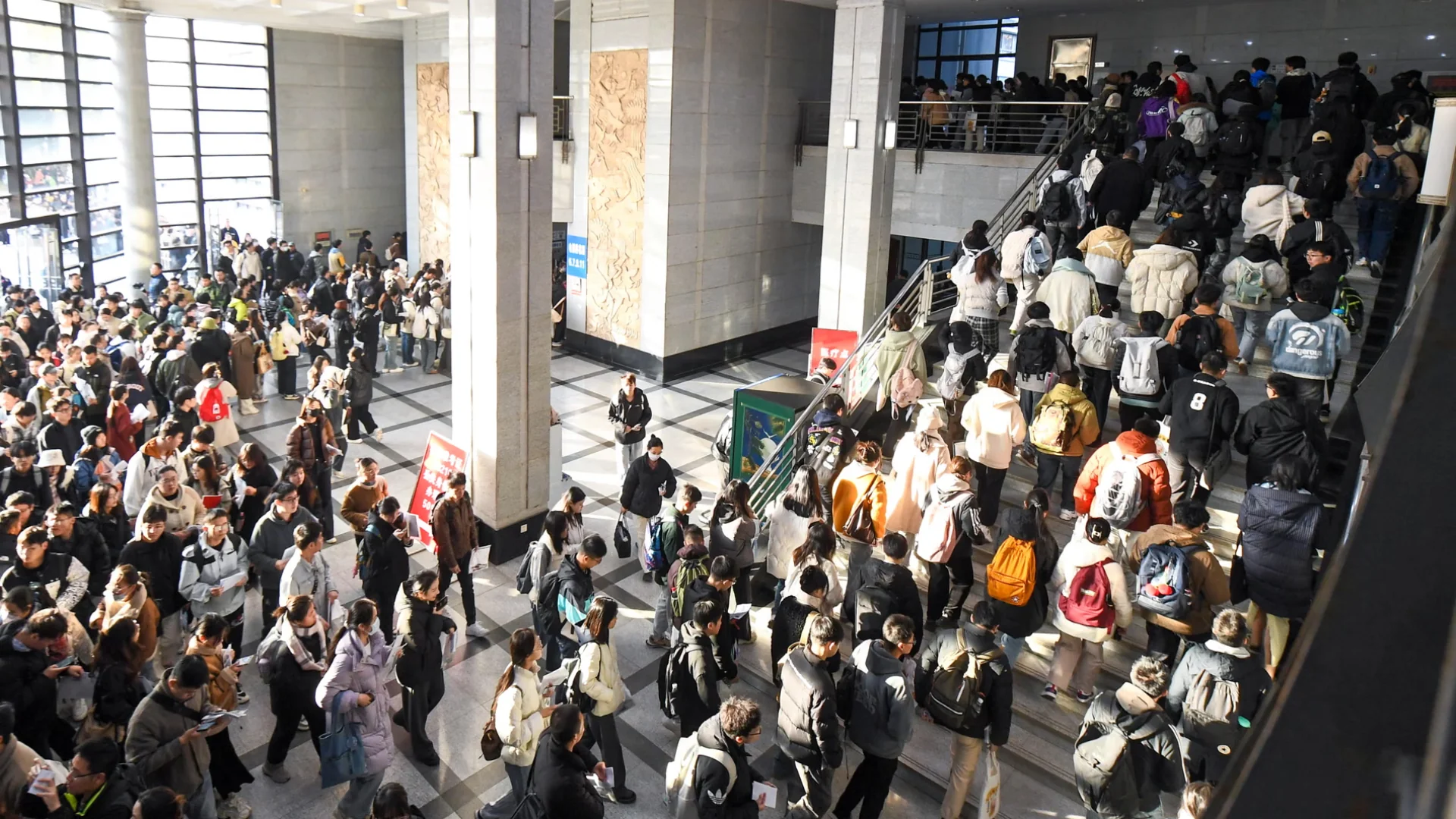
China's largest-ever graduating class is entering a labour market where entry-level roles face pressure from a slowing economy and expanding AI adoption, while government data show Vietnam's youth unemployment running roughly four times its national rate — two economies revealing the same structural strain from very different starting points.
China's Record 12.7 Million Graduates Enter a Market Squeezed by AI
China's Ministry of Education recorded 12.7 million college graduates this year, 480,000 more than 2025's then-record 12.22 million, according to reporting on this year's graduating class. Graduate numbers have topped 10 million annually since 2022, a cohort authorities must absorb each year that is roughly equivalent to the population of a mid-sized European country.
China's jobless rate among 16- to 24-year-olds stands at 15.6%, comparable to the UK's 16.2% and the EU's 15.1%, the same reporting shows. An unnamed Economist Intelligence Unit researcher describes China's youth employment strain as a persistent issue since 2020 that has not meaningfully improved, initially driven by the shift toward a manufacturing- and EV-led growth model, and more recently compounded by AI's effect on entry-level tasks — including, the researcher notes, in IT services where junior work is increasingly automated. Recent graduates describe sending out well over a hundred applications without success, particularly for roles that offer weekends off and standard social insurance.
The scale of the comparison across three very different labour markets is worth seeing directly.
Beijing Cuts 12,200 Degree Programs to Chase AI and Robotics Demand
Chinese universities culled 12,200 undergraduate programs, mostly in the arts and humanities, between 2021 and 2025, while introducing 10,200 in emerging and technical fields, according to Charles Jeffery Sun, founder of the consultancy China Education International, cited in the same reporting. The most sought-after undergraduate majors this year were electrical engineering, automation, and new-energy science and engineering, per a report from higher-education consulting firm MyCOS.
Because China's higher-education system is centrally governed, Sun notes that once Beijing sets a strategic direction, implementation across hundreds of universities happens rapidly — a pace of curriculum change he calls unique among countries pursuing similar AI- and tech-focused degree shifts. He describes the transition as painful for many graduates, but part of a "long-overdue reckoning" after decades in which Chinese higher education prioritized access over relevance.
Vietnam's Youth Joblessness Runs Four Times the Overall Rate
Vietnam's youth unemployment rate (ages 15–24) eased slightly to 8.86% in the first quarter of 2026, down from 9.04% in the fourth quarter of 2025 — itself an all-time high in a series stretching back to 2011, edging past the previous peak of 9.03% set in the third quarter of the same year, according to the General Statistics Office of Vietnam's quarterly data. Over the same stretch, Vietnam's overall unemployment rate barely moved, holding at 2.21% to 2.24%.
That gap suggests Vietnam's labour strain is concentrated among young and inexperienced workers rather than spread across the workforce broadly. Only 29.2% of Vietnam's total workforce holds a formal diploma or certificate, according to a 2026 Vietnam labour-market report from Dezan Shira & Associates — one of the narrower "high-value pipeline" bases in the region. The International Labour Organization's application of its GenAI occupational-exposure index to Vietnam's 2024 labour force survey estimates that roughly 20.8% of jobs, or about 11.5 million positions, may be affected by generative AI at the task level.
A Shared Skills Gap Underpins Both Countries' Youth Unemployment
Vietnamese labour economist Tran Anh Tuan has flagged accounting, teller work, data entry, customer service, graphic design, and content marketing as occupations at high risk of displacement — repetitive-task roles that generative AI handles relatively easily. Employers reportedly weight "attitude," meaning perseverance, dedication, and trustworthiness, in the large majority of hiring decisions for young employees, ahead of pure technical credentials, per the same expert commentary. In response, AI and digital-skills training is being mandated across Vietnamese university curricula in fields from IT and logistics to medicine and hospitality, and some universities have formed dedicated digital and green-transformation committees.
The gender split within Vietnam's youth-unemployment data sharpens the picture further: young women's NEET rate (not in employment, education, or training) reached 12.1% in the fourth quarter of 2025, against 8.3% for young men and a 10.2% total youth NEET rate, according to Vietnam labour-market reporting citing GSO and ILO data.
On China's side, the demand-to-supply ratio for AI positions stands at 3.5 to 1, and for robotics engineers at 5.2 to 1, according to Xinhua's reporting on the country's employment transition — meaning openings in these fields outnumber qualified applicants even as millions of graduates in other fields struggle to find work. That pattern, repeated across both economies, points to a mismatch between the skills graduates hold and the skills employers need, rather than a simple shortage of jobs. Sun describes China's trend as likely to worsen in the short term before stabilising as structural adjustments take hold; in Vietnam, analysts are watching the next GSO release to determine whether the multi-quarter climb in youth unemployment has genuinely turned, or whether the first-quarter dip is temporary.

The Phillips Curve in 2026: Unemployment at 4.1%, Inflation Still at 3.4%
U.S. unemployment held at 4.1% in August 2026 while inflation stayed at 3.4%. Here is what seven months of BLS data show about the Phillips curve trade-off.

The Impossible Trinity: Why Hong Kong's Peg and China's Capital Controls Are Two Sides of the Same Trade-Off
Hong Kong's dollar peg and China's capital controls look opposite, but both are answers to the same economic trilemma: pick two of three, never all three.

Carbon Taxes Range From 11 Cents to $170 for the Same Ton of CO2
Carbon taxes span 11 cents in Poland to $169.71 in Norway per ton of CO2, per Tax Foundation Europe. Here is what actually explains that 1,500-fold gap.

The Market for Lemons: How Hidden Quality Wrecks a Market
Asymmetric information about quality can push good products out of a market entirely. Akerlof's 1970 lemons model explains why, and how markets adapt.
Comments (0)
Please sign in to join the discussion.
No comments yet.
Be the first to share your perspective on this topic.