
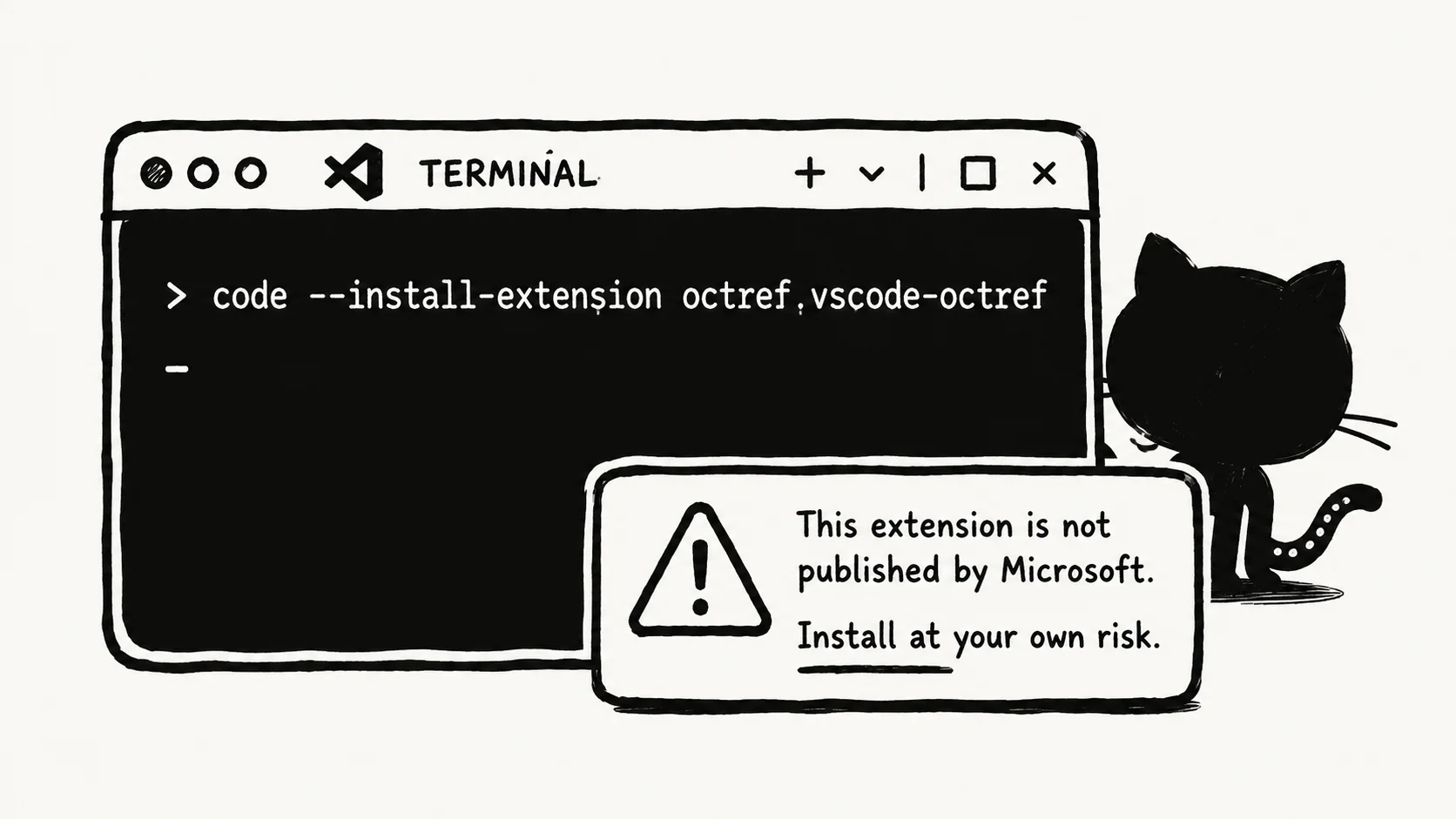
GitHub confirmed on May 19–20, 2026, that an attacker accessed and exfiltrated data from roughly 3,800 of the company's internal repositories after compromising a single employee's device through a malicious extension distributed via the official Visual Studio Code marketplace.
A Poisoned Marketplace Extension Was the Entry Point
The breach traced back to one infected employee endpoint. According to GitHub's public statements, the employee had downloaded a trojanized VS Code extension from the official marketplace — a trusted distribution channel that developers routinely use without additional vetting. Once installed, the extension provided the attacker with a foothold on the device.
That foothold appears to have been enough. From a single compromised workstation, the threat actor was able to reach GitHub-internal repositories — systems that would normally require authenticated access tied to that employee's credentials or stored secrets accessible from the infected environment.
This attack path is not novel, but the target makes it significant. GitHub hosts hundreds of millions of repositories and is a critical piece of software development infrastructure globally. An employee's developer environment carries implicit trust in many organizations: it holds tokens, SSH keys, API secrets, and cached credentials. Compromising that environment doesn't require exploiting GitHub's platform directly — it requires only that a developer install something they shouldn't have.
TeamPCP Claimed Responsibility and Listed the Data for Sale
A threat group operating under the name TeamPCP publicly claimed responsibility for the breach on a cybercrime forum, listing the stolen data at a minimum asking price of $50,000. The group framed it as a straight sale rather than extortion — stating they would provide the data to one buyer and destroy their copy, or leak it publicly if no buyer materialized.
An account associated with the group mocked GitHub on social media, claiming the actor had been active inside GitHub's infrastructure for several months before the breach was detected or disclosed.
GitHub said the attacker's stated figure of approximately 3,800 to 4,000 repositories is "directionally consistent" with its own internal assessment. That phrasing is worth noting: it is not a confirmed forensic count. It means the company's ongoing investigation has not contradicted the attacker's claim at the order-of-magnitude level, but the precise scope remains under review.
TeamPCP has been linked to other recent supply chain incidents, including a compromise of the durabletask Microsoft Python package on PyPI (versions 1.4.1 through 1.4.3). That intrusion reportedly relied on credentials stolen from an infected developer environment to publish directly to the official package index — a structurally similar technique to what appears to have been used here. The group has also been associated with self-replicating malware researchers have called "Mini Shai-Hulud," though independent technical confirmation of that malware's capabilities has not been cited in available sources.
Attribution based on forum posts and social media claims carries inherent uncertainty. No law enforcement body or independent forensic firm has publicly confirmed TeamPCP's identity or direct involvement at the time of writing.
GitHub Contained the Affected Endpoint and Began Rotating Credentials
Upon detecting the intrusion, GitHub isolated the compromised employee device, removed the malicious VS Code extension from the marketplace, and began rotating what it described as critical, high-impact secrets and credentials.
GitHub stated there is currently no evidence that customer data — including repositories belonging to enterprises, organizations, or individual users outside GitHub's own internal systems — was accessed or exfiltrated. That is a material boundary: the confirmed scope is GitHub's own internal source code and data, not the repositories customers store on the platform.
The company has not publicly described which internal systems the repositories contained, what secrets or credentials were accessible from the compromised endpoint before rotation, or whether the attacker retained any access after isolation. Those are the questions that matter most to defenders trying to assess downstream risk.
The incident follows a pattern visible in a recent npm supply chain attack and other 2025–2026 campaigns: attackers are increasingly targeting the developer toolchain — package registries, IDE extensions, build environment credentials — rather than production systems directly. The VS Code marketplace, like npm and PyPI, depends substantially on publisher reputation and community reporting rather than pre-publication security review. A single extension with a plausible name and a small install base can reach thousands of developer machines before it is flagged.
What Operators and Security Teams Should Verify Now
GitHub has not issued a formal security advisory listing affected extension names, hashes, or publisher identifiers beyond removing the extension from the marketplace. Organizations that want to assess their own exposure should audit recently installed VS Code extensions across developer endpoints, review whether any employee devices authenticated to internal GitHub systems during the window TeamPCP claims to have been present, and verify that any secrets stored in developer environments or CI/CD pipelines have been rotated if those environments had access to sensitive internal systems.
The rotation of credentials GitHub described covers GitHub's own infrastructure. It does not extend automatically to third-party systems or customer pipelines that may have stored tokens issued by or linked to GitHub's internal environment. Security teams relying on GitHub-issued tokens for automated workflows should treat those tokens as potentially exposed until GitHub provides a clearer remediation scope or time window.
The investigation is ongoing. GitHub has not disclosed a confirmed start date for the intrusion, the full inventory of affected repositories, or whether any exfiltrated material has circulated beyond the threat actor's initial forum listing.

Cache Invalidation Isn't One Problem: It's Three Layers With Different Guarantees
RFC 9111, Cloudflare's rebuilt purge pipeline, and Facebook's memcache paper show cache invalidation as three layers, each with a trigger and failure mode.

zk-SNARKs vs zk-STARKs: What Benchmark Data Shows About Speed, Size, and Quantum Risk
zk-SNARK and zk-STARK proof size, speed, and quantum-resistance data, and how that tradeoff shapes ZK-Rollups, digital identity, and compliance today.

Session Cookies vs. JWTs in 2026: Why Revocation, Not Statelessness, Is the Real Trade-Off
OWASP calls JWT-based sessions "frowned upon." Here is the real 2026 trade-off between stateful cookies and stateless JWTs, and how to secure each one.

GraphQL's N+1 Problem in NestJS: What DataLoader Fixes and What It Doesn't
A NestJS benchmark shows field resolvers cut throughput 57-74% before DataLoader batching even runs. Here's when to batch and when to just join.
Comments (0)
Please sign in to join the discussion.
No comments yet.
Be the first to share your perspective on this topic.