
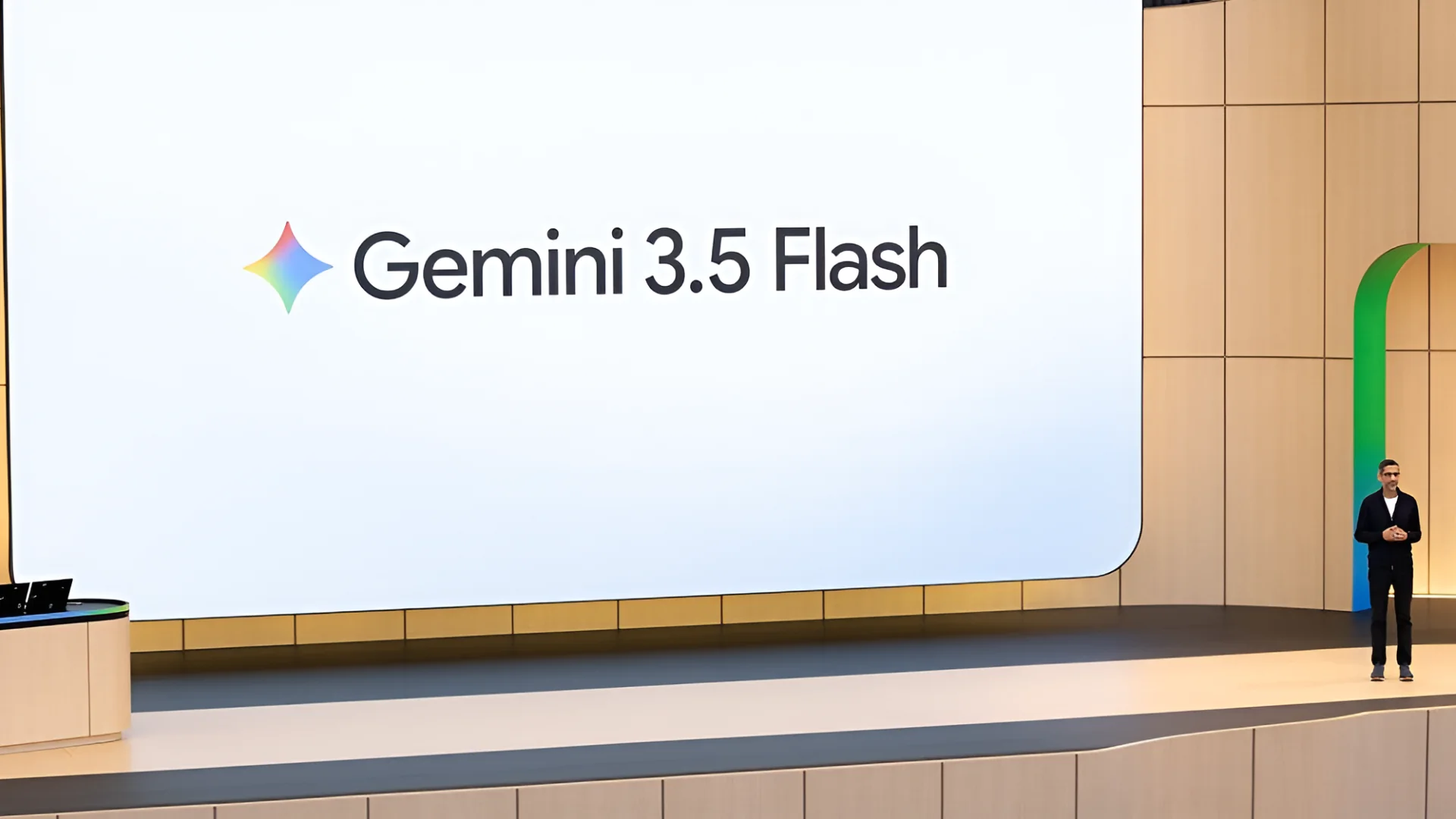
Google used its I/O 2026 developer conference on May 19–20 to ship four overlapping announcements: a new default AI model, an entirely new multimodal model family, a cloud-hosted autonomous agent, and a restructured subscription lineup with a premium tier priced at $99.99 per month.
Gemini 3.5 Flash Becomes the Default, While Pro Waits
The most immediate change for users of the Gemini app and Google's AI Mode in Search is a model swap. Gemini 3.5 Flash, announced via Google's model research blog, became the default model across both surfaces starting May 19–20. Google describes it as four times faster than competing frontier models in output tokens per second — a vendor-stated figure with no named third-party benchmark cited at launch. The company also said it outperforms Gemini 3.1 Pro across most key benchmarks, with particular gains in coding tasks and what Google calls "GDPVal," a category measuring real-world economic task performance.
The more capable Gemini 3.5 Pro, by contrast, is not yet publicly available. According to reporting on the conference, its absence drew audible frustration from the live I/O audience, and Google indicated it would arrive the following month without naming a specific date. The gap between the two models matters for developers planning production deployments: Flash's speed advantage may not offset Pro's benchmark lead on complex reasoning tasks, so teams building applications today are operating without access to the stronger model in the same generation.
The chart below shows the user scale at which these models are now operating, based on figures Google disclosed at I/O.
Gemini Omni Introduces Conversational Video Editing Across Google Surfaces
Alongside the Flash update, Google introduced a new model family it calls Gemini Omni — described as a fully multimodal architecture capable of accepting text, images, video, and audio as inputs and generating content across those same modalities. The first model in the family, Gemini Omni Flash, began rolling out immediately at I/O to paid subscribers on the Gemini app and on Google Flow, the company's video creation tool.
A wider release to YouTube Shorts and YouTube Create at no cost was announced for later in the same week. The practical distinction Google drew is that Omni Flash is not a text-to-video generator in the conventional sense. Rather than accepting a prompt and producing a fixed clip, it supports iterative video editing through ongoing conversational dialogue — a user can ask for a revision mid-process without starting over. Whether that workflow holds at scale, and what its latency and output quality look like in practice, are not addressed by the available source material.
The diagram below maps the input modalities and primary output surfaces disclosed for Gemini Omni Flash at launch.
Gemini Spark Runs Continuously on Google Cloud Infrastructure, Not on User Devices
The most architecturally distinct announcement was Gemini Spark, an autonomous AI agent Google describes as always-on and running 24 hours a day, seven days a week. Spark is powered by Gemini 3.5 Flash and operates on Google Cloud virtual machines — meaning its continuous processing requires no local hardware on the user's end, but shifts the computational workload, and any associated latency, entirely to Google's infrastructure. That design choice also means the agent is not an offline tool and cannot function without a persistent cloud connection.
As disclosed at I/O, Spark automatically parses emails, tracks hidden credit card fees, organizes Google Docs, and generates study guides or workplace summaries. It integrates with Google Workspace natively. Google also said it plans to connect Spark to more than 30 third-party tools through the Model Context Protocol, listing Adobe, Uber, and Dropbox as named examples, though those integrations had not launched as of the conference. For enterprise Workspace administrators, the relevant constraint is that Spark's beta access is initially limited to the United States and is exclusive to subscribers of Google's new highest-tier plan. The infrastructure dependency on Google Cloud's TPU capacity may become a material factor as the agent scales.
The chart below maps Spark's confirmed functions and the integration scope announced at I/O, distinguishing what is live from what remains pending.
A Three-Tier Subscription Structure With Spark Locked to the $99.99 Top Plan
Google reorganized its AI subscriptions into three distinct tiers, consolidating what had been a simpler offering. The entry-level AI Plus plan is priced at $7.99 per month. The mid-tier AI Pro plan, at $19.99 per month, reflects pricing consistent with prior Gemini Advanced positioning. The new AI Ultra plan at $99.99 per month is the most significant structural change: it is the exclusive home for Gemini Spark in beta, includes priority access to Google Antigravity (described as an agent-first coding platform), raises usage limits to five times the standard ceiling, provides 20 terabytes of cloud storage, and bundles an individual YouTube Premium subscription.
The $100 price point places AI Ultra in direct competition with enterprise-tier AI offerings from other providers, though Google's bundling of storage and YouTube Premium may appeal differently to consumer subscribers than to business users evaluating it purely on AI capability. Access to Antigravity and Spark is meaningful for developers, but those features remain in early access or beta, and the full scope of what the plan delivers at scale is not yet clear from the available source material. Google also confirmed at I/O that the Gemini app has reached 900 million monthly active users — more than double the 400 million reported the previous year — and that AI Overviews in Search now serves 2.5 billion monthly users, figures that underscore the distribution scale across which these subscription tiers will operate.
The chart below compares the three plans by price and their key exclusive features as disclosed at I/O.

How EUV Lithography Prints Chips: Tin Plasma, 13.5 nm Light and High NA Optics
EUV lithography fires a CO2 laser at tin droplets to make 13.5 nm light. See how source power grew from 75 W to 1,000 W and what High NA at 0.55 NA changes.

SSR vs. SSG vs. ISR in 2026: What the Caching and Cost Data Actually Show
SSR vs SSG vs ISR compared with Vercel's 2026 ISR pricing and Google's CrUX field data, showing why revalidation frequency drives cost more than traffic.
Cache Invalidation Isn't One Problem: It's Three Layers With Different Guarantees
RFC 9111, Cloudflare's rebuilt purge pipeline, and Facebook's memcache paper show cache invalidation as three layers, each with a trigger and failure mode.

zk-SNARKs vs zk-STARKs: What Benchmark Data Shows About Speed, Size, and Quantum Risk
zk-SNARK and zk-STARK proof size, speed, and quantum-resistance data, and how that tradeoff shapes ZK-Rollups, digital identity, and compliance today.
Comments (0)
Please sign in to join the discussion.
No comments yet.
Be the first to share your perspective on this topic.