
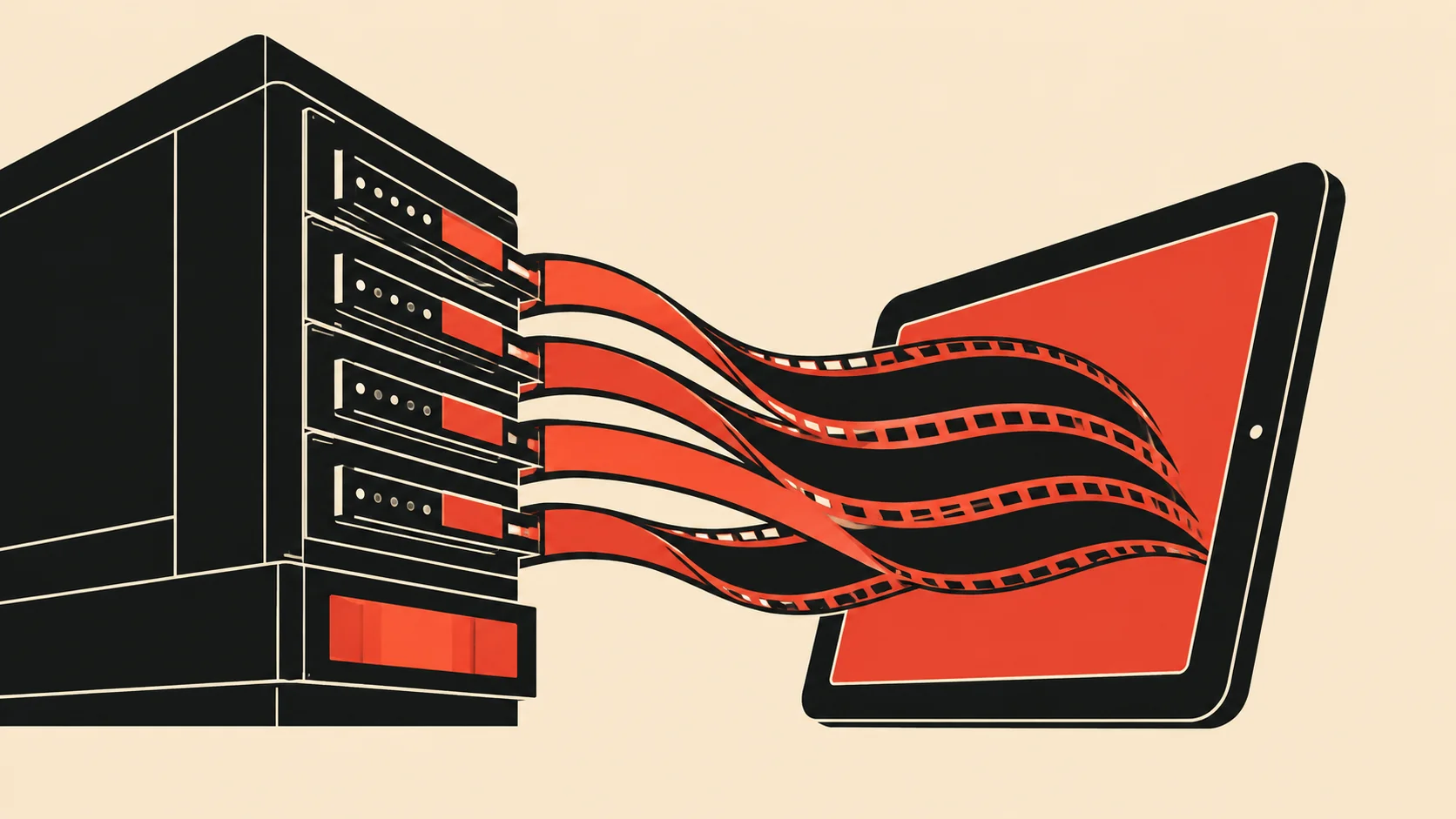
On January 26, 2026, Netflix switched on variable bitrate encoding for every live event it streams. The change is small on its own, but it sits on top of a much older engineering stack built for one job: keep the picture clean when the network isn't.
A Bitrate Ladder Built Per Title, Then Per Shot
Every Netflix title is encoded into a set of versions at different resolutions and bitrates, called a bitrate ladder. In 2015, Netflix stopped using one fixed ladder for every title and started testing dozens of resolution-and-bitrate combinations per title to find the specific rungs that gave the best picture at each bitrate. At the time, those bitrate-and-resolution decisions were driven by PSNR, a simpler fidelity measure, while Netflix's own perceptual metric, VMAF, was still being validated internally, according to an interview with the engineer who led the project.
By 2018, Netflix pushed the same idea further down to the level of individual shots rather than whole titles, in a system it calls the Dynamic Optimizer. A fast-cut action scene and a static dialogue scene in the same movie no longer share an encoding recipe. VMAF, by then mature enough to trust, became the direct optimization target. Netflix's own results, cited in a Streaming Media review of the project, show the payoff: at matched VMAF quality, the shot-based approach cut required bitrate by roughly 28% for H.264, 33% for H.265, and 38% for VP9 compared with the older per-title ladders.
That progression, from one ladder per title to one recipe per shot, is worth naming because Netflix never announced it as a single roadmap. Reading the 2015, 2017, and 2018 posts together shows a pipeline getting more granular in time, not just better at compression: every step spends its computation on a smaller slice of video to avoid wasting bits on scenes that don't need them.
The Player Decides, Not the Server
A finished bitrate ladder only matters once a device is playing it back. Netflix's client software, running on a phone, a browser, or a TV, downloads video in short chunks and repeatedly checks two things: how full its playback buffer is, and how fast the last few chunks arrived. Using those two numbers, it picks the highest rung in the ladder it can download faster than it plays back, then requests the next chunk at that rung. Netflix's own engineering write-up on adaptive audio confirms the same pattern applies beyond video: bitrate "varies and can adapt periodically" during playback, chosen by the client rather than fixed at the start of the stream, according to Netflix's account of building high-quality adaptive audio.
This client-side autonomy is easy to underestimate. One detailed engineering breakdown of Netflix's playback system describes it directly: the server offers a menu of quality options, and the player, watching its own network in real time, is the one that orders from it, according to an engineer's public account of Netflix's system design. That division of labor is what lets the same encoded catalog serve a phone on patchy mobile data and a television on gigabit fiber without either device waiting on a central server to notice trouble.
Where the Video Actually Comes From: Open Connect
None of this matters if the chunk has to cross the open internet to reach the player. Netflix decided in 2011 to build its own delivery network rather than lean solely on commercial CDNs, a choice it later described in its own account of working with ISPs worldwide. The result, Open Connect, places Netflix-owned appliances called OCAs directly inside ISP networks or at internet exchange points, offered to qualifying ISPs at no charge, with Netflix's control plane running separately in AWS while the OCAs themselves handle the actual HTTP video delivery. By 2017, Netflix's engineering team had pushed a single appliance to sustain 100 Gbps of throughput, detailed in its writeup of that project.
Live streaming complicates this design because a live event can't be pre-positioned onto every OCA the way a catalog title can be cached in advance overnight. That gap is part of why the January 2026 VBR rollout matters: Netflix is now also testing whether devices can size their bitrate decisions around the real, variable byte size of upcoming segments instead of a nominal label, and is experimenting with reserving less server capacity than the old fixed-bitrate assumptions required, according to Netflix's own account of the rollout. Netflix has not yet published how much capacity headroom that discount actually frees up, so the scale of the benefit remains unconfirmed.
Taken together, the three layers explain why a Netflix stream rarely just stops: a shot-tuned ladder gives the player fine-grained options, the player itself watches the network and switches rungs on its own, and the video sitting behind those options is usually one hop away inside the viewer's own ISP rather than across the open internet. The live-streaming push into variable bitrate suggests Netflix is still finding places to apply that same discipline, even in the one part of its catalog it can't cache ahead of time.

TypeScript's Go Rewrite Officially Merges Into the Main Repository
Microsoft merged 2,495 commits from typescript-go into microsoft/TypeScript on Aug. 20, replaying full git history as it folds the Go compiler home for good.

How Stripe's Idempotency-Key Header Prevents Duplicate Charges
Stripe's 2017 engineering post explains the Idempotency-Key header; the exactly-once guarantee it enables actually lives in a database unique constraint.
WhatsApp's 2.8-Million-Connection Server, Rebuilt in Go and Rust
WhatsApp's real, sourced numbers: 200K to 2.8M connections per server, a three-stage dispatch fix, and a tested Go/Rust/Docker reproduction of the pattern.
Inside Polonius Alpha: How Rust's Borrow Checker Gets Flow-Sensitive
Rust enabled Polonius Alpha on nightly Aug. 4, replacing NLL flow-insensitive checks with a flow-sensitive analysis that accepts more provably safe code.
Comments (0)
Please sign in to join the discussion.
No comments yet.
Be the first to share your perspective on this topic.