
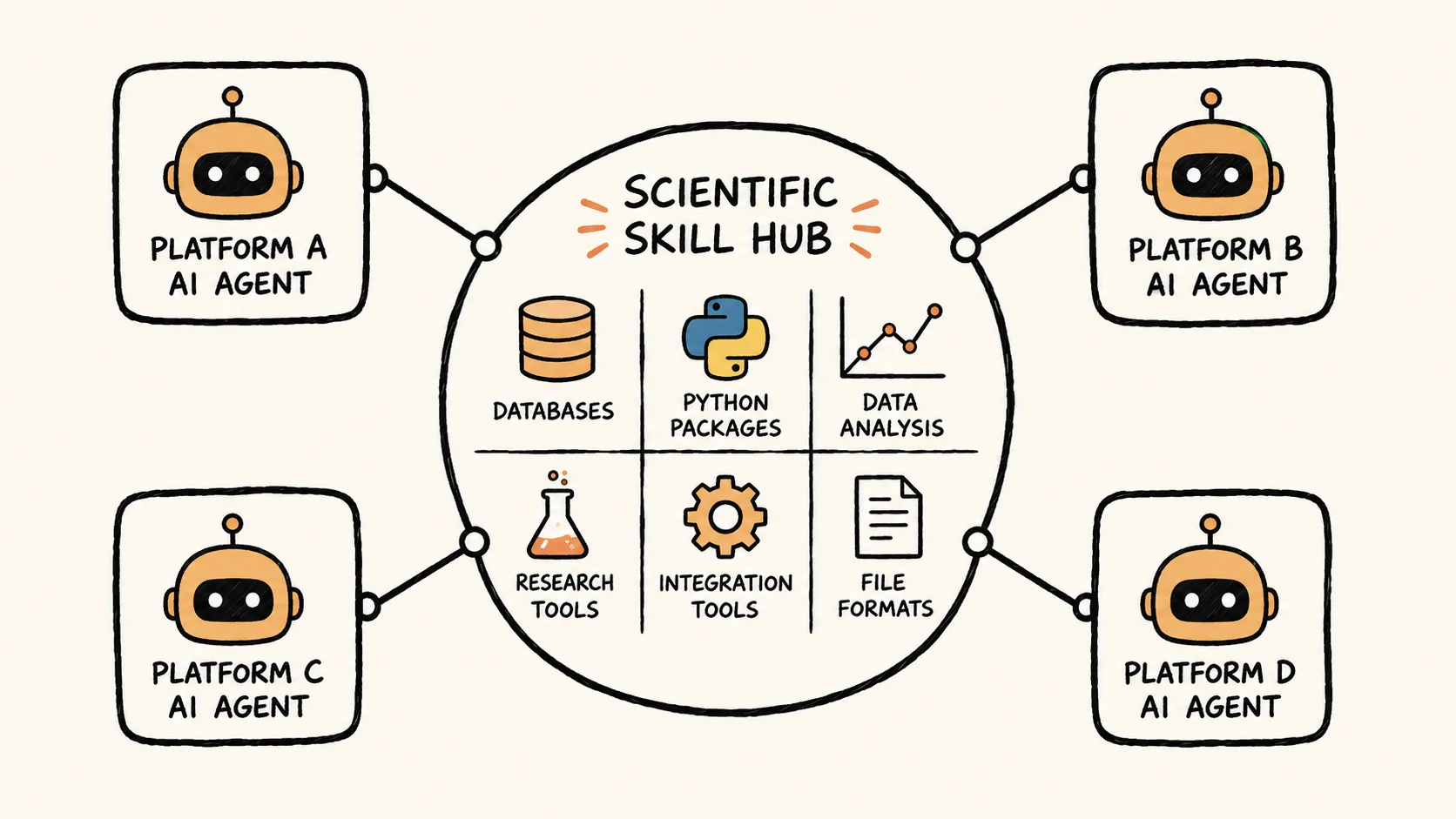
K-Dense has renamed its open-source scientific workflow repository from "Claude Scientific Skills" to Scientific Agent Skills, reflecting support for any AI agent that implements the open Agent Skills standard — and simultaneously launched K-Dense BYOK, a local desktop co-scientist that routes heavy compute to the cloud.
What the Repository Contains and How It Is Organized
The repository packages 135 skills across five scientific domains: biology, chemistry, medicine, physics, and climate data. These are not generic code snippets. Each skill is a structured, agent-readable unit of documentation and tooling, designed to give an AI agent the context it needs to invoke a specific library or database correctly without the user re-explaining the API each session.
The collection breaks into four functional categories. The first is a unified database lookup skill that covers 78 public scientific and financial databases — including PubChem, ChEMBL, UniProt, COSMIC, ClinicalTrials.gov, FRED, and the USPTO patent database — alongside multi-database packages such as BioPython and gget. The second is a set of over 70 optimized Python package skills for libraries including RDKit, Scanpy, PyTorch Lightning, scikit-learn, OpenMM, and Google's TimesFM time-series foundation model. The third group covers nine integration skills for platforms such as Benchling, DNAnexus, LatchBio, and OMERO, which are common in wet-lab and genomics pipeline settings. The fourth includes more than 30 analysis and communication tools for literature review, scientific writing, slide generation, and Mermaid diagramming.
Practitioners should note that this breadth creates a verification burden. A skill spanning RDKit molecular docking and a ClinicalTrials.gov lookup are structurally similar units in the repository, but their correctness requirements are not equivalent. The repository does not currently provide independent accuracy benchmarks for individual skills; users working in regulated or safety-critical contexts should validate skill outputs against primary documentation before relying on them.
The chart below maps the four skill categories to their approximate scope as described in the repository documentation.
How the Rebrand Changes Agent Compatibility and What Installation Looks Like in Practice
The renaming from "Claude Scientific Skills" to "Scientific Agent Skills" is not cosmetic. The repository now targets any agent supporting the open Agent Skills standard, which currently includes Cursor, Claude Code, OpenAI Codex, and Gemini CLI alongside others. This matters for research teams that are not committed to a single agent provider, or that run different agents across different workflow stages.
Two installation paths are documented. The first uses npx:
npx skills add K-Dense-AI/scientific-agent-skillsThis requires no additional tooling beyond Node.js and is the fastest path for individual users. The second path uses the GitHub CLI (gh) at version 2.90.0 or later — a release from April 2026 — and allows users to target a specific agent environment directly:
gh skill install K-Dense-AI/scientific-agent-skills --agent cursorThe GitHub CLI method also supports version pinning to a specific release tag or commit SHA. This is the more defensible path for research environments where reproducibility matters, since it makes the exact skill version part of the documented setup rather than resolving silently to the latest HEAD. Teams running long-term projects should consider pinning even if the npx path feels more convenient initially.
Both installation paths require Python 3.11 or later, with 3.12 recommended, and the uv Python package manager. The uv requirement is worth checking early: it is not installed by default on most systems, and some institutional computing environments restrict package manager installations.
The diagram below maps the four currently documented compatible agent platforms to their shared installation entry points.
Security Scan Coverage, Supply Chain Risk, and What the MIT License Does Not Cover
Agent skills can execute arbitrary code on a local machine. K-Dense acknowledges this directly in its documentation, and runs automated LLM security scans on repository skills using the Cisco AI Defense Skill Scanner (cisco-ai-skill-scanner). This provides a baseline for skills maintained by K-Dense itself.
Community-contributed skills carry a higher risk profile. The repository explicitly warns that user-contributed skills should be scanned locally using behavioral execution checks before installation. This is sound advice, but it places a real burden on the researcher: behavioral execution checks require a sandboxed environment, and most academic users do not have one configured as part of their default workflow. Institutional IT and research computing teams considering this toolset should treat community skills as untrusted third-party code and route them through their existing software review processes.
Licensing is a separate but related concern. The root repository carries an MIT license, which is permissive and well understood. However, individual skill directories contain their own SKILL.md metadata files specifying distinct third-party licenses. A skill that wraps RDKit, for example, may carry a different license obligation than the MIT wrapper around it. Users are required to comply with those individual licenses independently. This is not unusual in open-source scientific tooling, but it means that a team cannot rely on the repository-level MIT license when assessing whether a skill is compatible with their institution's intellectual property or commercial use policies. Legal review should happen at the skill level, not just the repository level.
K-Dense also offers a paid cloud-hosted environment called K-Dense Web, which the company describes as featuring more than 200 exclusive skills, shared team infrastructure, and pre-configured cloud GPUs. That count and the feature set are vendor claims and have not been independently verified. The open-source repository and the commercial tier are separate products; the repository can be used without any K-Dense account.
The diagram below maps the three trust layers a practitioner should evaluate before deploying a skill from this repository.
K-Dense BYOK and What the Open-Source Tier Does Not Include
Alongside the repository update, K-Dense released K-Dense BYOK, a desktop-based AI co-scientist application. The platform lets users bring their own API keys and select from more than 40 AI models, running inference locally against a research workspace. For computationally intensive workloads, the platform can scale jobs to the cloud using Modal, a serverless compute service. The BYOK model is significant for researchers in contexts where data cannot be sent to a third-party managed platform — though the actual data handling boundaries between the local client and Modal-mediated cloud execution are not fully specified in the available source material and should be confirmed before use with sensitive data.
The open-source BYOK platform is distinct from K-Dense Web, the company's paid hosted environment. K-Dense describes the commercial tier as offering more than 200 exclusive skills, zero-setup environments, shared team infrastructure, and access to cloud GPUs. Those claims are presented as vendor marketing and have not been independently reviewed. Researchers evaluating the commercial tier should request documentation on which skills are exclusive to that environment, what the compute pricing structure is, and how data is handled in the shared infrastructure.
For most academic users, the open-source repository and BYOK desktop application represent a usable starting point without any paid commitment, provided the Python environment requirements are met and the relevant skill licenses have been reviewed. The multi-agent compatibility introduced by the rebrand means that teams are not locked to a single AI agent provider — a meaningful practical advantage as research workflows increasingly mix tools from different vendors.

zk-SNARKs vs zk-STARKs: What Benchmark Data Shows About Speed, Size, and Quantum Risk
zk-SNARK and zk-STARK proof size, speed, and quantum-resistance data, and how that tradeoff shapes ZK-Rollups, digital identity, and compliance today.

Session Cookies vs. JWTs in 2026: Why Revocation, Not Statelessness, Is the Real Trade-Off
OWASP calls JWT-based sessions "frowned upon." Here is the real 2026 trade-off between stateful cookies and stateless JWTs, and how to secure each one.

GraphQL's N+1 Problem in NestJS: What DataLoader Fixes and What It Doesn't
A NestJS benchmark shows field resolvers cut throughput 57-74% before DataLoader batching even runs. Here's when to batch and when to just join.

Database Sharding vs. Partitioning vs. Read Replicas: Choosing a Horizontal Scaling Strategy
Read replicas scale reads, partitioning organizes large tables, and sharding splits data across servers. Here's how each works and when to use it.
Comments (0)
Please sign in to join the discussion.
No comments yet.
Be the first to share your perspective on this topic.