
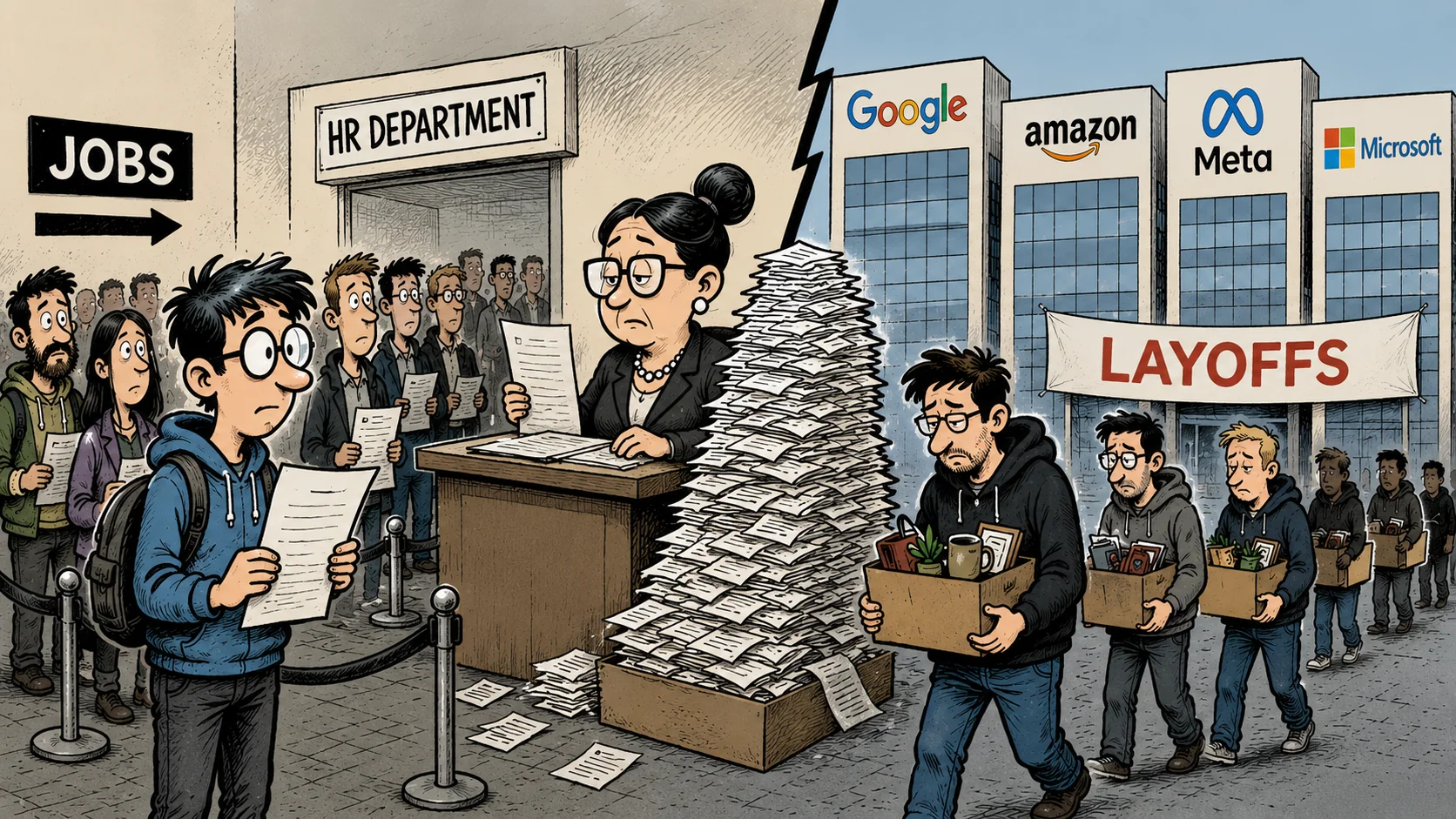
June's U.S. unemployment rate fell to a 12-month low of 4.2%. It fell because people stopped looking for work, not because more of us got hired — and as a fullstack developer six months into my own search, that distinction isn't academic.
The headline number and the number underneath it
The U.S. labor force participation rate hit 61.5% in June, a post-Covid and 50-year low, down from 62.5% in November. According to Pantheon Macroeconomics' participation-rate analysis, senior economist Oliver Allen calculated that if participation had simply held steady, the unemployment rate would have jumped to 5.6% instead of falling to 4.2%. In one month, 720,000 people left the labor force while the "not in the labor force" count grew by 832,000. The establishment survey — the one that counts filled jobs — showed a small gain of 57,000. The household survey, which counts actual people working, fell by 507,000. Those two surveys measuring the same economy and telling opposite stories is the whole story.
I bring this up first because I built BytePith while unemployed, and I've spent the last several months reading unemployment headlines that don't match what my inbox looks like. A 4.2% rate implies a labor market with some slack but broad churn. A household survey down 507,000 in a month implies something closer to what I'm actually seeing: fewer postings, longer silences, and roles that get pulled before a first interview.
The people the participation drop is actually made of
The prime-age (25–54) participation rate fell 0.6 points to 83.3% in June, its lowest since December 2023, driven mostly by workers 25–34. Economists are calling that group's decline near-term "noise," which is a reasonable read for one demographic cohort. It's harder to wave off youth participation (16–24), which has been sliding for years alongside a well-documented drought in entry-level postings, or the 55+ group, where the usual explanation — early retirement funded by stock-market gains — no longer explains the pattern as cleanly as it used to.
I don't fit any of those buckets cleanly either. I'm not entry-level, and I'm not near retirement. I have years across web3 infrastructure, KYC and 2FA flows, zero-knowledge proof integration, account abstraction, and donation-livestream platforms — the kind of specialized, full-stack breadth that used to be a hiring advantage. Right now it mostly means I'm competing for a smaller pool of roles against people with the same breadth, while AI coding tools push down what companies expect to pay for that breadth in the first place.
What Israel's high-tech layoffs show about who gets displaced
If the U.S. numbers are ambiguous about cause, The Jerusalem Post's report on Israeli high-tech unemployment is less so. High-tech unemployment in Israel has surpassed 16,000 registered job seekers, roughly three times the 2022 level. Inbal Mashash, director general of the Israel Employment Service, described a structural correlation between AI expansion and high-tech layoffs, with developers and software workers making up half of the claims. Notably, the people losing jobs aren't junior — veteran developers with eight-plus years of seniority are being cut directly, even as 14,000 open tech roles and 4,000 tech-adjacent openings in non-tech businesses sit unfilled. That gap — experienced workers displaced while roles go unfilled — is the same shape I see in my own search: postings that want senior-level judgment at a price point that assumes AI handles the routine work, with nothing in between.
Where the federal money is actually going, and where it isn't
The Department of Labor's funding announcement allocates $162 million across five cooperative agreements under the Pay-for-Performance Incentive Payments Program, with at least 85% required to flow to local apprenticeship sponsors. The sectors named are shipbuilding and maritime manufacturing, AI/semiconductor/nuclear infrastructure, telecommunications, general IT expansion, and automotive service technicians. This is real money aimed at real reindustrialization goals, and I don't think it's wrong to fund apprenticeships in shipbuilding or telecom buildout. But reading the sector list against the Israeli data above, it's hard not to notice what's missing: nothing here is aimed at the specific population showing up in the layoff numbers — mid-career and senior software engineers displaced by the same AI expansion the program is partly funding infrastructure for. Apprenticeship pipelines build new entrants; they don't obviously catch someone with eight years of backend experience whose team just got cut in half.
A regional counterpoint worth taking seriously
Not every local labor market is telling the national story. The Dallas Fed's new Fort Worth report card shows Fort Worth's unemployment flat at 4.0% in May, beating the Texas average of 4.3%, with 3-month annualized employment growth of 3.4% and nominal wages up 3.4% year-over-year to $37.23 an hour. The labor force there actually grew at a 6.1% annualized clip. Fort Worth's job base leans toward trade, transportation, and manufacturing rather than professional or financial services, which may simply mean it's less exposed to the kind of white-collar and software displacement showing up elsewhere. It's a useful reminder that "the labor market" isn't one market, and that the spiral AI layoffs can trigger doesn't move at the same speed everywhere.
What I'm actually watching next
Pantheon's own warning is the one I take most personally: a high risk of a labor-participation "snapback" in the second half of 2026, where people who left the workforce start looking again and push the reported unemployment rate up sharply — not because conditions got worse, but because the count finally catches up to what the household survey has been saying all along. If that happens while AI-driven displacement in software keeps compounding, the headline rate could stop flattering the labor market almost overnight. I'd rather my next job offer arrive before that snapback than after it, and if the Israeli trend line is any indication of where this heads, I'm not the only one racing that clock.
Why AI Coding Bills May Outpace Engineer Salaries by 2029
Enterprise AI coding tools are shifting from flat per-seat pricing to metered token billing, and early deployments at Uber and Microsoft show why budgeting for it is proving difficult.
Comments (0)
Please sign in to join the discussion.
No comments yet.
Be the first to share your perspective on this topic.