
Corporate investment in AI is framed almost entirely as an efficiency story. Fewer people, lower costs, higher margins. What that framing skips is the system it operates inside: the same workers being replaced are the consumers whose spending sustains the revenue that justifies the investment in the first place.
The Corporate Logic Is Sound — Until It Isn't
The case for AI-driven workforce reduction is straightforward from a single-firm perspective. If a task that required ten employees can be handled by two employees with AI tools, the labour cost falls. Margins improve. Shareholders are satisfied.
The problem is that this logic is being applied simultaneously across industries, not sequentially. When enough firms reduce headcount at the same scale at the same time, the aggregate effect stops being a microeconomic efficiency gain and starts being a macroeconomic demand event.
This is not a novel observation in economics — it is a modern restatement of the composition fallacy: what is rational for one actor can be destructive when every actor does it at once.
Phase 1 and Phase 2 Are Not the Same Problem
The two-phase structure of AI-driven displacement matters for anyone thinking about when and how to intervene.
Phase 1 is the direct substitution wave: roles that are automatable are automated, and headcount falls. This is the layer most commentary focuses on. It is real, it is already happening across customer service, back-office processing, content moderation, and entry-level data work, and it is expected to accelerate as model capability improves.
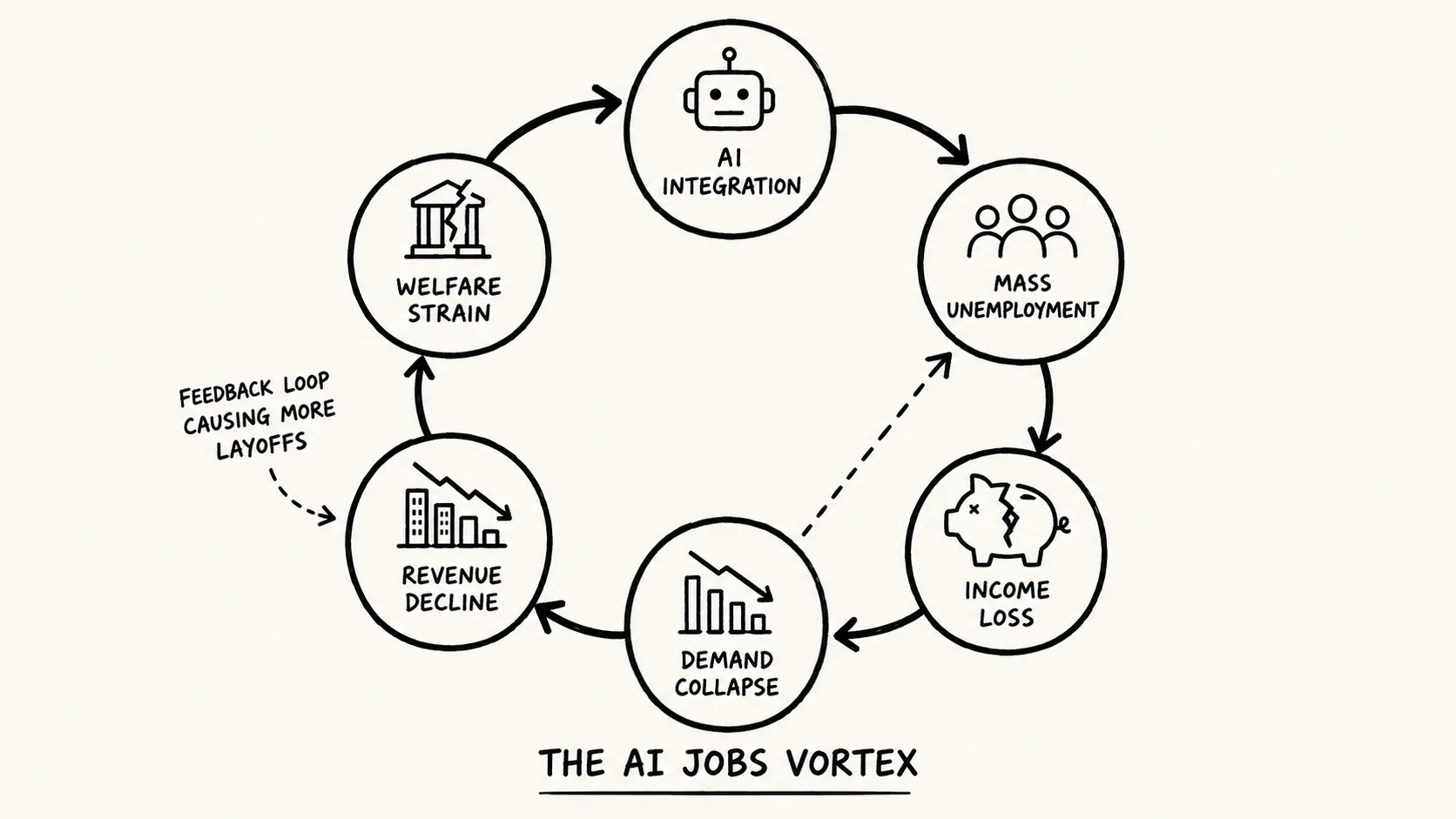
Phase 2 is less discussed and harder to time. When enough displaced workers reduce spending — because they have less income, or because they are rationally saving in the face of uncertainty — businesses across the economy face softening revenue. A retail chain, a restaurant group, a domestic travel operator: none of them may be directly threatened by AI, but all of them are exposed to a contraction in consumer spending. Their response, under margin pressure, is the same as the AI-adopting firms in Phase 1: reduce headcount to preserve the business. These are what might be called survival layoffs — not AI-driven, but AI-triggered downstream.
The causal loop below maps how Phase 1 and Phase 2 connect into a self-reinforcing cycle.
What the Aggregate Demand Identity Actually Shows
Standard macroeconomics describes total economic output as the sum of four demand components:
AD = C + I + G + (X − M)
Where C is household consumption, I is business investment, G is government spending, and (X − M) is net exports.
The optimistic reading of AI adoption is that rising I — corporate investment in AI infrastructure, model training, and hardware — compensates for any fall in C. This may hold at the firm level. It is less certain at the national level, for two reasons.
First, AI investment is highly concentrated. The companies building and deploying AI at scale are spending intensively, but they are not employing at scale proportionate to the output they generate. The investment flows to a narrow set of capital owners and skilled workers, not broadly across the labour market.
Second, consumption is the largest component of demand in most developed economies — typically 60 to 70 percent of GDP. A meaningful contraction in C across a wide population of displaced workers cannot be offset by investment growth that is itself predicated on the demand environment remaining stable.
This is the core tension the aggregate demand identity exposes: rising I in AI is partly a bet that C will hold. If C does not hold, the bet is self-undermining.
Whether Any Intervention Arrives in Time Is Unresolved
Two policy proposals are most frequently cited as potential circuit-breakers: Universal Basic Income and some form of taxation on automated production.
UBI would, in theory, sustain C by providing households with income independent of employment status. Robot taxation would, in theory, generate revenue that governments could redirect into social welfare or retraining programs, addressing the welfare strain described in Phase 1.
Both remain theoretically plausible and practically unproven at the scale the displacement scenario implies. No major economy has implemented either at meaningful scope. The design questions — at what threshold does a robot tax apply, how is UBI set without distorting labour supply, how are these programmes funded during the revenue shortfall they are intended to address — are genuinely open.
What this means practically is that the feedback loop described here is not inevitable. It is, however, plausible, and the window for intervention may be narrower than the pace of AI deployment would suggest. The displacement is already underway. The policy response is not.

Official Unemployment Is 4.1%. A Rival Measure Puts It Near 25%
LISEP's alternative measure puts U.S. functional unemployment at 24.9% in July, far above the 4.1% official rate, as payrolls and wages fall short.

Could AI Create a "Permanent Underclass"? What the Data Actually Shows
Stanford payroll data show AI-exposed 22-25 year-olds losing jobs at 3.8% a year, while wages diverge by income. What that means for a 'permanent underclass.'
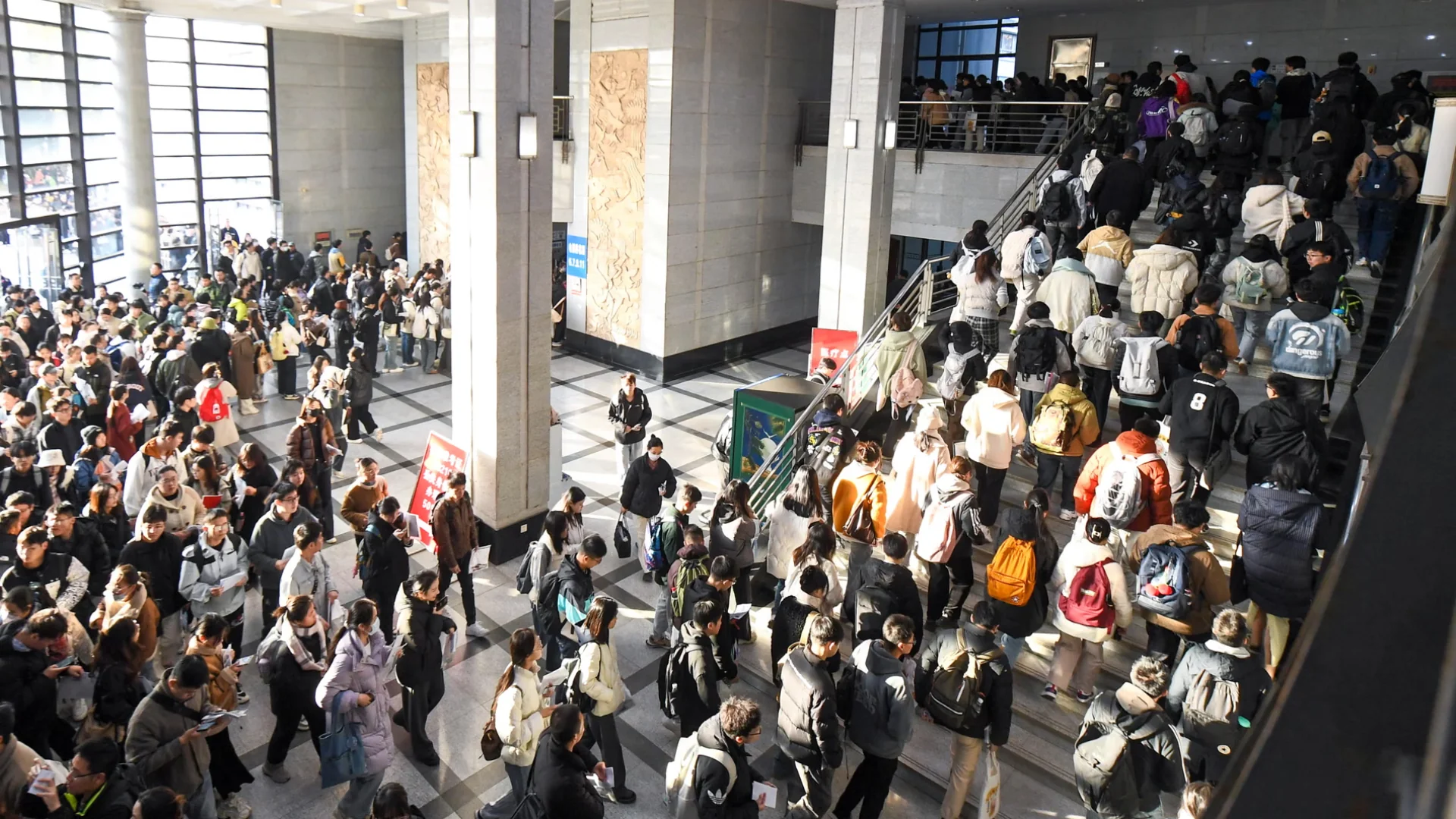
Asia’s Youth Job Squeeze: Inside China’s Record Graduate Influx and Vietnam’s AI Skills Gap
China's record 12.7 million graduates face a 15.6% youth jobless rate as AI reshapes hiring; Vietnam shows the same skills-gap pattern at smaller scale.
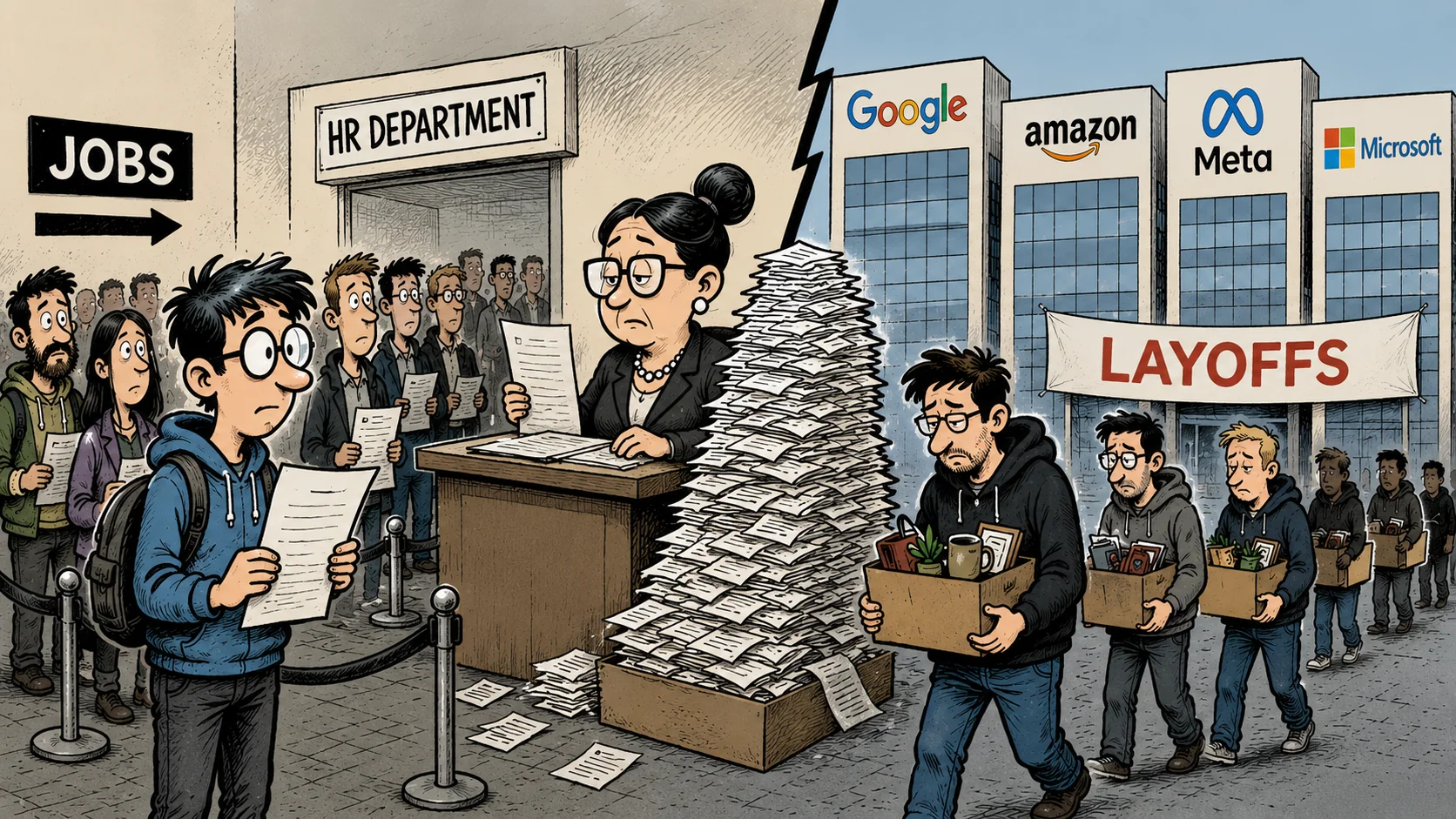
The 4.2% Unemployment Rate Is Hiding a Grimmer Labor Market — And I'm Living Proof
U.S. unemployment fell to 4.2% in June 2026, but a 720,000-person labor force exodus — not hiring — drove the drop. Here's what the real number is, and why it matters for tech.
Comments (0)
Please sign in to join the discussion.
No comments yet.
Be the first to share your perspective on this topic.