
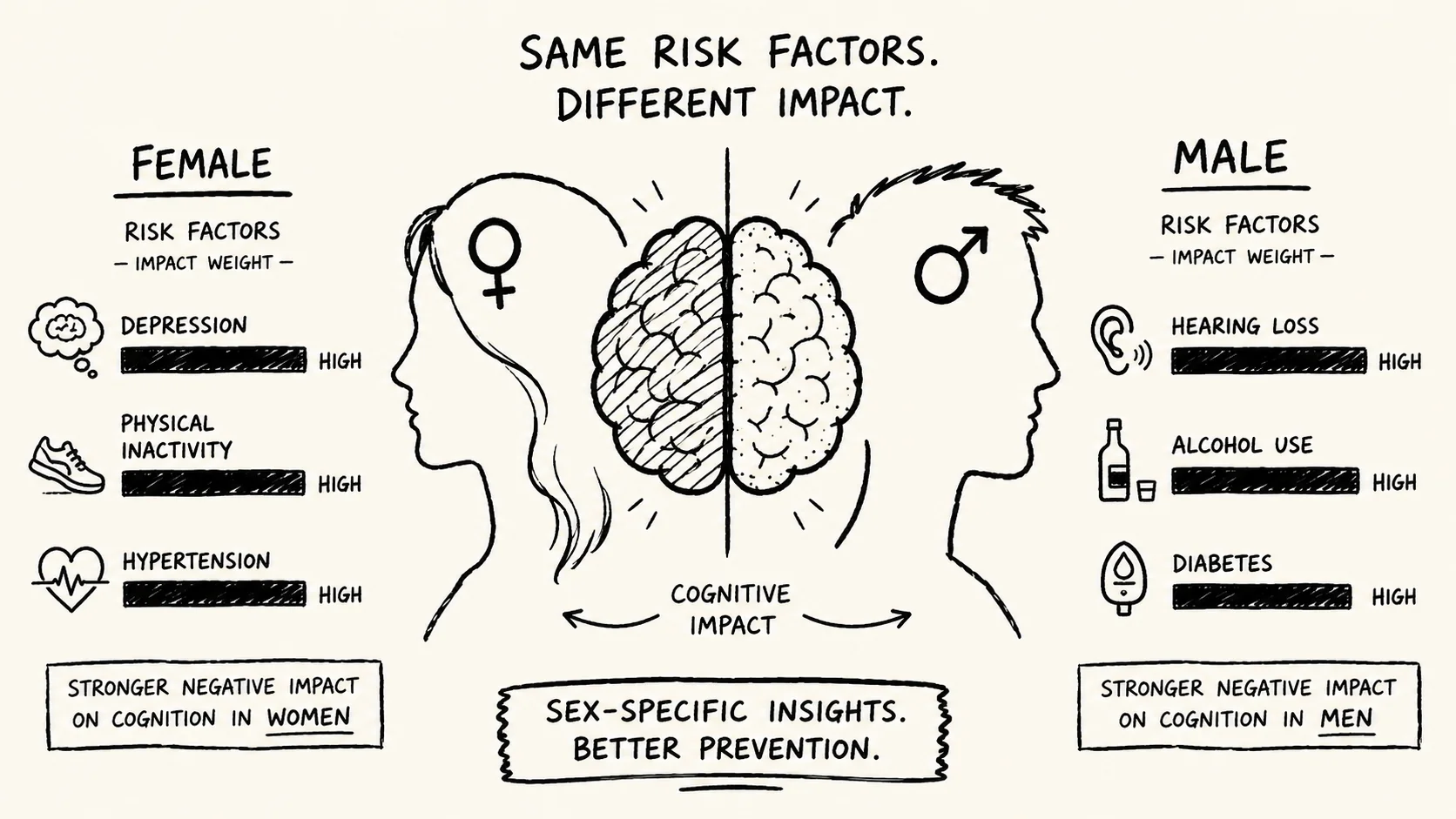
A study published May 19, 2026 in Biology of Sex Differences finds that women are not only more exposed to several modifiable dementia risk factors but also experience greater cognitive harm from those same factors compared with men — a pattern the researchers say calls for sex-specific prevention strategies.
Women Carry a Higher Burden of Several Key Risk Factors
The UC San Diego School of Medicine research team analyzed health and cognitive data from more than 17,000 middle-aged and older adults. Across the group, the distribution of known dementia risk factors was markedly unequal by sex.
Depression was nearly twice as common among women (17%) as men (9%). Physical inactivity affected 48% of women compared with 42% of men, and sleep problems were reported by 45% of women versus 40% of men. The picture was not uniform in the other direction: hearing loss was substantially more prevalent in men (64%) than women (50%), as were heavy alcohol use (22% vs. 12%) and diabetes (24% vs. 21%).
The chart below shows the prevalence gap for each factor across both sexes.
The Same Risk Factor Does Not Carry Equal Cognitive Weight by Sex
Prevalence differences alone do not account for women's elevated dementia risk profile. The study found that certain conditions inflict substantially greater harm on cognitive performance in women than in men, even when both groups are exposed to the same condition.
Untreated hypertension, depression, and physical inactivity each showed a meaningfully stronger negative association with cognitive test performance in women than in men. The lead author, Megan C. Fitzhugh, described this as a central motivation for reconsidering how dementia prevention is designed: "Ultimately, a more nuanced understanding of these differences could help us design smarter, more targeted interventions. That's an essential step toward reducing the burden of dementia for everyone, but especially for women, who are disproportionately affected."
Principal investigator Dr. Judy Pa noted the broader systemic gap the findings point toward: "These differences highlight the importance of considering sex as a key variable in dementia research. Sex differences are profoundly overlooked among many leading causes of death like Alzheimer's, heart disease and cancer."
The chart below shows the three conditions identified as having a directionally stronger cognitive impact in women, presented as ordinal indicators from the study's qualitative findings — not quantified effect sizes, which the available data does not supply.
What the Study Can and Cannot Establish
The research is observational in design. It identifies associations between modifiable risk factors and cognitive performance across a large, demographically diverse sample — it does not establish causation, and it does not resolve the mechanisms behind the sex differences it documents.
The biological and social pathways that could explain why women show greater cognitive vulnerability to certain exposures remain under active investigation. Potential contributors — including the effects of estrogen reduction over the lifespan, sex-linked genetic susceptibilities, and structural disparities in healthcare access — have not been disentangled by this or prior studies. The authors describe these as directions for future research rather than confirmed explanations.
What the study does offer is a quantified prevalence picture and a directional signal that differential cognitive impact exists at scale. That is a meaningful contribution to a field where, as Dr. Pa noted, sex as a variable has been underweighted relative to its apparent importance. The findings support a move toward what the authors call "precision prevention" — designing interventions calibrated to the specific risk profiles of women rather than applying population-wide general guidance. For women, the study suggests that managing depression, increasing physical activity, and treating cardiovascular conditions such as hypertension should be prioritized.
The chart below summarizes the study's scope and funding context.
The study was supported by the National Institute on Aging (grant RF1AG088811, PI: Pa) and the Alzheimer's Association (grant SAGA23-1141238, PI: Pa). The full paper is available in Biology of Sex Differences. A summary of the findings appears via UC San Diego / ScienceDaily and EurekAlert.

Micro-Rough Surfaces Cut Aerodynamic Drag by 43%
A new study using the world's largest magnetic wind tunnel balance system shows that microscopic surface irregularities delay the laminar-to-turbulent flow transition, cutting aerodynamic drag by 43.6% — a result that contradicts decades of aerodynamic theory.

QuEChERS-GC-MS Detects PAHs in Food: Key Findings
A peer-reviewed 2025 study from SeoulTech optimized a QuEChERS-GC-MS method for PAH detection in foods, reporting validated recovery rates of 86–109% and LODs as low as 0.006 µg/kg.

How Much Exercise Does Your Heart Actually Need?
New observational research published in the British Journal of Sports Medicine links 10 weekly hours of exercise to a 30%-plus drop in cardiovascular risk, well above the 150-minute WHO guideline.


Why Scientists Still Can't Measure Big G Precisely
Despite centuries of effort and modern precision instruments, Newton's gravitational constant G is known to only 3 significant figures. NIST and BIPM are running a rare cross-laboratory replication to find out why high-precision experiments keep disagreeing.
Comments (0)
Please sign in to join the discussion.
No comments yet.
Be the first to share your perspective on this topic.