
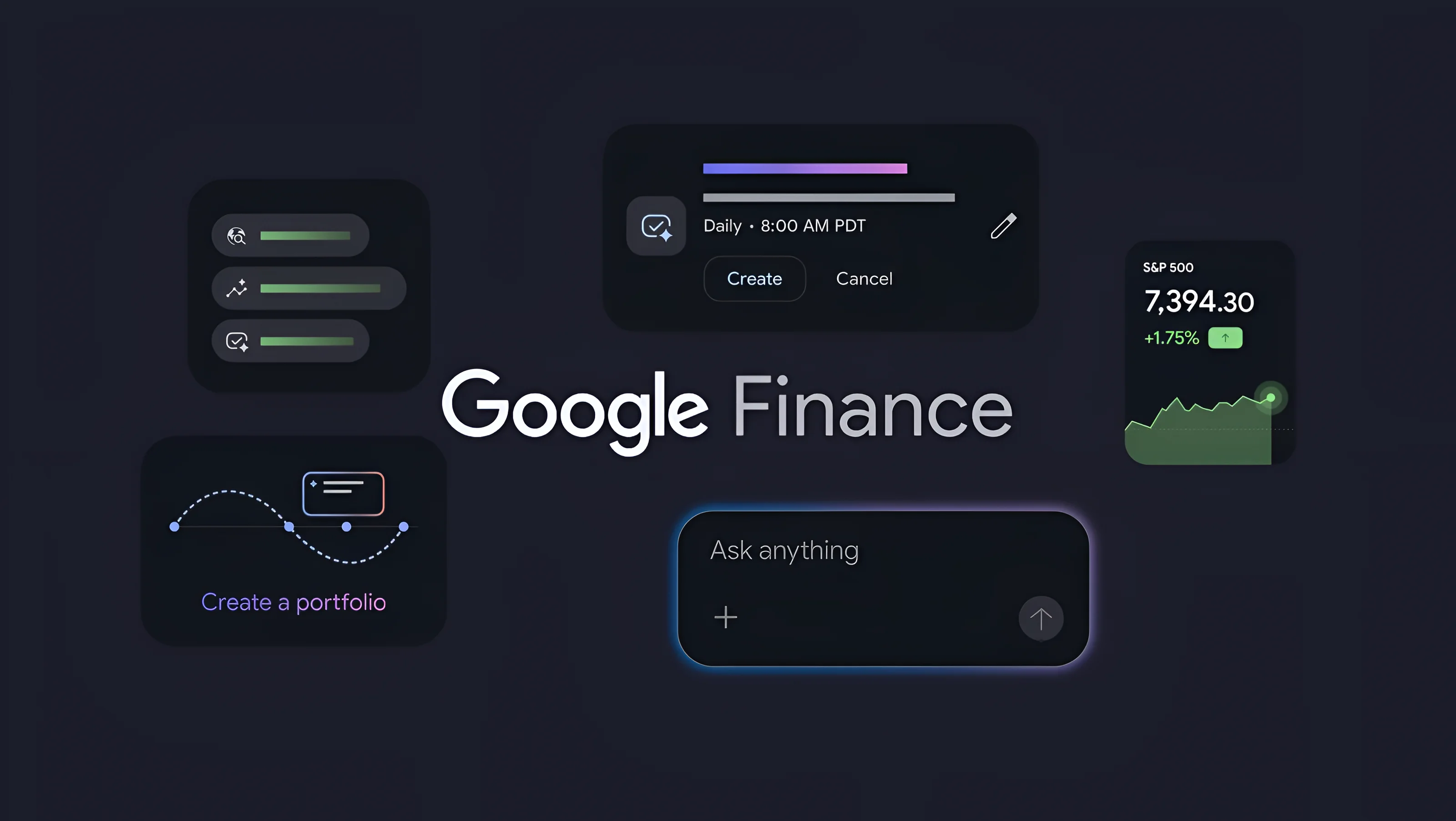
Google has folded Gemini-powered research tools — Deep Search, threaded follow-up questions, and thread history — directly into Google Finance. The timing is notable: the feature set is settling in during a week when U.S. markets are sending unusually mixed signals.
Google Finance's AI Layer Moves From Add-On to Default
According to Google's product post on Deep Search, prediction markets, and earnings tracking in Google Finance, the tool runs a multistep process that issues large numbers of simultaneous searches and reasons across the results before producing a cited response. Users can see the research plan as it's generated, then ask follow-up questions without restarting the process. The underlying Gemini model family also powers a "New thread" and "Thread history" interface, letting investors return to a prior line of inquiry rather than re-running a query from scratch. None of this replaces a trading terminal, but it does compress the kind of multi-source synthesis that previously took an analyst an afternoon.
Micron's Earnings Beat Collided With an Apple-Led Tech Pullback
The kind of question Deep Search is built for showed up almost immediately. Per CNBC's live market log for the June 25 session, the Nasdaq Composite slipped for a fourth straight session even as Micron Technology's quarterly results beat Wall Street's profit and revenue estimates by a wide margin. Apple shares led the index lower after the company said it would raise prices on its computers and tablets. The Dow Jones Industrial Average, lacking heavy tech exposure, touched a fresh intraday high the same day. Micron's stock, by contrast, jumped sharply in the after-hours session once the earnings landed, a reminder that a single name's earnings reaction can run in the opposite direction of the broader tech tape.
May's Inflation Print Narrows the Fed's Room to Maneuver
The same week brought a less encouraging number. Per CBS News's coverage of the May PCE report, the Personal Consumption Expenditures price index, the Fed's preferred inflation gauge, rose 4.1% year over year in May, up from 3.8% in April and the highest reading since April 2023. Core PCE, which excludes food and energy, ticked up to 3.4% from 3.3%. Both figures matched economists' forecasts, but the move was driven largely by energy costs tied to the Iran conflict, and it has pushed traders to price in a greater chance of a rate increase before the end of the year rather than the cut some had expected earlier in 2026.
A Strike Off Oman Adds a Wildcard for Energy-Sensitive Forecasts
Energy markets supplied the third complication. CNN's account of the UN's pause on the Hormuz evacuation plan reports that a cargo vessel was struck by an unidentified projectile off the coast of Oman on June 25, damaging its bridge but causing no casualties. The strike came hours after Iran's Revolutionary Guard Corps warned that ships using a newly designated Oman route would do so at their own risk, and it prompted the International Maritime Organization to pause a planned evacuation of stranded vessels. U.S. officials told reporters they believe Iran was responsible, though Tehran had not commented publicly at the time of reporting. The incident lands inside a fragile 60-day arrangement meant to keep the strait open following February's outbreak of fighting, and it is the kind of fast-moving, attribution-uncertain event that a synthesis tool with live citations is arguably built to track.
None of this week's events resolve on their own. Micron's results say more about AI-driven memory demand than about the rest of the Nasdaq. The PCE print is a single month's data inside a Fed cycle that has already shifted from talk of cuts to talk of a hike. And the Hormuz strike's attribution remains, officially, unconfirmed. What's changed is that a tool built into Google Finance can now pull threads like these into one cited, followable research path — which is precisely the kind of week that puts that promise to the test.
IonQ's Revenue Jumped 287% in Q2 2026, but Its Stock Is Still 47% Below Its High
IonQ's Q2 2026 revenue rose 287% to $80.1 million and guidance climbed to $280-$290 million, yet IONQ shares still trade 47% below their October peak.
CoreWeave and Nebius Are Chasing $145 Billion in AI Deals on $16 Billion of Revenue
Microsoft, Meta and Nvidia have committed more than $145 billion to neoclouds CoreWeave and Nebius, whose combined 2026 revenue is projected near $16 billion.
Why AI Coding Bills May Outpace Engineer Salaries by 2029
Enterprise AI coding tools are shifting from flat per-seat pricing to metered token billing, and early deployments at Uber and Microsoft show why budgeting for it is proving difficult.
China's 360 Security Claims Mythos Rival After Export Ban
Qihoo 360 CEO Zhou Hongyi unveiled Tulongfeng at ISC.AI 2026, positioning it as China's answer to Anthropic's Mythos. The claim rests on an agentic workaround, not a benchmark result — and remains unverified by independent parties.
Comments (0)
Please sign in to join the discussion.
No comments yet.
Be the first to share your perspective on this topic.