
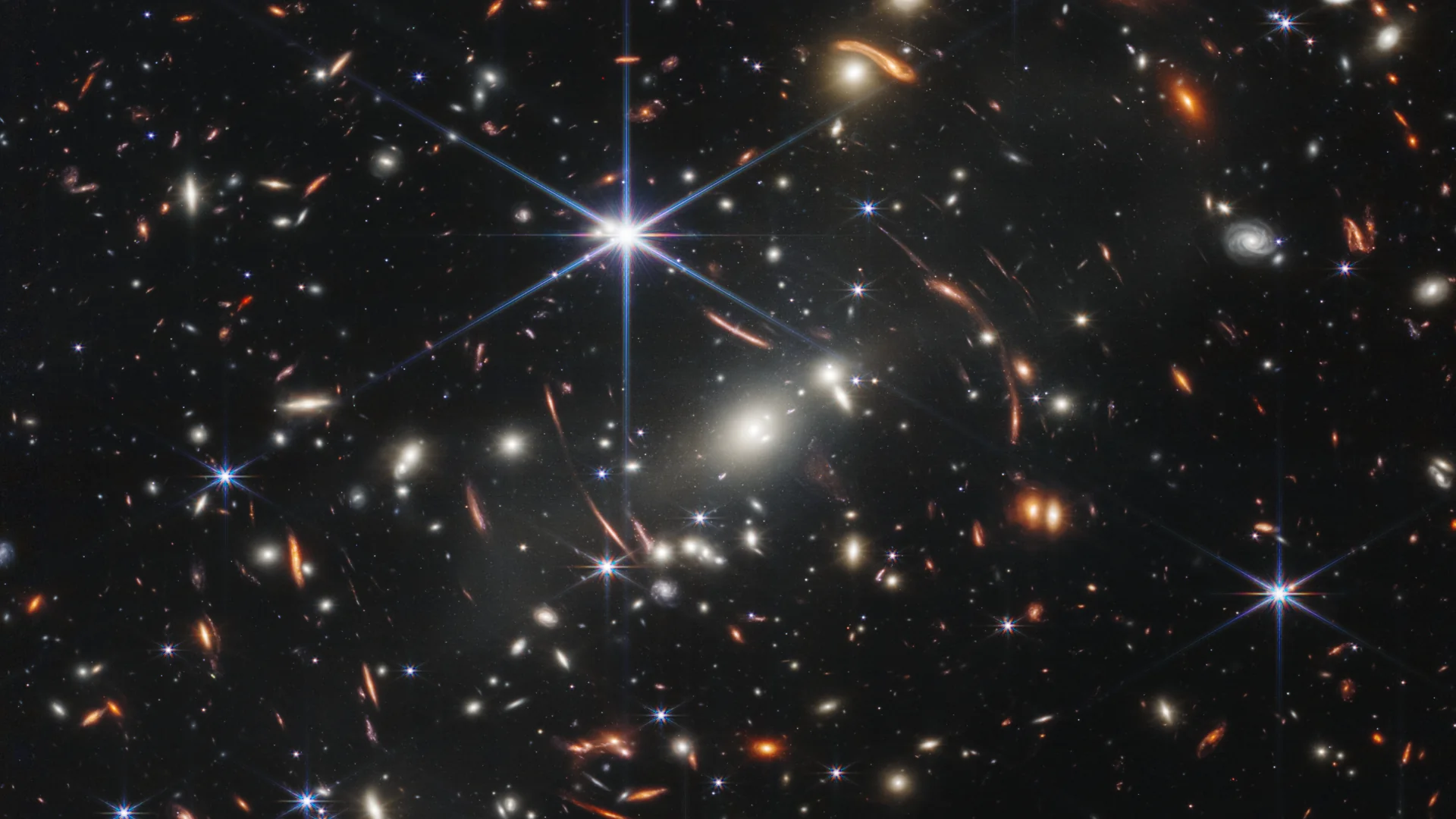
A new Physical Review D paper argues that a universe's total entropy can climb even as the entropy packed into each unit of its expanding volume falls — a distinction that may explain how galaxies, stars, and life keep forming without breaking the second law of thermodynamics.
A Century-Old Tension Between Disorder and Structure
The second law of thermodynamics holds that the total entropy of an isolated system tends to rise over time. Physicists have long treated this as one of the most secure principles in the field. Cosmology, though, has a standing problem with it: the early universe is thought to have started in a low-entropy state and has been moving toward higher entropy ever since, yet matter has spent that same time assembling into increasingly organized structures — galaxies, stars, planets, and eventually life.
The idea that gravity itself might have a thermodynamic character traces back to Jacob Bekenstein's 1973 demonstration that black holes carry entropy, and Stephen Hawking's 1975 finding that black holes emit thermal radiation. Those results tied spacetime, information, and heat together for the first time and set up decades of work trying to extend the connection beyond black holes to the universe as a whole.
Ginestra Bianconi, a mathematician at Queen Mary University of London, has been building one such extension. In 2025 she proposed Gravity from Entropy (GfE), a framework in which gravity emerges from entropy at the quantum level rather than being treated purely as spacetime curvature. Her newest paper, published this month in Physical Review D, works out what that framework implies thermodynamically for an expanding universe.
The Geometric Relative Entropy Behind Gravity From Entropy
GfE does not treat gravity as only a curvature of spacetime or a fundamental force acting between masses. Instead, it proposes that gravity emerges from an informational tension between two things: the actual, physical metric of spacetime, and a second metric induced by matter fields and curvature. The mismatch between them is captured by a quantity called the Geometric Quantum Relative Entropy (GQRE), and that quantity is what defines the GfE Lagrangian — the mathematical core of the theory.
Bianconi's new paper works through what happens when this Lagrangian is applied to Friedmann-Robertson-Walker spacetimes, the standard mathematical description of a universe expanding uniformly on large scales. The result is a set of modified gravitational field equations. In the low-energy, small-curvature limit — the regime that describes most everyday physics — these equations collapse back to ordinary General Relativity. Away from that limit, they diverge, producing an emergent, evolving dark energy term that General Relativity does not have.
Why Expanding Volume Lets Total Entropy Rise While Local Entropy Falls
The paper's central thermodynamic claim is the one that speaks most directly to the old cosmological paradox. Applying the GfE Lagrangian to an expanding Friedmann universe, Bianconi shows that the theory's local entropy quantity — the GQRE measured per unit of volume — behaves like a genuine physical entropy density: it satisfies a first law of thermodynamics, alongside quantities that behave like an effective local temperature and pressure.
The key move is separating that local density from the total. As the universe expands, its volume grows, and within the GfE framework that growing volume is what drives total entropy upward, in line with the second law. At the same time, because the same amount of entropy is being spread across an ever-larger volume, the entropy contained in any single unit of that volume can decline. Bianconi's account, distributed by Queen Mary University of London, frames this decline as room for organized structures — galaxies, stars, planets, and life — to form locally without any single region needing to run against the second law's global direction.
What the Theory Does Not Yet Establish
Gravity from Entropy remains an early-stage theoretical proposal, and this paper is a derivation, not an observational test. Its strongest, most concrete result is mathematical: that GfE cosmologies admit a consistent thermal description, with local quantities that behave like temperature, pressure, and entropy density and that satisfy a first law of thermodynamics. That the theory reduces correctly to General Relativity in the low-curvature limit is a meaningful consistency check, but it also means the interesting departures — including the evolving dark energy term — only appear outside that limit, where the theory has not yet been checked against cosmological data.
Bianconi herself describes the work as opening a line of investigation rather than closing one. As she put it, the aim is connecting "cosmological irreversibility, the emergence of complex structures, and ultimately life, with fundamental gravitational dynamics." Whether GfE's dark energy term produces predictions distinguishable from the standard cosmological model is a question the paper raises but does not answer, and it is the next place independent scrutiny would need to focus.
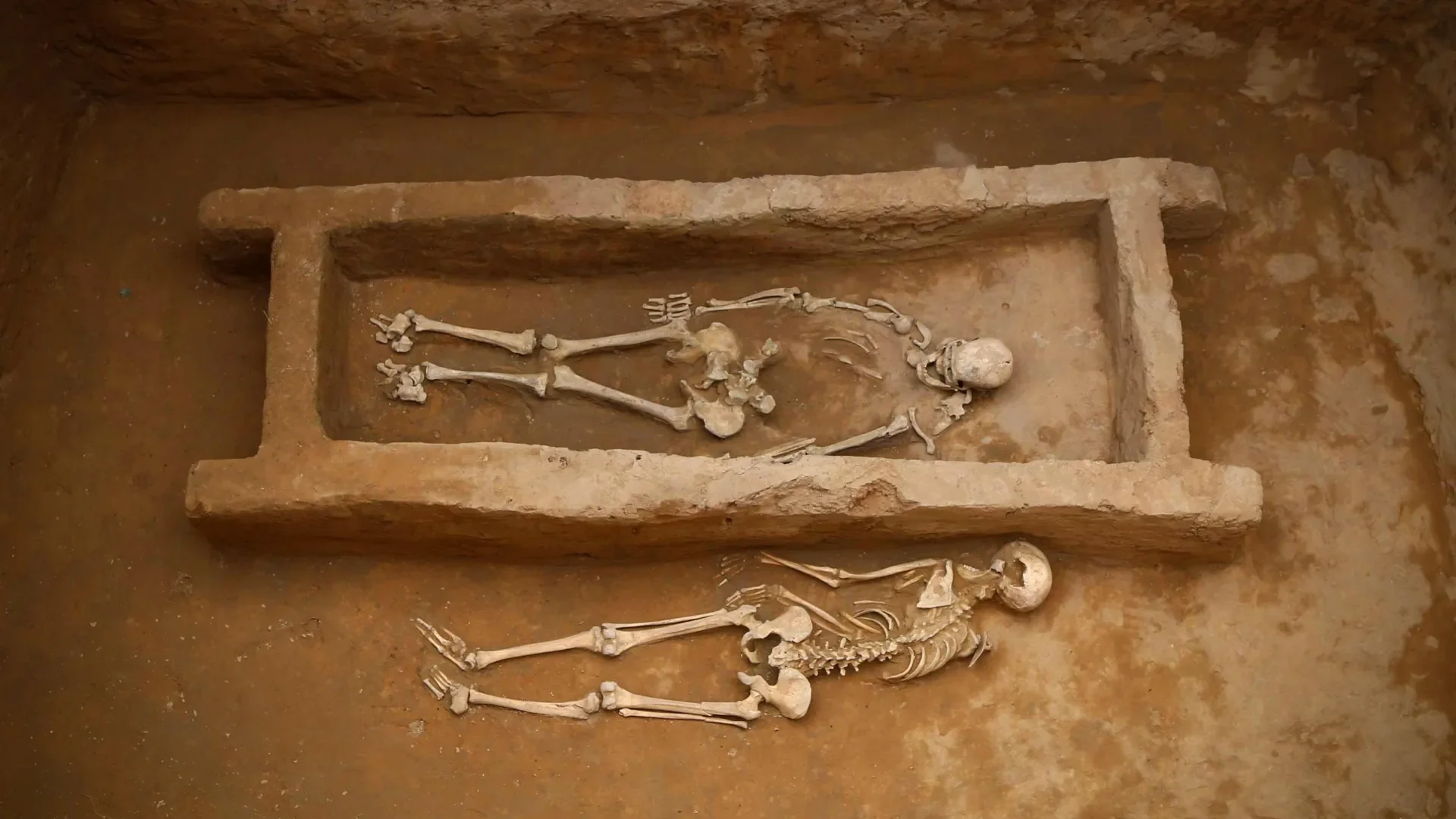
Ancient DNA Overturns Assumptions About Who Was Sacrificed at Shimao
Ancient DNA from 144 Neolithic Shimao burials shows nine of ten East Gate sacrifice victims were male, reversing earlier morphology-based assumptions.

Nanoplastics Push Bacterial Stress-Response Genes Up to 5-Fold in Drinking Water Biofilms
Nanoplastics raised bacterial stress-response genes up to 5.13-fold in a Water Research study, strengthening drinking-water biofilms against disinfectants.

AI Model Flags 261,000 Cancer Papers as Suspected Paper Mill Work
A BERT-based screening tool checked 2.6 million cancer papers and flagged 9.87% as textually similar to retracted paper mill studies, a new BMJ study finds.
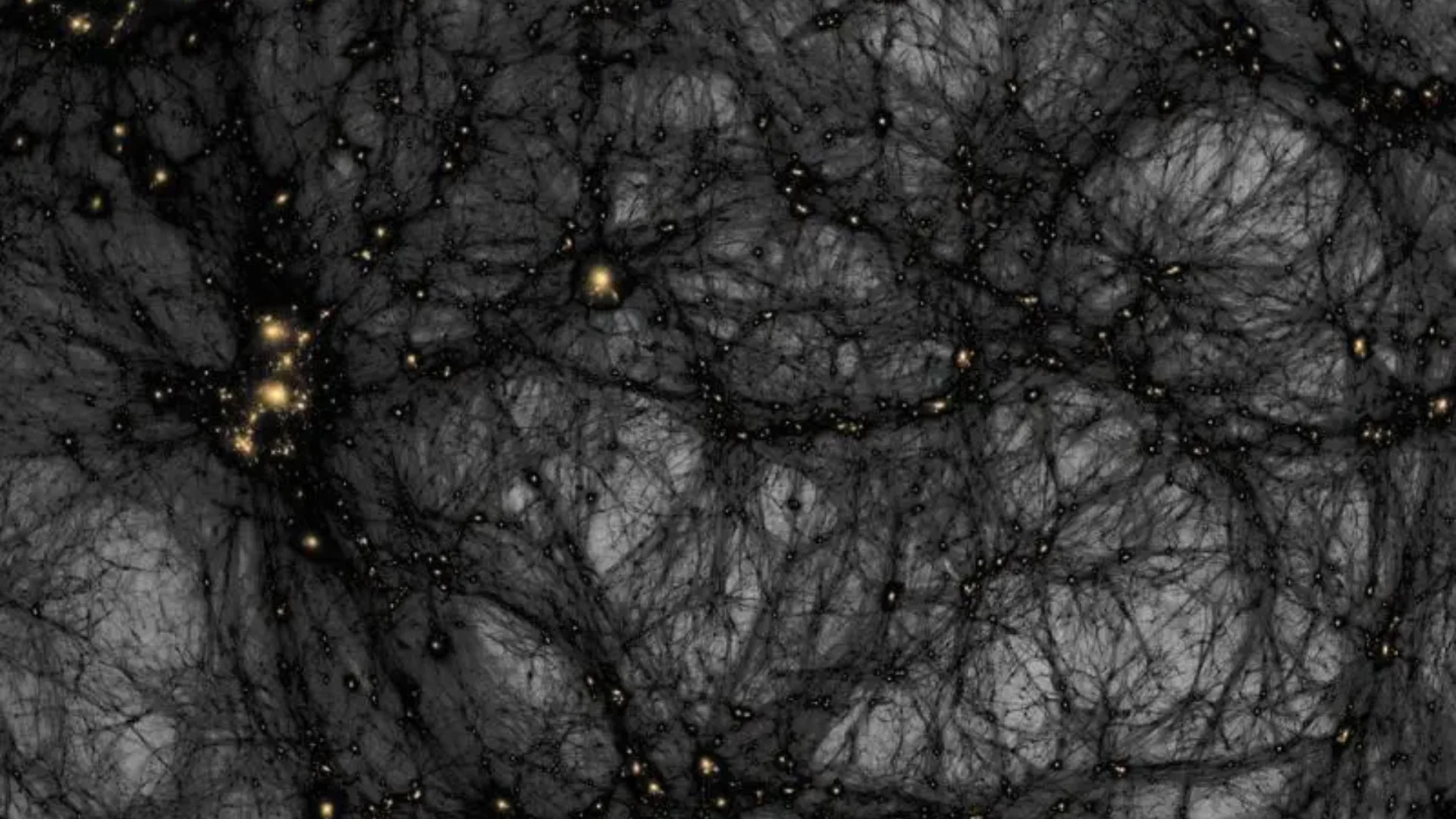
A Two-Particle Dark Matter Model Tries to Explain Two Conflicting Anomalies at Once
A Purple Mountain Observatory model with two dark-matter masses links diffuse dwarf-galaxy cores to a 3–6x lensing excess first reported by Meneghetti et al.
Comments (0)
Please sign in to join the discussion.
No comments yet.
Be the first to share your perspective on this topic.