
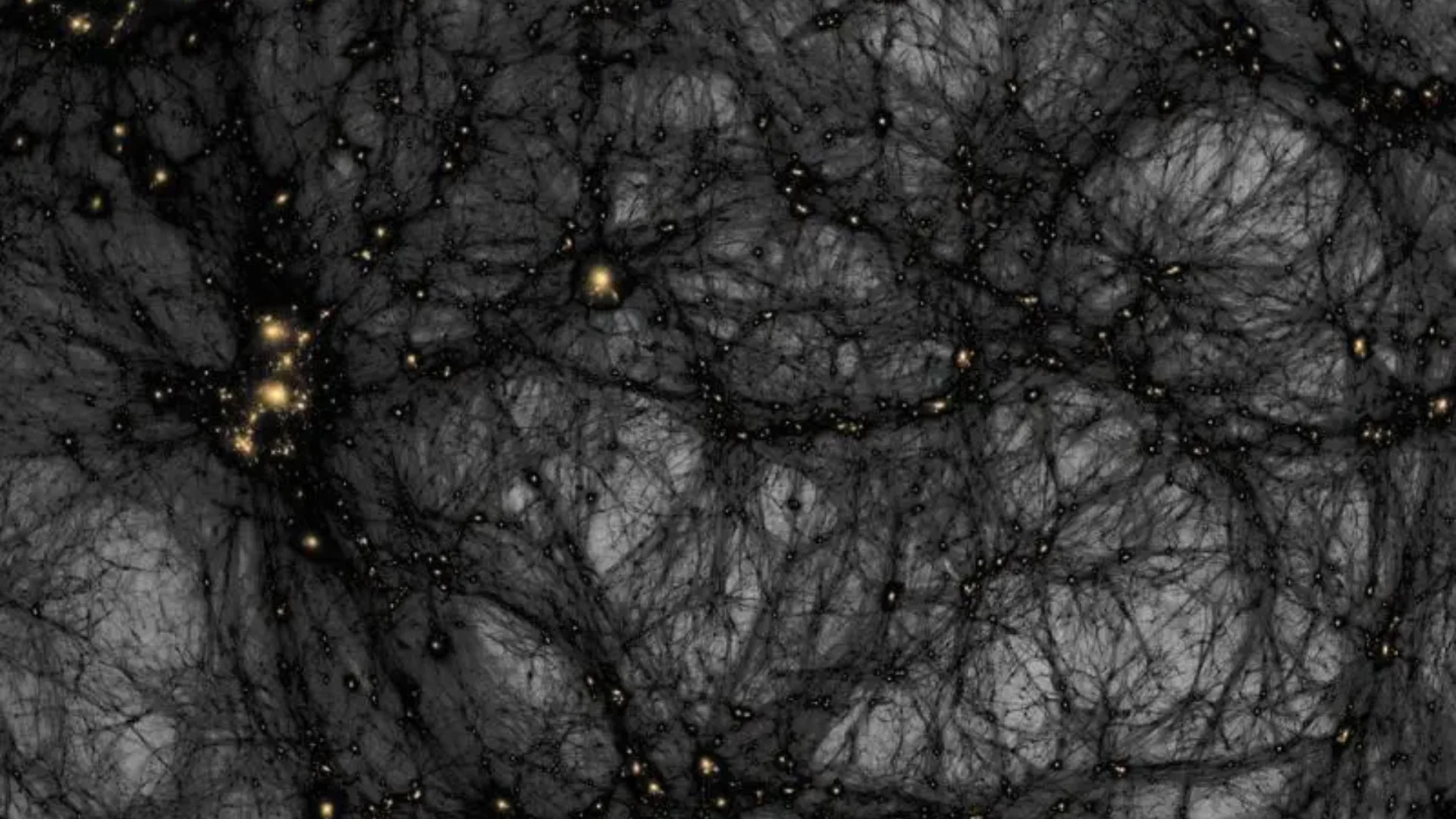
Two unrelated-looking puzzles in galaxy observations — dwarf galaxies with oddly diffuse dark matter cores, and gravitational lenses that are unexpectedly dense — may share a single cause, according to a new paper from a Purple Mountain Observatory team.
Dwarf Cores and Cluster Lenses Have Been Pulling in Opposite Directions
Standard cold dark matter (CDM) simulations predict halos with dense, cuspy centers. Real dwarf galaxies often don't look that way: their inner regions appear diffuse, with lower density than CDM expects. Separately, strong gravitational lensing systems such as SDSS J0946+1006 and JVAS B1938+666 have revealed dark substructures far more compact than CDM would produce. A widely cited 2020 analysis by Meneghetti and colleagues found that galaxy clusters generate roughly three to six times more small-scale strong-lensing events than CDM simulations predict — a gap that has persisted across multiple follow-up studies.
Self-interacting dark matter (SIDM), where particles collide with each other rather than only feeling gravity, was proposed partly to soften cuspy cores into the diffuse profiles dwarf galaxies show. But a single-species SIDM halo with ordinary baryonic matter mostly boosts the wrong kind of lensing signal — it enhances two-image lens configurations, while the excess observed shows up in four-image systems. That mismatch is the specific gap the new paper tries to close.
Mass Segregation Is the Mechanism Doing the Work
The team's proposal adds a second dark matter species. In this model, dark matter includes at least two particle types of different mass, and — unlike in one-species SIDM — the two species can collide with each other, not just with themselves. That inter-species scattering drives what physicists call mass segregation: over time, the heavier species sinks toward a halo's center while the lighter species diffuses outward. The paper describes this as directly analogous to how massive stars sink toward the center of a star cluster while lower-mass stars migrate to larger radii.
The environment a halo sits in determines which outcome dominates. In dwarf-scale halos, the effect keeps or reinforces a diffuse core, matching recent dwarf-galaxy clustering measurements. In denser, higher-concentration halos — the kind found inside galaxy clusters — the same segregation instead compacts the structure further, increasing the mass packed inside the Einstein radius and, with it, the odds of producing a detectable strong-lensing arc. The paper reports this raises small-scale lensing efficiency "by a factor of a few," which the authors present as roughly in line with the observed excess rather than a precise match to it.
What the Model Actually Establishes, and What It Doesn't
This is the Purple Mountain Observatory group's second paper on two-component SIDM. An earlier study, published in Physical Review D, established the mass-segregation mechanism at Milky Way and dwarf halo scales. The new paper extends the same idea to cosmological cluster-scale simulations and ties it explicitly to the lensing excess, which the earlier work did not address.
The authors are explicit that their results are "proof-of-principle" rather than a confirmed detection: the simulations demonstrate that a two-species SIDM framework can connect dwarf-core diversity with cluster-lensing excess, not that it uniquely does so or that it has been measured directly. No specific particle masses or cross-sections are reported publicly as settled values, and the model still needs to be checked against cluster-scale constraints beyond the cases modeled here. The authors point to upcoming higher-precision lensing and galaxy-clustering surveys as the next real test — if those surveys keep finding the same pattern of diffuse dwarf cores alongside compact cluster substructures, that would be the kind of independent confirmation this proof-of-principle model doesn't yet have.

Ancient DNA Overturns Assumptions About Who Was Sacrificed at Shimao
Ancient DNA from 144 Neolithic Shimao burials shows nine of ten East Gate sacrifice victims were male, reversing earlier morphology-based assumptions.
Gravity From Entropy Theory Explains How Life Emerges as Cosmic Entropy Rises
A Physical Review D study finds the universe's total entropy keeps rising while entropy per unit of volume falls as space expands, leaving room for structure.

Nanoplastics Push Bacterial Stress-Response Genes Up to 5-Fold in Drinking Water Biofilms
Nanoplastics raised bacterial stress-response genes up to 5.13-fold in a Water Research study, strengthening drinking-water biofilms against disinfectants.

AI Model Flags 261,000 Cancer Papers as Suspected Paper Mill Work
A BERT-based screening tool checked 2.6 million cancer papers and flagged 9.87% as textually similar to retracted paper mill studies, a new BMJ study finds.
Comments (0)
Please sign in to join the discussion.
No comments yet.
Be the first to share your perspective on this topic.