
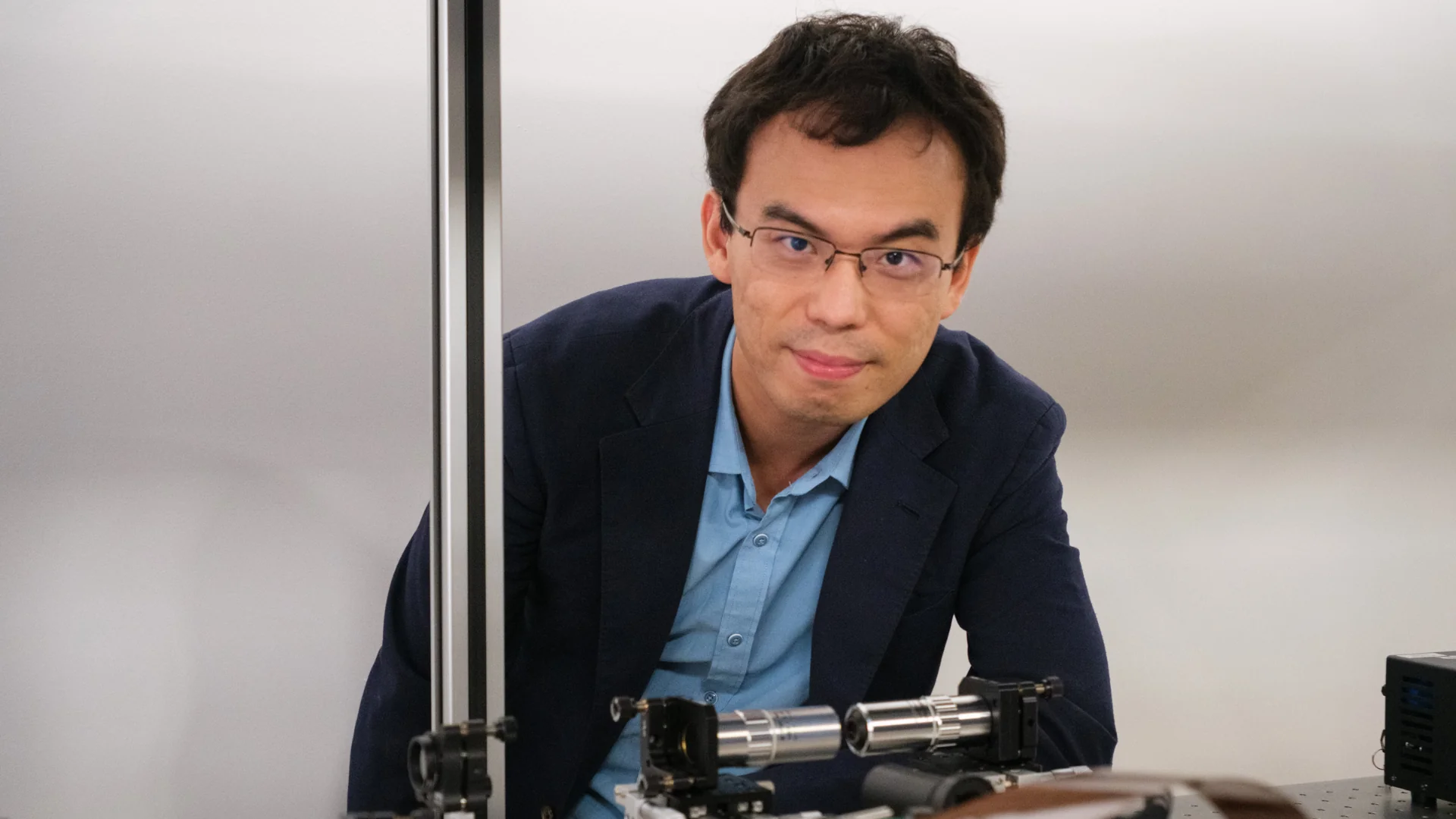
Physicists at Nanyang Technological University, Singapore, say they generated four distinct topological patterns in a single beam of light using a 19th-century diffraction effect instead of the engineered materials such experiments usually depend on. The work, published in Optica, points to a simpler route into a field that has mostly required expensive, custom-built optical hardware.
An 1818 Argument About Light Becomes a 2026 Lab Tool
The effect at the center of the paper is the Poisson spot, sometimes called the Arago spot. In the early 19th century, Siméon Poisson used Augustin-Jean Fresnel's wave theory of light to derive what he thought was an absurd prediction: shine light past a small circular disk, and a bright point should appear at the exact center of its shadow. François Arago then built the experiment and found the spot was real, turning a proposed reductio ad absurdum into supporting evidence for the wave theory of light.
That two-century-old curiosity is now the mechanism the NTU team used to build something from a much newer field: optical skyrmions, tiny stable swirling patterns in properties of light such as spin and polarization. The idea of a skyrmion originated in 1960s particle physics, migrated into condensed-matter and magnetic-materials research, and has more recently been studied in photonics. To make one, researchers point a coherent laser at a small opaque disk. The resulting Poisson spot, according to the Optica listing, turns out to host rich topological structure of its own.
Four Topological Patterns, One Beam
According to the NTU account of the experiment, the team identified four coexisting skyrmion types inside the same light spot: spin skyrmions, Stokes (polarization) skyrmions, electric-field skyrmions, and magnetic-field skyrmions, with the magnetic-field pattern derived mathematically from the electric-field one. Nanyang Assistant Professor Shen Yijie, describing the result, said several types of optical vectors formed topological structures at once, but added that these components of light are closely connected without necessarily forming identical patterns.
That distinction is the technical core of the finding. It is not simply that light near the disk is "topological" in some general sense — it is that multiple, separately defined vector quantities carried by the same beam each organize into their own skyrmionic structure, and those structures can be compared directly because they share one physical origin. That gives researchers a single system in which to study how skyrmions in different physical quantities relate to each other, rather than having to build a different apparatus for each one.
Why Skipping Metamaterials Is the Actual News
Generating optical skyrmions has typically meant working with engineered metamaterials, complex structured media, or precise wavefront-shaping setups — all of which raise the cost and technical barrier to entry. The NTU method instead uses a laser and a plain circular disk, leaning on diffraction physics that has been understood since Arago's experiment. "This could make optical skyrmions much more accessible to researchers," Shen said, arguing that a lower technical barrier opens the method to more labs working on future optical, materials, and computing research.
The authors point to data storage, optical communications, and computing as areas where this could eventually matter, on the reasoning that a skyrmion's topological stability makes it a naturally robust way to encode information. That reasoning is consistent with why researchers have pursued optical skyrmions at all, but it describes a motivation for further work, not a demonstrated product.
What This Demonstration Doesn't Yet Show
Nothing in the available material describes a working data-storage or communications device built from this method — the result is a laboratory demonstration of a coexisting four-skyrmion light spot, not a component ready for deployment. It's also worth noting that most public coverage of this result, including the university's own release and its syndication elsewhere, traces back to a single NTU statement rather than independent reporting, and the full Optica paper's methods and figures sit behind a paywall. The core claim — that Poisson-spot diffraction can host four coexisting skyrmion topologies — comes from the peer-reviewed journal listing itself, but the framing around accessibility and applications reflects the authors' own characterization of their work.

Ancient DNA Overturns Assumptions About Who Was Sacrificed at Shimao
Ancient DNA from 144 Neolithic Shimao burials shows nine of ten East Gate sacrifice victims were male, reversing earlier morphology-based assumptions.
Gravity From Entropy Theory Explains How Life Emerges as Cosmic Entropy Rises
A Physical Review D study finds the universe's total entropy keeps rising while entropy per unit of volume falls as space expands, leaving room for structure.

Nanoplastics Push Bacterial Stress-Response Genes Up to 5-Fold in Drinking Water Biofilms
Nanoplastics raised bacterial stress-response genes up to 5.13-fold in a Water Research study, strengthening drinking-water biofilms against disinfectants.
AI Model Flags 261,000 Cancer Papers as Suspected Paper Mill Work
A BERT-based screening tool checked 2.6 million cancer papers and flagged 9.87% as textually similar to retracted paper mill studies, a new BMJ study finds.
Comments (0)
Please sign in to join the discussion.
No comments yet.
Be the first to share your perspective on this topic.