
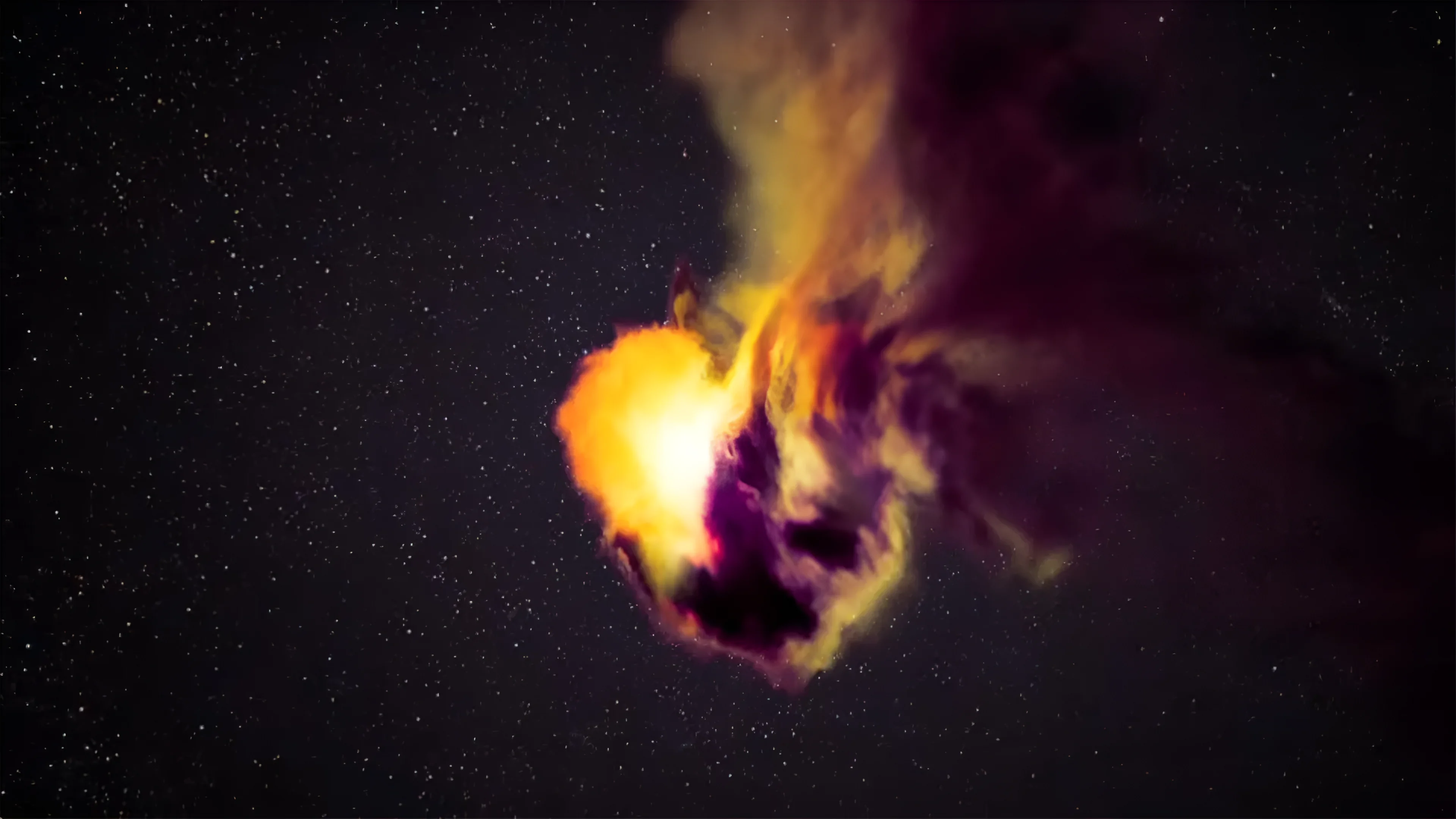
A supernova observed in 2021 has done something no stellar explosion had managed before: it exposed the deep internal layers of a massive dying star, providing the first direct physical evidence of a structure that astrophysicists had long theorized but never seen from the inside out.
The Onion Shell Model Gets Its First Direct Test
For decades, the standard model of stellar evolution held that massive stars burn through a sequence of nuclear fuels in concentric shells — hydrogen first, then helium, then carbon, oxygen, neon, and finally silicon, before an iron core forms and collapse becomes inevitable. This "onion" picture was well-supported by theory and indirect evidence, but no supernova had ever lit up the deepest layers directly.
SN 2021yfj changed that. The event, classified as an extremely stripped supernova and detailed in a paper published in Nature, ejected material rich in silicon, sulfur, and argon — elements produced in the final nuclear fusion cycles that occur immediately above a star's iron core. These are not the outer shells that stripped supernovae ordinarily expose. Prior events in this class had revealed hydrogen, helium, or carbon and oxygen envelopes. SN 2021yfj went deeper, into territory that had never been illuminated by an actual explosion.
What makes this scientifically significant is the timescale problem the observation solves — or rather, sharpens. The chart below shows why the deep layers are so difficult to observe: the burning cycles that forge them operate on radically compressed schedules compared to earlier fusion stages.
The hydrogen cycle sustains a star for millions of years. The silicon cycle — which forges the argon, sulfur, and silicon that SN 2021yfj ejected — lasts months at most, and sometimes only days. The practical implication is stark: the deep ejecta formed in that window do not ordinarily have time to travel far enough from the star's core to be exposed by the explosion itself. Something else had to act first.
Why the Binary Companion Hypothesis Is the Best Available Explanation
Astronomers studying SN 2021yfj propose that the answer is gravitational stripping by a binary companion star. The reasoning follows directly from the timing constraint established above. For the silicon-rich layers to be illuminated, the outer envelopes of hydrogen, helium, and carbon that normally bury them had to be removed — and this removal had to occur on a timescale of months, not millennia.
A binary companion in a tight orbit could exert sufficient gravitational tidal force to rapidly siphon the outer shells before the primary star's core collapsed. This is consistent with known mass-transfer dynamics in close binary systems and fits the observation that the event was "extremely stripped" to a degree not seen in prior supernovae. The researchers' hypothesis is that this siphoning occurred just months before the blast — making the companion star an inadvertent instrument of cosmic archaeology, peeling back layers that would otherwise have been destroyed in the collapse.
It is worth being precise about what is confirmed and what remains inferred. The Nature paper establishes the observational fact: SN 2021yfj ejected and illuminated deep silicon-bearing layers. The binary companion mechanism is the most physically coherent hypothesis to explain how the outer envelopes were removed in time, but it is not yet confirmed through direct detection of a companion. The diagram below traces the pathway from binary interaction to the exposed interior.
The significance extends beyond this single event. If the binary stripping pathway is confirmed for SN 2021yfj, it offers a physical model for how the universe's deep stellar interiors might be probed through future observations. A companion star, in effect, acts as a geological core drill — exposing strata that an unassisted explosion would never reach.
How the Heaviest Elements Take a Different Path
Silicon and sulfur are produced by stellar fusion and scattered when a massive star dies. But the periodic table does not stop at iron. Elements heavier than iron — gold, platinum, silver — cannot be built by fusion at all: the process requires an environment so neutron-dense and energetically extreme that no dying star's interior can provide it. For these, a different cosmic event is required.
That event is a neutron star merger — the collision of two ultra-dense stellar remnants, each the compressed core left by a prior supernova. In August 2017, the gravitational wave observatory LIGO and its partner telescopes detected GW170817, the first confirmed neutron star merger observed simultaneously in both gravitational waves and light. The kilonova afterglow it produced was rich in the spectral signatures of heavy elements, confirming what had been theorized: neutron star mergers drive the rapid neutron-capture process, or r-process, that forges the heaviest stable elements. The metric cards below summarize the key verified figures from GW170817.
The two processes — stellar nucleosynthesis and the r-process — are complementary rather than competing. Core-collapse supernovae like SN 2021yfj seed space with silicon, sulfur, oxygen, and the lighter metals. Kilonova events seed space with gold and platinum. Both classes of ejected material eventually find their way into molecular clouds that collapse into new stars and planetary systems. The iron in a rocky planet's core, the gold in a ring, and the silicon in a semiconductor wafer each arrived by a different astrophysical route.
SN 2021yfj's contribution is to make the stellar route more concrete. By exposing the silicon-burning layer directly — the final forge above the iron core — it provides the first physical confirmation that the onion-shell model describes something real, not just something mathematically convenient. For researchers who study how elements are distributed across the galaxy, that distinction matters considerably.

Fish Oil Supplements Don't Protect Memory, USC Trial Finds
A randomized controlled trial published in eBioMedicine found that 2,000 mg daily DHA supplements failed to improve memory or slow hippocampal shrinkage in 365 at-risk adults over 24 months, despite confirmed CSF delivery.

Did Earth Seed Venus's Clouds With Life?
New atmospheric-entry modeling estimates how many Earth-origin microbial cells could survive the trip to Venus's clouds, and what that means for biosignatures.

Ultra-Processed Foods and Brain Health: What Studies Show
Research from Monash University, Harvard, and studies of tens of thousands of adults connects ultra-processed food intake to measurable cognitive decline, dementia risk, Parkinson's symptoms, and depression — with actionable thresholds in the data.

Million-Year-Old Cave Fossils Close a Gap in New Zealand's Bird History
New fossils from Moa Eggshell Cave, dated to about 1 million years old, reveal 16 species and show extinction was already underway before humans arrived.
Comments (0)
Please sign in to join the discussion.
No comments yet.
Be the first to share your perspective on this topic.