
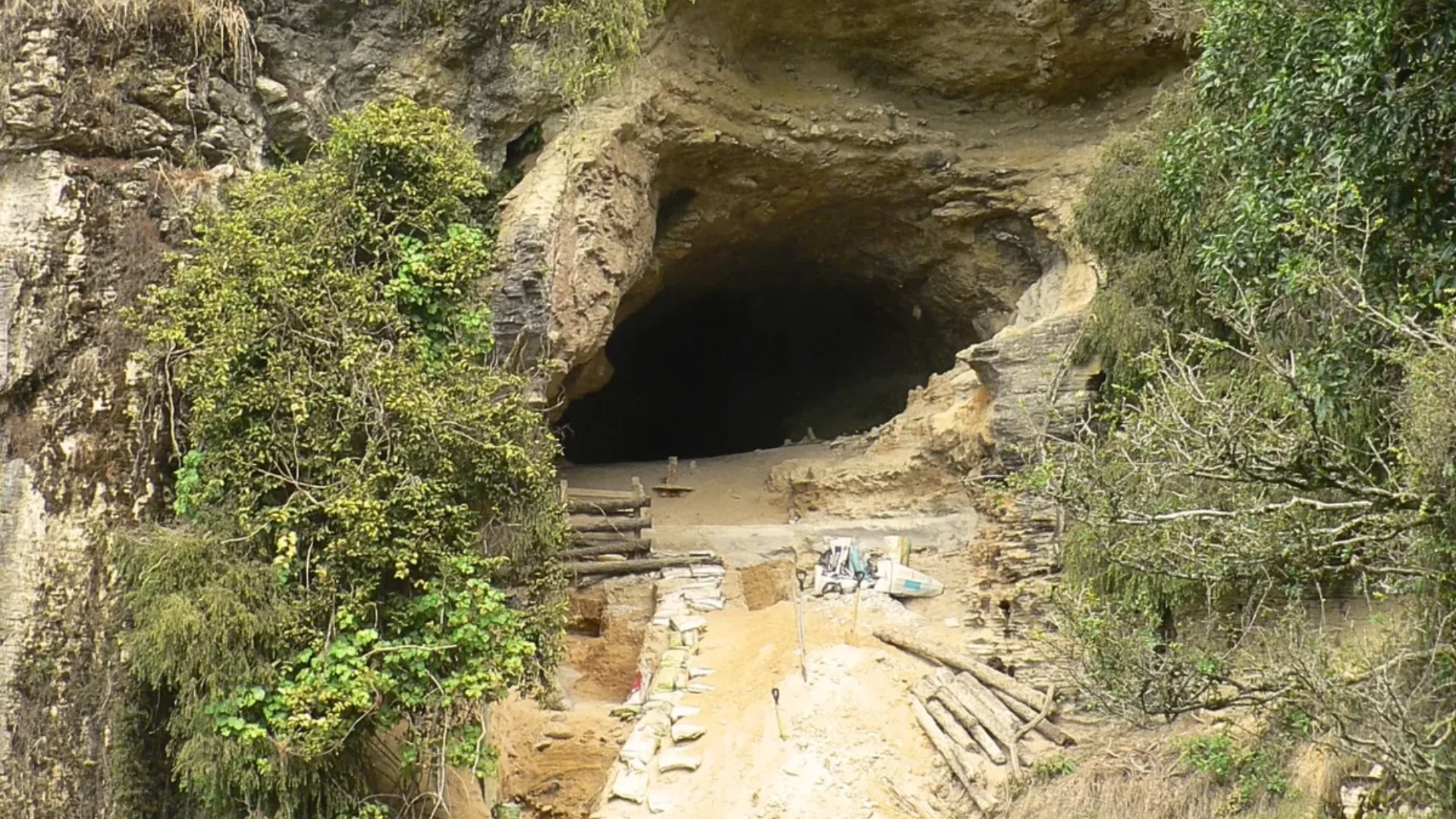
A cave near Waitomo has produced New Zealand's first Early Pleistocene land-vertebrate fauna, a roughly 1-million-year-old assemblage that researchers say closes one of the largest blank spots in the country's fossil record.
A cave deposit closes a 15-million-year void in the fossil record
Before this discovery, New Zealand's terrestrial fossil record had two well-known anchor points: the Early Miocene St Bathans Fauna, dated to roughly 20 to 16 million years ago, and the much younger Late Pleistocene-Holocene record. Almost nothing connected them. The new fauna, recovered from Moa Eggshell Cave on New Zealand's North Island, sits in between, at close to 1 million years old.
Paul Scofield of Canterbury Museum, one of the researchers involved, said the find was bigger than a single missing piece of the timeline. "This isn't a missing chapter in New Zealand's ancient history, it's a missing volume," he said. The cave is thought to be the oldest known cave deposit yet identified on the North Island, based on the volcanic ash layers preserved inside it.
Researchers from Flinders University and Canterbury Museum led the work, with volcanologists from the University of Auckland and Victoria University of Wellington contributing the dating evidence that anchors the find.
Two volcanic ash layers anchor the fossils' age
The fossils were not dated using the method most people associate with fossil sites. Instead, the deposit sits between two layers of volcanic ash, or tephra, each tied to a known eruption. The lower layer comes from the Ngaroma eruption, dated to about 1.55 million years ago. The upper layer comes from the Kidnappers supereruption, dated to about 1 million years ago, an eruption large enough to have buried much of the North Island in meters of ash and pyroclastic flow. A 535,000-year-old speleothem formed on top of the sediment provides a further upper limit on the deposit's age.
That bracketing is what lets researchers put a tight age on fossils that would otherwise be very difficult to date directly. The chart below lays out the three dated layers in sequence.
New species, including a possibly flighted ancestor of the kākāpō
The cave produced 16 species-level taxa: 12 bird species and four frog species from the genus Leiopelma. Three findings stand out among them.
The first is Strigops insulaborealis, a newly described relative of the modern kākāpō. Unlike the living bird, which is a heavy, ground-bound climber, this ancestor had comparatively weaker legs. The researchers say that anatomy points away from a climbing lifestyle and may indicate the bird could still fly, a trait the modern kākāpō has lost entirely.
The second is Porphyrio claytongreenei, an extinct relative of the takahē, today one of New Zealand's best-known flightless swamphens. The third is the first New Zealand record of a phabine pigeon, a group otherwise known from Australian bronzewings, suggesting an additional dispersal connection between the two landmasses that had not previously shown up in the fossil record.
Pre-human turnover reshapes how the extinction story is told
New Zealand's bird extinctions are usually discussed as a story that begins with human arrival, roughly 750 years ago, and the predators and habitat change that came with it. The new fauna complicates that framing. Comparing the Moa Eggshell Cave species against the Late Pleistocene record shows a 33 to 50 percent turnover in local avifauna over the intervening million years, with at minimum four species, and probably six, absent from the later record entirely.
Trevor Worthy of Flinders University said the pattern points to forces that predate people by a long margin. Worthy said super-volcanoes and rapid glacial-interglacial climate shifts were already "sculpting the unique identity of our wildlife" well before humans reached the islands. The Kidnappers supereruption in particular, which buried large areas of the North Island in ash and pyroclastic flow, is a plausible direct cause of loss for ground-dwelling species in the region, though the study does not claim to trace any single extinction to that one event.
The study does not resolve how much of that turnover came from the Kidnappers eruption specifically versus the slower pressure of repeated glacial cycles, and the researchers are careful to frame the figure as a baseline rather than a complete extinction count, since some species may simply be missing from the small sample the cave preserved. What it does establish is a pre-human turnover rate against which any later, human-era losses can now be measured.

Ultra-Processed Foods and Brain Health: What Studies Show
Research from Monash University, Harvard, and studies of tens of thousands of adults connects ultra-processed food intake to measurable cognitive decline, dementia risk, Parkinson's symptoms, and depression — with actionable thresholds in the data.


Cannabis Terpenes Reduce Chronic Pain Without a High
A preclinical study from the University of Arizona shows cannabis terpenes geraniol, linalool, beta-caryophyllene, and alpha-humulene reduce fibromyalgia and post-surgical pain in mice through the adenosine A2a receptor pathway.

DNA Time Stamps Rewrite the Strawberry's Origin
Researchers used LTR retrotransposon similarity matrices to map the octoploid strawberry's subgenomes and date three ancient genome-merging events.

NASA Picks Schmidt's Relativity Space For Mars Mission
NASA's Aeolus mission hands a 2028 Mars orbiter to Relativity Space, the Eric Schmidt-led rocket company that has yet to reach orbit, under a commercial model echoing its ISS and lunar lander contracts.

Comments (0)
Please sign in to join the discussion.
No comments yet.
Be the first to share your perspective on this topic.