

Spain's consumer protection ministry ordered internet service providers to block access to Polymarket and Kalshi on May 26, 2026, citing the absence of gambling licences and critical user safeguards. The move places Spain among a growing cluster of countries that have moved to restrict the two platforms now dominating an $11 billion monthly global prediction market.
Spain's Gambling Regulator Cites Unlicensed Operations and Absent Safeguards
The block was initiated by Spain's Directorate General for Gambling Regulation (DGOJ) and executed via a ministry order to ISPs — a preventative administrative measure that takes effect while a formal investigation proceeds. The platforms are accused of offering wagers on uncertain future events without the mandatory authorization required under Spanish gambling law.
The DGOJ's public complaint is not limited to the licensing gap. Spanish authorities flagged the complete absence of identity verification systems, no age-gating to restrict minors, and no mechanism to protect users who have voluntarily self-excluded or been banned from gambling platforms. These are baseline compliance requirements under Spain's gambling framework, and their absence formed the operational basis for the emergency block rather than a slower enforcement route.
The investigation is expected to run between three and four months before a formal sanction file is settled. During that window, neither platform can legally serve Spanish users, and there is no confirmed indication from either company that they are pursuing a Spanish licence to resolve the regulatory status before the investigation concludes. The following chart shows the scale of the market at stake: the two blocked platforms account for roughly 88% of global prediction market volume.
Spain Joins a Widening Group of Countries Restricting Prediction Market Access
Spain's block did not arrive in isolation. Indonesia and India enacted similar access restrictions in the same week, according to the Reuters account of the regulatory environment. France, Taiwan, Thailand, and Ukraine had already moved to restrict the platforms in earlier actions. The pattern suggests that prediction markets — which expanded rapidly into mainstream awareness during the 2024 U.S. election cycle — are now encountering a second wave of regulatory scrutiny as jurisdictions assess whether they fit inside existing gambling frameworks or require new classification.
The grounds for restriction vary by country, but the Spanish case makes the core tension explicit: platforms that route users into wagers on political and economic events without obtaining domestic gambling authorizations are exposed to the same enforcement tools as unlicensed sports betting operators. Spain's approach — an ISP-level block followed by a formal investigation — is more procedurally structured than some peer-country actions, which have ranged from informal pressure to outright criminal classification.
The following chart shows the countries that have enacted confirmed prediction market restrictions as of May 2026, illustrating how quickly the regulatory map has changed in a single week.
The U.S. Regulatory Position Diverges as Other Markets Restrict Access
While Spain and several Asian markets have applied gambling-law frameworks to prediction markets, the United States has moved in a different direction at the federal level. The Commodity Futures Trading Commission has asserted sole federal jurisdiction over prediction markets, a position it has used to resist independent state-level bans — including a recent Minnesota measure that would have classified participation as a felony.
That CFTC posture has effectively kept Kalshi and Polymarket legally operational across most of the United States, creating a stark jurisdictional split. U.S. regulators classify these platforms as event contracts subject to commodity market rules, while European and Asian counterparts increasingly treat the same products as unlicensed gambling. The distinction matters operationally: a commodity-contract classification implies disclosure and market integrity requirements, while a gambling classification implies age verification, self-exclusion registries, and licensing fees that directly affect platform economics.
Spain's investigation runs three to four months, after which a final sanction determination will be issued. Whether either platform uses that window to pursue a Spanish gambling licence — or contests the regulatory classification through administrative channels — will likely influence how other European countries with pending review processes proceed. The chart below maps the regulatory pathway Spain has initiated.

Ferrari Luce: Inside the $640K Jony Ive EV
Ferrari unveiled the Luce, its first battery-electric vehicle, priced at €550,000. Designed by LoveFrom and powered by an 880V Halbach-array drivetrain, the car trades range for dynamics — and sent Ferrari shares down 6%.
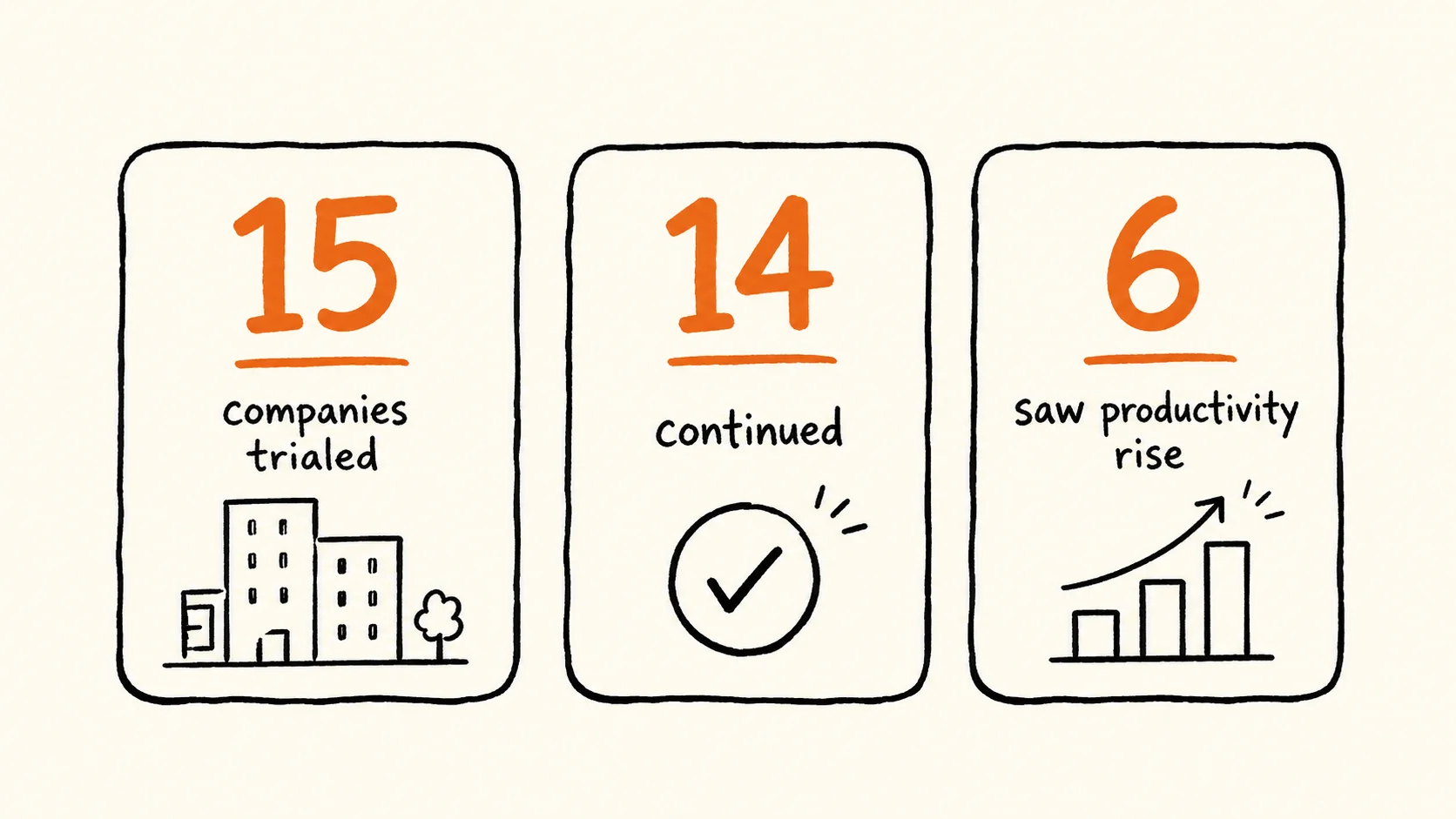
Four-Day Work Week: What Australian Data Actually Shows
A Nature-published study of 15 Australian companies trialing the four-day work week found that 14 permanently continued it, with zero reporting productivity losses. Here's how the model works and where the limits are.

Frontier AI Industry Lost $787B Through May 2026
Cumulative capex across Amazon, Google, Microsoft, Meta, OpenAI, Anthropic, and peers has reached $1.4T against $613B in total revenue. Nvidia is the only net-positive participant in the frontier AI buildout.

Why Japanese Firms Do So Many Unrelated Things
Using Aoki's J-Firm framework, this analysis explains why Japanese corporations diversify across unrelated fields, what institutional structures enable it, and where the model breaks down.
Comments (0)
Please sign in to join the discussion.
No comments yet.
Be the first to share your perspective on this topic.