
A two-year study of 15 Australian companies has produced the most detailed look yet at what actually happens when businesses attempt the four-day work week at scale — not as a policy gesture, but as a structural redesign of how work gets done.
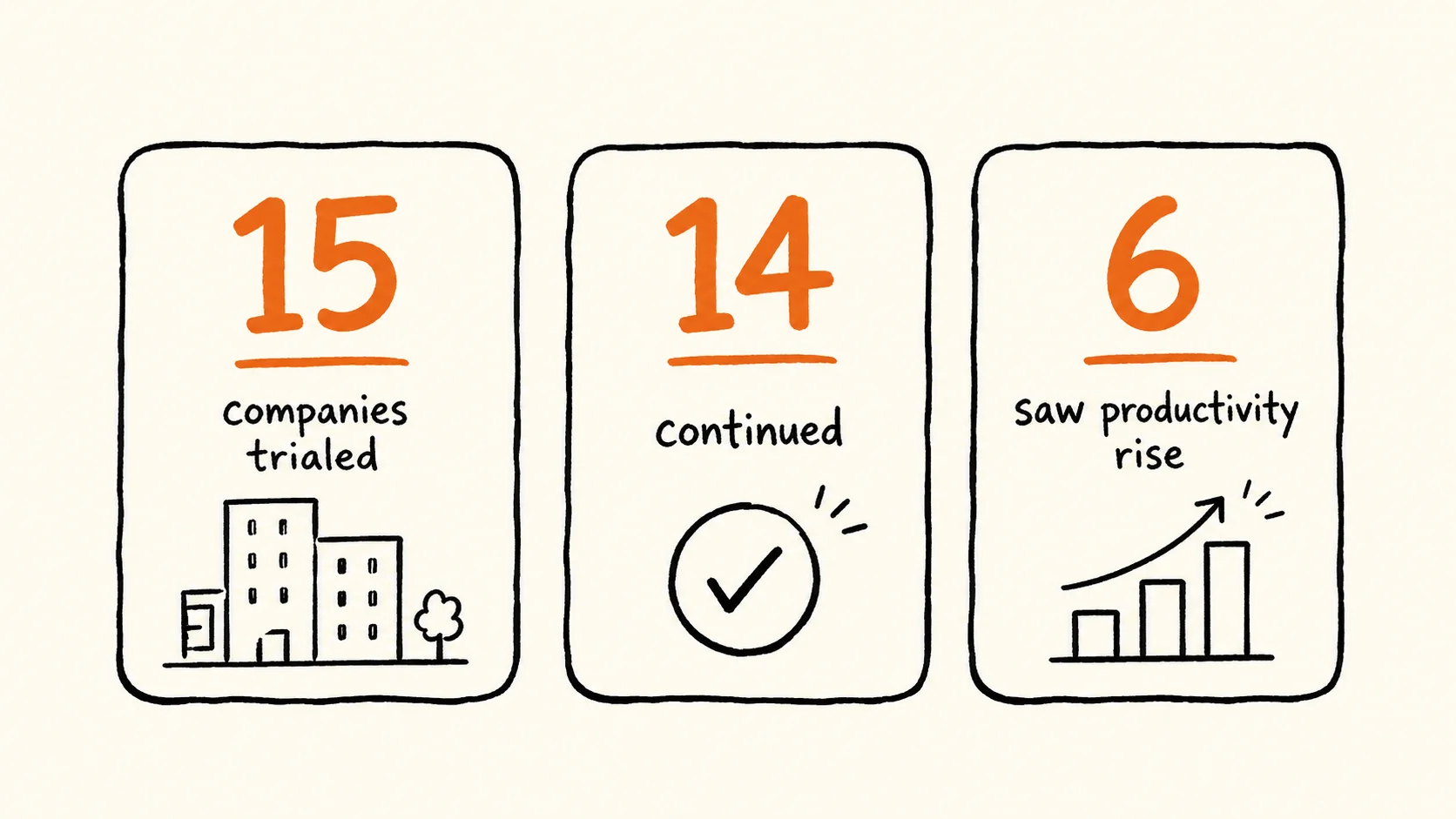
The results, published in Nature's Humanities and Social Sciences Communications journal, are striking in their consistency: 14 of the 15 companies chose to make the model permanent. Not one reported a drop in productivity.
What 15 Companies Found After Two Years
The trial, led by Professor John Hopkins of Deakin University, ran from 2022 to 2024. Participating companies spanned sectors including publishing, property management, and health technology — a deliberate choice to test the model across different operational contexts rather than confine it to one industry.
The framework they tested is known as the 100:80:100 model: employees receive full pay for 80% of their previous working hours, on the condition that they maintain 100% of their original output. This is not a compressed schedule — working four ten-hour days, for instance. It is a commitment to doing the same volume of work in genuinely less time, which requires eliminating the activities that were never generating output in the first place.
Of the 14 companies that continued, six reported an actual increase in productivity. The remaining nine reported output that remained roughly unchanged. The one company that ended the trial did so primarily because it was already mid-way through a major internal restructuring — a timing conflict rather than a failure of the model itself.
Six of the 15 companies entered the trial not to boost output but to address burnout directly. That context matters: a 2025 survey by Beyond Blue found that one in two Australian workers report experiencing burnout, with youth and parents at the highest risk. For some employers, the trial was less a productivity experiment than a retention and wellbeing intervention.
The following cards summarise the headline outcomes from the study.
How the 100:80:100 Model Actually Works
The reason the trial required companies to self-define productivity is not a methodological weakness — it is an honest acknowledgment that "output" means different things to a law firm, a health technology startup, and a property management company. Researchers accepted metrics including revenue, profit, projects completed on time, employee turnover rates, absenteeism rates, and net promoter scores. This makes direct cross-firm comparison difficult, but it also makes the results applicable across sectors rather than confined to a narrow industry benchmark.
What the model demands in practice is structural. The five-day week is not simply shortened to four — it is audited. Companies that participated in the trial reported cutting unnecessary meetings, automating repetitive administrative tasks, and eliminating low-value work that filled time without generating output. The four compressed days that result are meant to be days of high-focus execution, not the same workload crammed into fewer hours.
Client-facing companies faced an additional constraint: they could not close on the same day, because clients still operate five days a week. Many resolved this by staggering days off across teams, ensuring continuous availability without requiring any individual to work a full five-day week.
The diagram below maps the operational levers companies used to make the transition.
Where the Model Works — and Where It Doesn't
The Australian results join a growing international dataset. In the United Kingdom, more than 200 companies across multiple sectors have permanently adopted the four-day week without reducing pay. In Germany, a separate 2024 trial involving 45 companies — mostly small and mid-sized businesses — found that financial performance held year-over-year while active working hours fell.
These numbers suggest a pattern rather than an anomaly, but they also reflect a selection effect: the companies that enter these trials are already motivated to make the model work. Critics raise a legitimate concern about the novelty effect — the possibility that productivity gains during a structured trial reflect employee enthusiasm and observation bias rather than durable structural change. The Australian study's two-year window reduces but does not eliminate that concern.
The more durable limitation is sectoral. The 100:80:100 model is built around knowledge work, where output is separable from hours and where meetings, email, and administrative overhead are the primary sources of recoverable time. It is far harder to apply in healthcare, emergency services, logistics, and hospitality, where shift coverage is mandatory and where reducing hours means either adding headcount or reducing service capacity. The study does not resolve this constraint, and it should not be read as doing so.
For context on how these shifts intersect with broader labor market changes, the April 2026 jobs report traces the current pressure points across sectors, and how AI-driven layoffs reshape labor markets explores what happens when productivity gains flow through technology rather than time redistribution.
The chart below shows the scale of permanent four-day week adoption across the three countries with documented trial data.
The five-day, 40-hour standard week took its current form in the early 20th century, shaped by the rhythms of factory production. Knowledge work, remote collaboration, and more recently AI-assisted task completion have changed the relationship between time at work and value produced. The Australian study does not settle the policy debate — no single trial can — but it does make the empirical case that the 100:80:100 model is operationally viable for companies willing to do the structural work that makes it function.

Could AI Create a "Permanent Underclass"? What the Data Actually Shows
Stanford payroll data show AI-exposed 22-25 year-olds losing jobs at 3.8% a year, while wages diverge by income. What that means for a 'permanent underclass.'

Europe's Debt Pile Is Nearing €1 Trillion. It's Still Not a Safe Asset
EU bonds are AAA-rated and near €1 trillion, but a 50-basis-point spread over German Bunds explains why a true European safe asset still doesn't exist.

UOB Sells UOBAM to Allianz Global Investors for S$555 Million
UOB Group has agreed to sell UOB Asset Management to Allianz Global Investors for S$555 million while keeping a long-term distribution tie for wealth clients.

Why the U.S. Stepped In to Save Japan's Yen — and What It Risks
The U.S. Treasury sold euros, not dollars, to buy yen in the first joint U.S.-Japan intervention since 1998, after USD/JPY hit a 40-year low of ¥163.73.
Comments (0)
Please sign in to join the discussion.
No comments yet.
Be the first to share your perspective on this topic.