
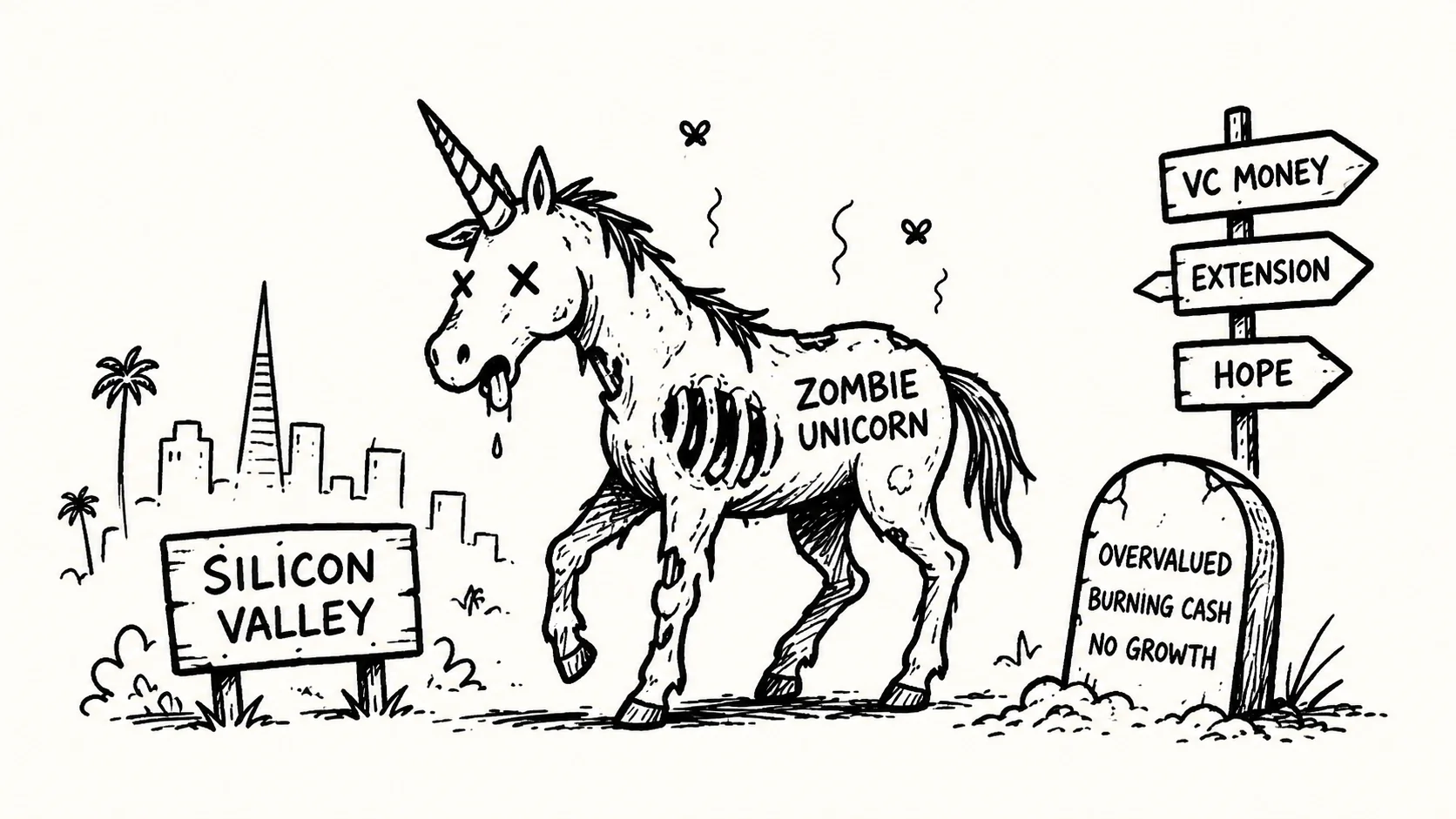
Hundreds of startups once valued above $1 billion are stuck in a kind of corporate limbo — unable to raise fresh capital at their old prices, unwilling to accept the terms that would let them move forward, and watched by investors who no longer know what to do with them. The numbers are more severe than most of the industry has acknowledged.
How Many Unicorns Are Actually Distressed
Ilya Strebulaev at Stanford University has been tracking the global unicorn population, and his figures, current as of May 2026, suggest the problem is broad. Of roughly 1,900 unicorns tracked globally, 332 have raised money at or below their previous peak valuation — a sign that the market has already revised their worth downward. A subset of 212 have seen their valuations drop entirely below the $1 billion threshold that defined them as unicorns in the first place. Most striking is a separate count of 383 firms that have not disclosed any new funding in the past three years. Of those, 41 have formally lost their unicorn designation.
These categories overlap but are not identical. A startup can be in a down-round without falling below $1 billion. It can also be raising no new money while still technically sitting at its last disclosed valuation — a number that may not reflect what anyone would actually pay today. Strebulaev's data tracks all three failure modes, and the cumulative picture is of a sector in which a substantial share of the headline unicorn count is not functioning as a going concern. The chart below summarizes the four key distress indicators from that dataset.
The term "zombie unicorn" has become shorthand for this cohort: firms that were once valued above $1 billion during the low-rate era but have since become unable to grow, raise at their old price, or find a buyer. Cameo, the celebrity video-greeting platform, is a frequently cited example — valued at $1 billion in 2021 and now estimated to be worth around $82 million, a decline of more than 90 percent.
The Interest Rate Shock That Dried Up the Money
The macroeconomic mechanism behind the zombie problem is not difficult to trace. When interest rates were near zero, institutional investors found it difficult to generate meaningful returns from bonds or other conventional instruments. That drove capital into venture funds, which promised higher returns in exchange for illiquidity. The results were self-reinforcing: more money chasing a fixed number of deals pushed valuations higher, encouraging more fund formation and more deal-making.
That dynamic reversed sharply. At the peak of the cheap-money era, venture capitalists raised $223 billion in 2022, according to PitchBook. Following the subsequent sequence of interest rate increases, that figure had fallen to $66 billion by 2025 — a drop of roughly 70 percent in three years. For context on the broader market context of 2026, that fundraising contraction sits alongside persistent tension between asset prices and underlying economic conditions. The chart below shows the scale of that compression directly.
The consequences are asymmetric. Startups that raised at 2021 valuations built cost structures, headcounts, and roadmaps premised on continued access to capital at similar prices. When the market turned, many could not adjust quickly enough. Newer VC funds launched into the post-2022 environment have also suffered: those that missed the concentrated group of AI breakout companies have substantially underperformed the S&P 500, according to the World Economic Forum. The market concentration problem is stark — roughly 5 percent of venture firms account for approximately 90 percent of the industry's total profits.
The 2027 Deadline and What a $1 Trillion Repricing Would Mean
The pressure building inside the zombie cohort has a structural deadline. Many of these companies raised their last meaningful round in 2021, and the typical venture timeline of five to ten years before an IPO or acquisition means the window for patient waiting is narrowing quickly. PitchBook projects that by late 2027, institutional investors will begin demanding results in earnest — likely forcing net cuts to valuations in a range of $500 billion to $1 trillion across the sector, as companies reprice in down-rounds, seek emergency buyers, or fail entirely.
To calibrate the severity of that figure: PitchBook tracks the aggregate value of all unicorns excluding the top ten largest at roughly $5 trillion. A $500 billion to $1 trillion haircut would therefore represent somewhere between 10 and 20 percent of that pool being written down. That is not a tail risk — it is a base-case scenario built into the projections of one of the sector's main data providers. The chart below places the projected cull against the total pool it would draw from.
The structural feature that makes resolution difficult is the governance architecture of venture-backed companies. Early investors in many of these firms hold veto rights over public offerings — a protective clause inserted to prevent founders from staging an IPO at a price that would not return investors their preferred multiple. In a rising market, those provisions are rarely invoked. In a market where the only realistic IPO price is well below the last private valuation, those same clauses can freeze a company in place: investors unwilling to accept the loss, and management unable to force a resolution without consent.
The firms most likely to survive this period intact are those that can attract AI-adjacent investment theses, accept significantly reduced valuations, or find strategic acquirers before the 2027 deadline hardens. Tech investor Peter Cohan has noted that for those without those options, the terms available from any willing lender will be substantially less favorable than anything seen during the era that created the zombie problem in the first place. Some VC firms are also restructuring their own vehicles — moving from traditional fixed-lifetime funds toward "continuous funds" that blend private stakes with liquid public holdings, allowing periodic distributions to institutional investors rather than waiting for a single exit event that may not come.
The zombie cohort is, in a narrow sense, a legacy problem: the direct consequence of a period when money was cheap, valuations were inflated, and the assumption of perpetual growth was baked into deal structures that nobody has yet unwound. The unwinding, when it comes, is unlikely to be orderly.

The Retirement Countdown: What to Fix at 5 Years, 3 Years and 1 Year Out
Retirement checklist: what advisors say to fix at 5, 3 and 1 year out — Social Security claiming order, IRA withdrawal sequencing and a 2028 tax deadline.

UnitedHealth's Adjusted EPS of $6.38 Beats Estimates by 30% as It Sheds Members for Margin
UnitedHealth posted $6.38 adjusted EPS in Q2 2026, beating estimates by 30%, as medical costs eased to 86.7% and full-year guidance rose to $19.50–$20.00.

Why SaaS Companies Fail: What the 2024 Shutdown Data Shows
CB Insights' 2024 study of 431 failed startups found 43% cite poor product-market fit; Carta data shows enterprise SaaS led 2024's shutdown wave at 32%.

Valuations Are Nearing Dot-Com Peaks: Is a 2026 Market Crash Imminent?
The S&P 500's Shiller CAPE ratio hit 41.76 and the Buffett Indicator sits near 214%, levels unseen since just before 2000 — here's what history suggests next.
Comments (0)
Please sign in to join the discussion.
No comments yet.
Be the first to share your perspective on this topic.