
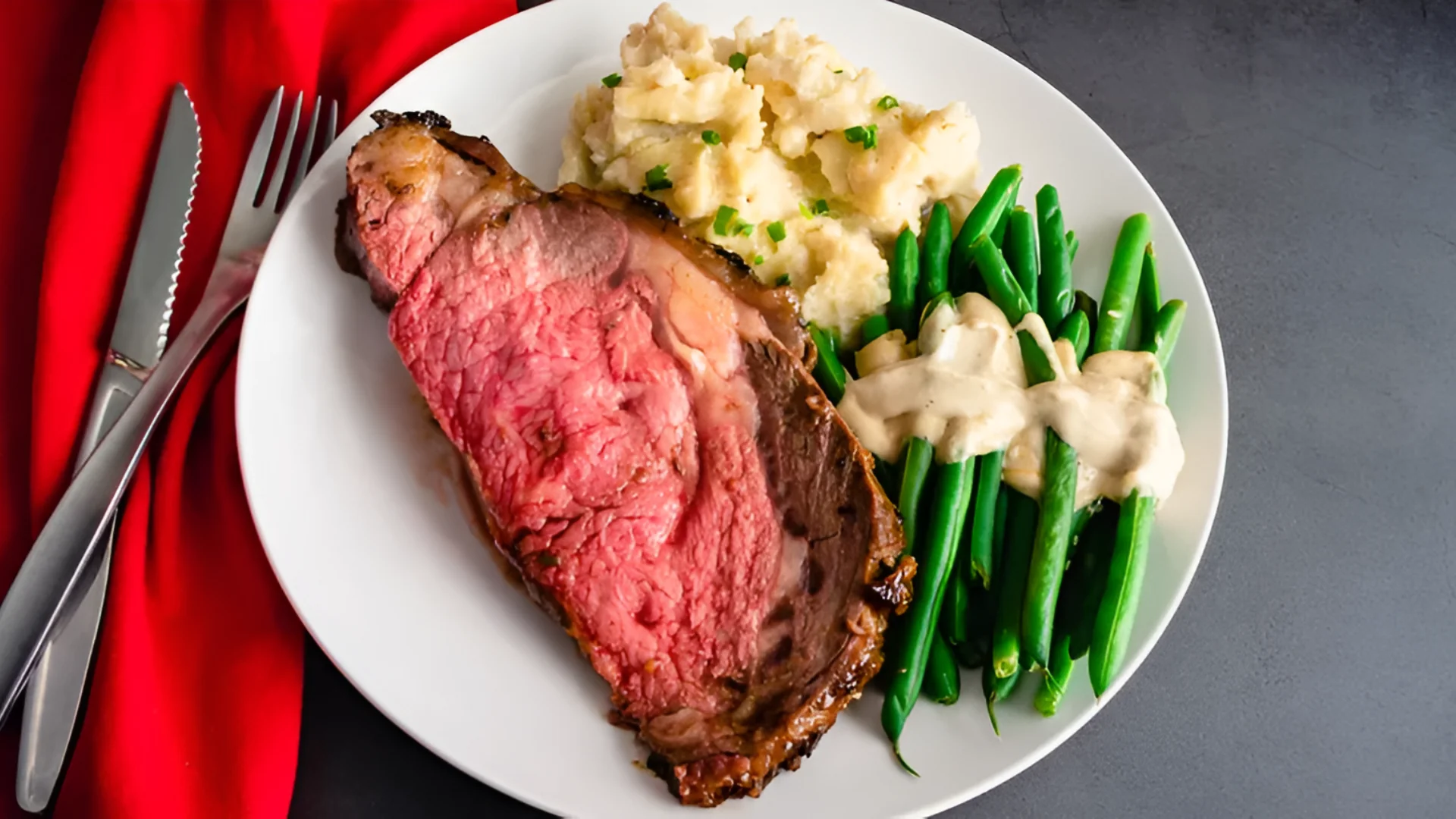
A well-executed prime rib is one of the most demanding dishes a restaurant kitchen can produce. The margin for error is narrow, the roast takes hours, and the result is either genuinely exceptional or quietly forgettable. These are the restaurants across the United States that have figured it out.
What Separates a Great Prime Rib From a Standard One
The preparation method matters more than almost anything else. At its core, prime rib is a standing rib roast slow-cooked to a consistent internal temperature, then rested and carved to order. The differences between a forgettable version and a memorable one come down to three variables: aging, seasoning, and the willingness to take time.
Kansas's Scotch & Sirloin in Wichita serves a 45-day dry-aged prime rib, which concentrates the beef's flavor significantly compared to a fresh-roasted cut. In New Orleans, the Rib Room at the Omni Royal Orleans applies a rosemary and tellicherry peppercorn crust with a worcestershire-based jus — a preparation that treats the roast more like a French rôti than a steakhouse slab. Colorado's Buckhorn Exchange takes a different direction entirely: its slow-roasted buffalo prime rib produces a leaner, slightly sweet result that has no real equivalent elsewhere in the country.
Smoke is another separating factor. Florida's The Ravenous Pig in Winter Park lightly smokes the entire rib roast before service, adding a layer of complexity that a conventionally roasted version won't carry. Arkansas's Table Orleans at The Hickory Inn uses slow smoking specifically to seal in moisture across both its 10 oz and 12 oz cuts.
The chart below shows sourced cut sizes at notable restaurants across the US, illustrating the range from compact weeknight portions to the kind of single-sitting challenge that defines a destination meal.
Regional Standouts Worth Traveling For
California's House of Prime Rib in San Francisco is probably the most written-about prime rib destination in the country, and for clear reasons: the roast is carved tableside from a rolling cart, paired with a tossed salad finished at the table, and accompanied by Yorkshire pudding. The format hasn't changed in decades, which is part of its value — it's a precise, repeatable experience rather than a rotating seasonal concept.
In New Orleans, the Rib Room's rosemary-tellicherry peppercorn crust and worcestershire jus give the dish a distinctly European character, closer to British beef traditions than the American chophouse standard. Chicago's Gene & Georgetti cuts prime rib two fingers thick and serves it on weekends only, a restriction that functions as a quality signal — the kitchen runs the roast when it has the capacity to do it properly.
Hawaii's Ray's Cafe in Honolulu operates at the opposite end of the formality scale: cash-only, carryout containers, and a supply that sells out. The stripped-down approach makes it one of the more unusual prime rib destinations in the country.
The three specialty preparation details below capture what makes the most distinctive approaches stand out from a standard chophouse offering.
Timing and Availability: When to Go
Several of the best prime rib destinations in the country are not daily operations. Connecticut's The Main Pub serves its 12 oz prime rib only after 4 p.m. on Fridays and Saturdays. Delaware's Walter's Steakhouse runs a Friday night special. Alabama's Tin Top Restaurant & Oyster Bar in Bon Secour features its 14 oz prime rib as a Friday special specifically.
Illinois's Gene & Georgetti restricts its weekend-only prime rib for similar reasons — it is a kitchen-capacity decision as much as a marketing one.
Hawaii's Ray's Cafe is the most extreme case: no reservations, cash only, and the supply runs out. Arriving late means leaving without it.
The practical implication for anyone planning a trip around prime rib is straightforward: call ahead, confirm the day and time, and arrive early at the spots known to sell out. The restaurants doing this right are not running it every night because they choose not to, not because they can't.

Inside the Physics Self-Study Guide 600,000 People Have Used
Susan Rigetti's physics self-study guide pairs a 9-stage curriculum with named textbooks, as U.S. physics bachelor's degrees fell to 7,776 in 2023-24.


Dior Beats Chanel for Taylor Swift's Wedding Gown
Jonathan Anderson designed custom Dior couture for Taylor Swift and Travis Kelce's wedding, a high-stakes celebrity commission LVMH needed as it competes with Chanel in a slow luxury market.

Savory, High-Protein Snacks Are Replacing Sugar Bars
Sugary bars are losing ground to savory, protein-forward snacks as "functional indulgence" and whole-food ingredients reshape what health-conscious shoppers reach for.

Taylor Swift and Travis Kelce's Reported MSG Wedding: What the Sources Actually Show
A breakdown of what permits, security documents, and sourced reporting reveal about the reported Taylor Swift and Travis Kelce wedding at Madison Square Garden on July 3, 2026.
Comments (0)
Please sign in to join the discussion.
No comments yet.
Be the first to share your perspective on this topic.