
![Texas Attorney General Ken Paxton, a Republican candidate for the US Senate, speaks to supporters at a campaign event in McKinney, Texas, the US, on May 19, 2026 [LM Otero/AP]](/uploads/1779863798651-Trump-backed_Paxton_topples_Senator_Cornyn_in_Texas_primary_run-off.webp)
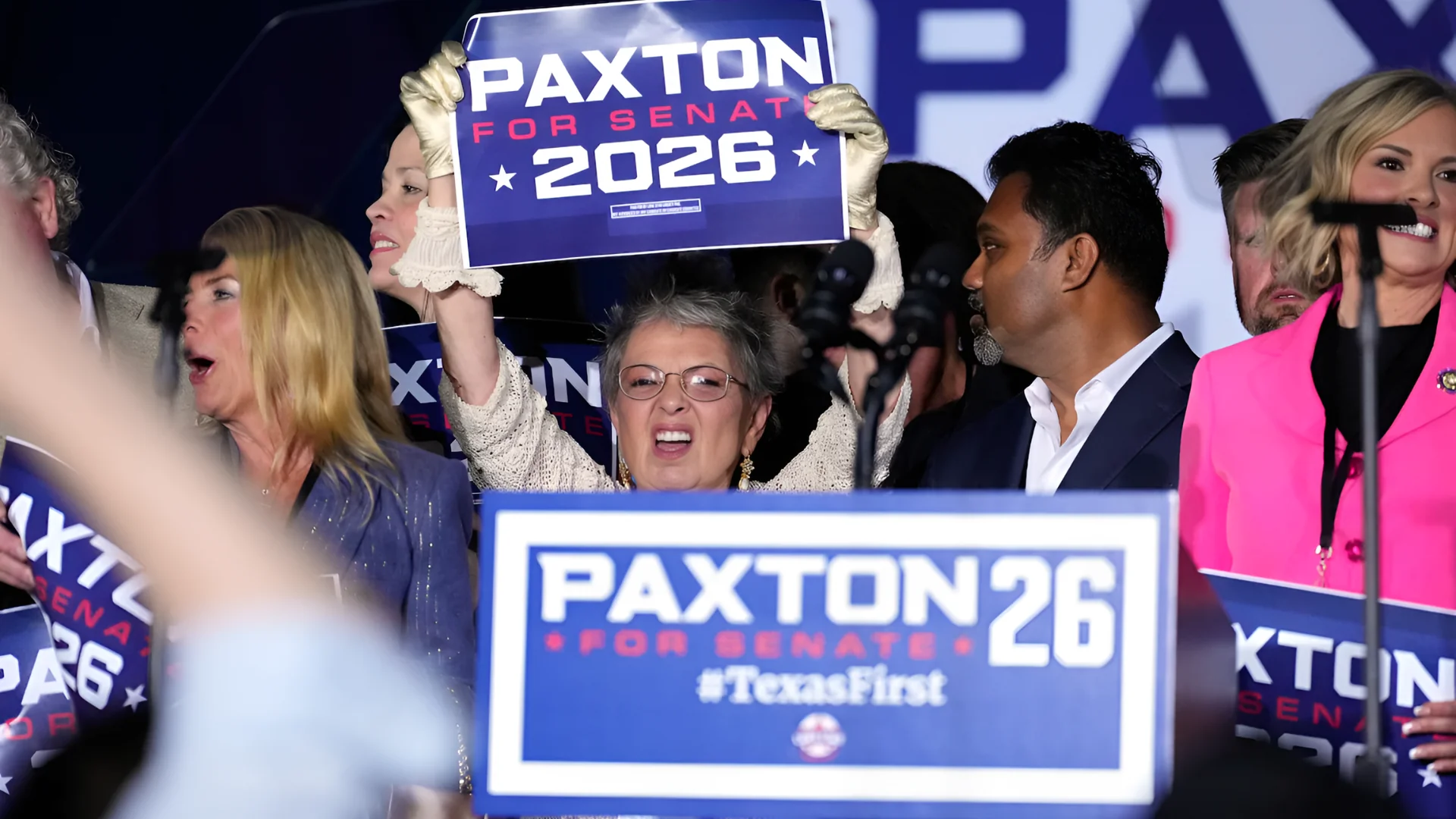
Ken Paxton, the embattled Texas Attorney General backed by Donald Trump, defeated four-term incumbent Senator John Cornyn in the Republican primary runoff on May 26, 2026 — the first time a Republican senator from Texas has lost his party's nomination for re-election.
How a 24-Year Senate Career Ended in a Primary
Cornyn had represented Texas in the Senate since 2002, rising to serve as Republican whip. His defeat was not rooted in a single recent failure. It was the accumulation of two years of exposure to a Republican primary electorate that had grown hostile to any deviation from Trump's political line.
The clearest inflection point came in May 2022, when Cornyn led bipartisan negotiations on gun legislation in the weeks after 19 students and two teachers were killed at an elementary school in Uvalde, Texas. The resulting Bipartisan Safer Communities Act passed with broad Senate support, but it made Cornyn a marked man in a primary environment where any compromise with Democrats on the issue could be framed as betrayal. Paxton and his allies used the vote repeatedly during the campaign.
Cornyn had also drawn Trump's ire through past public criticism, giving Paxton a ready-made contrast: a candidate who could position himself as the authentic Trump loyalist against a senator Trump had reason to punish. Paxton told supporters after the result that Trump's endorsement was "the most powerful force in politics." Cornyn, in his concession, quoted 2 Timothy 4:7 — "I have fought the good fight, I have finished the race, I have kept the faith" — and pledged to support the Republican ticket regardless.
The following chart traces the key moments in Cornyn's political arc that culminated in Tuesday's result.
Paxton Brings Significant Legal Baggage Into the General
The Paxton nomination confronts Republicans with a candidate who carries a documented record of legal and ethical controversy that would be unremarkable in a low-profile primary but is significant in a competitive general election.
In 2023, the Republican-led Texas House impeached Paxton on charges that included bribery and abuse of office. The Texas Senate subsequently acquitted him. Paxton has consistently characterized the proceedings as politically motivated. He also faced a high-profile divorce during the period — a complicating factor in a general electorate broader than the Republican primary base.
Democratic state Representative James Talarico, who secured his party's nomination by defeating Jasmine Crockett, moved quickly to define Paxton. Within hours of the result, Talarico called Paxton "the most corrupt politician in America" and described the race as one against "the broken system we're running against." The framing is consistent with a Democratic campaign strategy built around Paxton's legal record rather than a policy contrast.
Whether that framing reaches beyond the Democratic base depends on how independent and suburban voters — groups that shifted in Texas in 2018 and 2020 — respond to a Paxton candidacy in a midterm environment.
What the General Election Stakes Look Like
The Texas race is not an ordinary Senate contest. Internal Republican campaign memos, as reported ahead of the runoff, warned that a Paxton nomination represented a rare Democratic opening. Paxton himself acknowledged the scale of the stakes in his victory speech, telling supporters: "If Republicans lose this state, we lose the country."
Texas has not elected a Democrat to statewide office since 1994. No Republican senator from Texas has ever lost re-election — until Cornyn lost his primary on Tuesday. The November matchup is the first in which a credible Democratic nominee faces a Republican candidate whose vulnerabilities extend well beyond ideological disagreement.
Senate control may turn on whether Democrats can convert that opening. The combination of an unusually flawed Republican nominee, a competitive national environment, and a Democratic candidate with an explicit contrast strategy gives this race a profile unlike any previous Texas Senate contest.
The chart below captures the three core facts that frame the electoral stakes.
Trump's Endorsement Record and Its Limits
Tuesday's result adds a significant data point to the ongoing argument about how far Trump's endorsement power extends. Paxton's victory over a well-funded, institutionally connected four-term senator in a large state demonstrates that the endorsement remains capable of decisive primary outcomes. Cornyn had broad support from the Republican establishment and a substantial financial advantage. Neither insulated him.
The harder question is whether that same endorsement translates into a general election asset or liability in Texas. Trump carried Texas comfortably in 2024, but Texas is not a closed primary electorate in November. The suburban drift that made Beto O'Rourke's 2018 Senate campaign unexpectedly competitive — he lost by fewer than three percentage points — has not reversed.
Republicans now face a November race where they must hold Texas without the incumbent they were relying on, with a nominee whose legal record gives Democrats a concrete contrast argument that does not depend on ideology. Paxton has warned his own party about the stakes. The question the November result will answer is whether Trump's continued involvement in the general election can compensate for the vulnerabilities his endorsement created.
Paxton Defeats Cornyn in Texas Senate Runoff
Ken Paxton won the Texas Republican U.S. Senate primary runoff on May 26, 2026, defeating four-term incumbent John Cornyn by nearly 28 points despite a 9-to-1 spending disadvantage, setting up a competitive general election against Democrat James Talarico.

Spain Blocks Polymarket and Kalshi Over Gambling Licences
Spain's DGOJ ordered ISPs to block Polymarket and Kalshi on May 26, 2026, citing no gambling licences, no age verification, and no self-exclusion controls. The action joins Indonesia, India, France, and others in a widening global split over how to classify prediction markets.


Trump's DC Triumphal Arch: Legal Fight, Protests
A federal commission dominated by Trump appointees approved a 250-foot gilded arch near the Lincoln Memorial over near-unanimous public objection, a veterans' lawsuit, and questions about public funding.
Trump DOJ's $1.776B Anti-Weaponization Fund, Explained
A breakdown of the DOJ's $1.776 billion Anti-Weaponization Fund — its commission structure, accountability gaps, January 6 eligibility questions, and the constitutional challenges already filed against it.
Comments (0)
Please sign in to join the discussion.
No comments yet.
Be the first to share your perspective on this topic.