
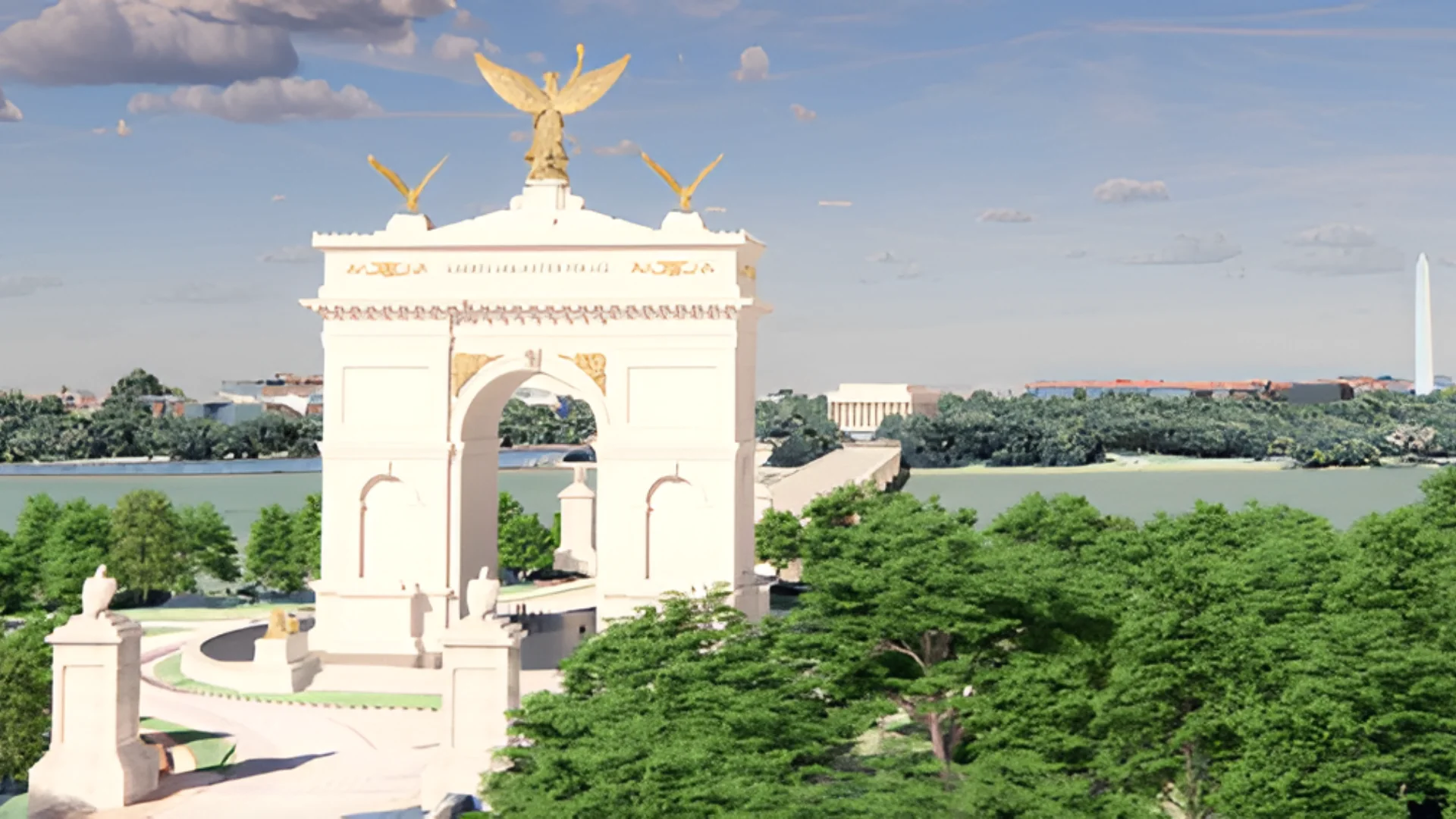
A federal design commission whose members were all appointed by President Trump granted final approval on May 21 to a 250-foot gilded monument near the Lincoln Memorial — a plan opposed by roughly 99.5% of public commenters, a majority of Americans surveyed, and a group of Vietnam War veterans who argue it violates federal law.
A Fast-Tracked Monument on Hallowed Ground
The "United States Triumphal Arch" — also called the "Independence Arch" in some administration materials — is planned for Memorial Circle on Columbia Island, directly along the historic axis connecting the Lincoln Memorial and Arlington National Cemetery. At 250 feet, the structure would stand more than twice the height of the Lincoln Memorial and exceed both the Arc de Triomphe in Paris and Mexico City's Monument to Independence.
The design features a gilded Lady Liberty-like figure holding a torch at the apex, flanked by two 24-foot gilded eagles, with gold-leaf inscriptions of "One Nation Under God" and "Liberty and Justice for All" on the arch face. The Trump administration pitched the project as a commemoration of the 250th anniversary of the Declaration of Independence, with groundbreaking targeted for summer 2026 and completion within the current presidential term.
Trump first unveiled 3D mockups at a White House East Wing fundraiser in October 2025, in front of business executives and corporate donors. When an attendee asked who the arch was for, Trump said, "Me." The White House later issued a clarification attributing the monument to the "enduring triumph of the American spirit."
Design modifications disclosed in late May 2026 removed four proposed gold lion sculptures at the base and replaced a planned underground pedestrian tunnel with surface-level crosswalks, according to architect Nicolas Charbonneau.
The chart below tracks the project's key milestones from introduction to final design approval.
The Legal and Procedural Disputes
The sharpest legal question is whether the administration is required to obtain explicit congressional authorization before breaking ground. The 1986 Commemorative Works Act requires congressional approval for national monuments on federal land. Three Vietnam War veterans and an architectural historian — represented by the Public Citizen Litigation Group — filed a federal lawsuit in February 2026 arguing the arch proceeds without that required authorization.
The Justice Department moved to dismiss the case on two grounds: first, that the plaintiffs lack legal standing to sue; and second, that a century-old plan approving "two stately columns" at Memorial Circle constitutes existing statutory authorization for the site. A federal judge denied the plaintiffs' motion for a preliminary injunction in April 2026, allowing survey and geotechnical work to begin while the case continues.
The Commission of Fine Arts, which granted preliminary approval in April and final approval on May 21, is an advisory body with no independent legal authority to authorize construction under the Commemorative Works Act. Its current commissioners were all appointed by President Trump. CFA Secretary Thomas Luebke disclosed publicly that of approximately 600 written public comments submitted, between 99.5% and 100% expressed opposition to the project. The commission approved the revised design regardless.
The diagram below maps the core procedural and legal dispute.
Public Opposition and the Sightline Question
The monument's critics span veterans' organizations, historic preservation groups, and a majority of the general public. A late-April 2026 Washington Post-ABC News-Ipsos poll found that 52% of Americans oppose the planned structure, including roughly 60% of political independents. Among Republicans, 51% expressed support.
Veteran plaintiffs Jon Gundersen and Shaun Byrnes — both of whom served diplomatic tours in Moscow and post-Soviet Eastern Bloc countries — stated publicly that the self-promoting character of the project resembles monuments built under authoritarian governments. Byrnes, 83, said he would reconsider his plans to be interred at Arlington National Cemetery if the arch stands.
Beyond the symbolism of the structure itself, preservationists and historians argue that the specific site choice causes irreversible harm. The axis between the Lincoln Memorial and Arlington House — the former home of Robert E. Lee, now the Robert E. Lee Memorial — was deliberately engineered more than a century ago to symbolize national reconciliation after the Civil War. A 250-foot structure at Memorial Circle would physically interrupt that line of sight and, critics argue, sever the deliberate spatial meaning the axis was designed to convey.
A multiday protest rally titled "86 Trump's Arch" began near the Lincoln Memorial on May 24, 2026, organized by the activist group Third Act DMV, coinciding with the annual "Rolling to Remember" Memorial Day motorcycle ride through the area.
The poll breakdown below shows where American opinion stands as the project moves toward a summer 2026 groundbreaking.
A Funding Claim That Doesn't Fully Hold
President Trump stated from the outset that the monument would be financed entirely through private donations. That framing has not held on closer examination. The National Endowment for the Humanities has already allocated at least $15 million toward the project, according to watchdog reporting — raising questions about the boundary between private fundraising and federal expenditure that the administration has not yet addressed in detail.
The project proceeds toward a planned summer 2026 groundbreaking, pending the outcome of the active federal lawsuit. The legal question of whether the 1986 Commemorative Works Act requires additional congressional authorization — and whether the plaintiffs have standing to argue it — remains unresolved.
Paxton Defeats Cornyn in Texas Senate Runoff
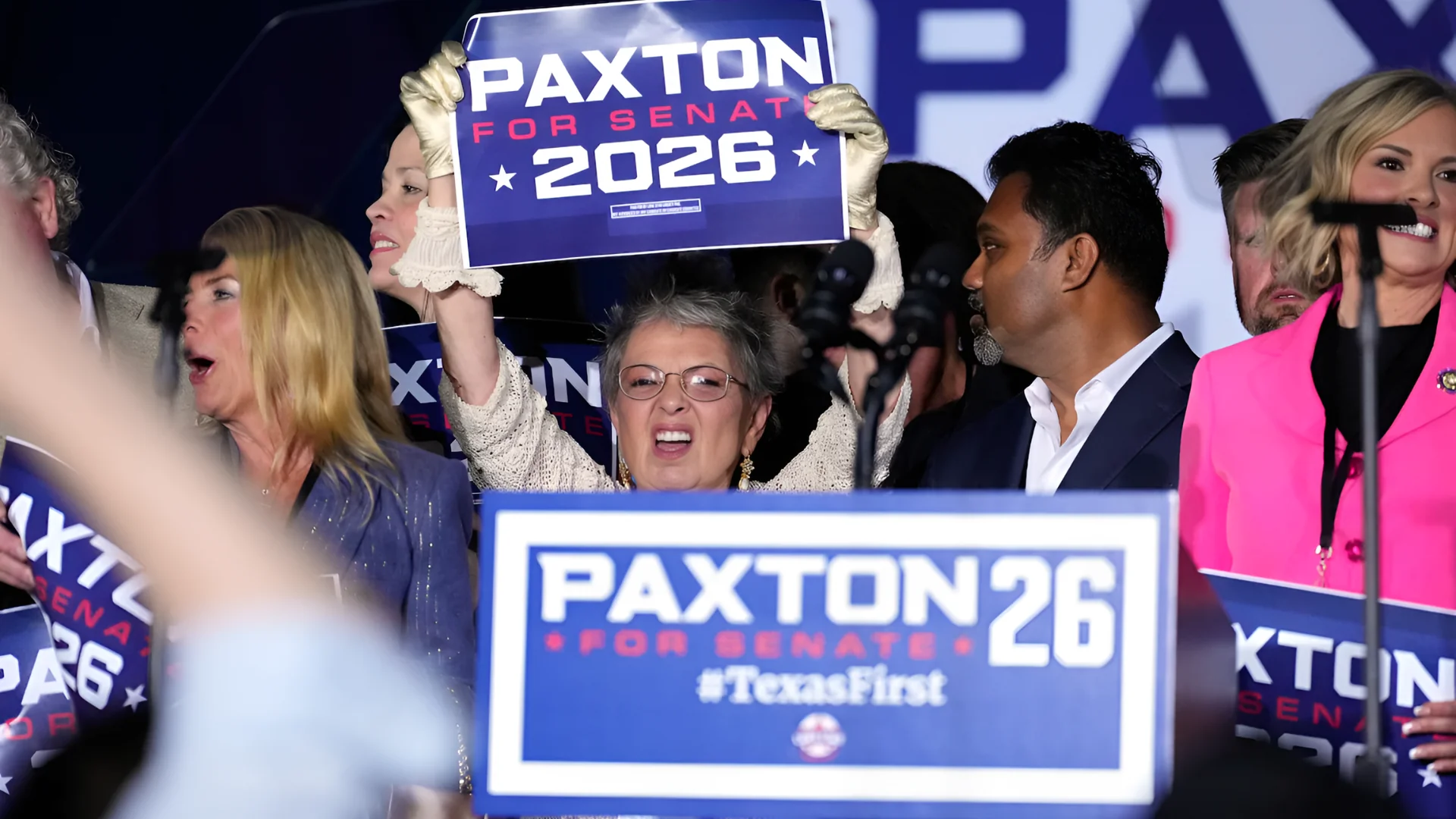
Ken Paxton won the Texas Republican U.S. Senate primary runoff on May 26, 2026, defeating four-term incumbent John Cornyn by nearly 28 points despite a 9-to-1 spending disadvantage, setting up a competitive general election against Democrat James Talarico.

Spain Blocks Polymarket and Kalshi Over Gambling Licences
Spain's DGOJ ordered ISPs to block Polymarket and Kalshi on May 26, 2026, citing no gambling licences, no age verification, and no self-exclusion controls. The action joins Indonesia, India, France, and others in a widening global split over how to classify prediction markets.

![Texas Attorney General Ken Paxton, a Republican candidate for the US Senate, speaks to supporters at a campaign event in McKinney, Texas, the US, on May 19, 2026 [LM Otero/AP]](/uploads/1779863798651-Trump-backed_Paxton_topples_Senator_Cornyn_in_Texas_primary_run-off.webp)
Ken Paxton Defeats John Cornyn in Texas Senate Primary
Ken Paxton defeated incumbent Senator John Cornyn in the May 26, 2026 Texas Republican primary runoff. The result tests whether Trump's political influence can hold a state Republicans have never lost at the Senate level.
Trump DOJ's $1.776B Anti-Weaponization Fund, Explained
A breakdown of the DOJ's $1.776 billion Anti-Weaponization Fund — its commission structure, accountability gaps, January 6 eligibility questions, and the constitutional challenges already filed against it.
Comments (0)
Please sign in to join the discussion.
No comments yet.
Be the first to share your perspective on this topic.