
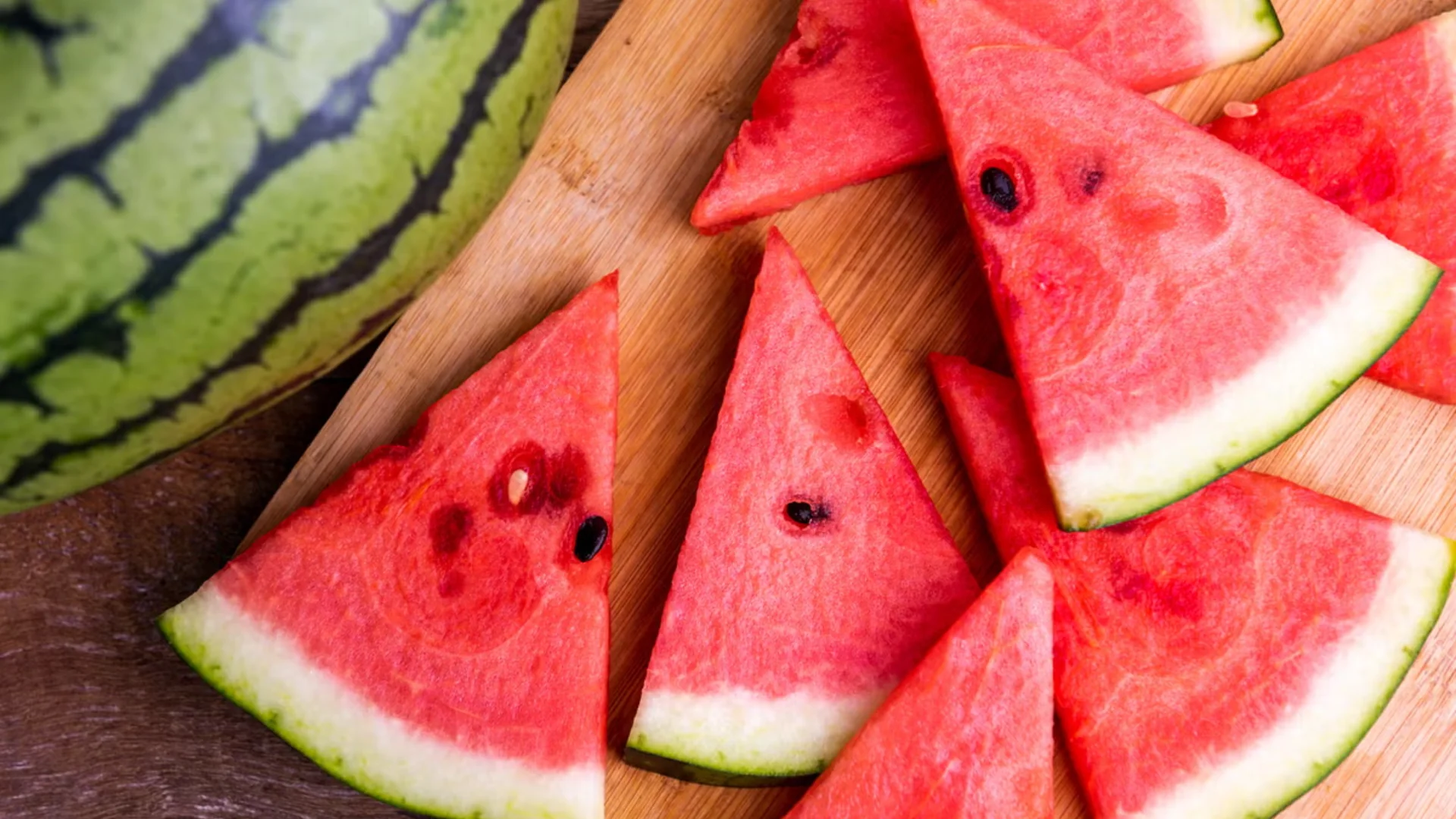
Two studies published this month add measurable detail to what was mostly folk wisdom: people who eat watermelon tend to have better overall diets, and short-term watermelon juice supplementation may help maintain vascular function during blood sugar spikes. The findings are genuine, but they come with limits worth understanding.
What People Who Eat Watermelon Actually Consume
The broader of the two findings comes from an analysis of National Health and Nutrition Examination Survey data, the federal dietary tracking study known as NHANES. Researchers found that children and adults who regularly ate watermelon consumed significantly more dietary fiber, magnesium, potassium, vitamin C, vitamin A, lycopene, and carotenoids than non-consumers. They also took in less added sugar and saturated fat overall.
This is a dietary association, not a controlled experiment. It shows that watermelon fits into the eating patterns of people who make more nutritious choices generally — it does not prove that watermelon is causing those outcomes in isolation. Still, the nutrient picture of the fruit itself is worth examining directly.
A standard two-cup serving delivers roughly 80 calories, is 92 percent water by weight, and provides 25 percent of the daily value for vitamin C and 8 percent for vitamin B6. Watermelon is also one of the richest natural food sources of L-citrulline, an amino acid that the body converts to L-arginine, which in turn supports nitric oxide production. Nitric oxide helps blood vessels relax and widen — a mechanism with direct relevance to circulation. Red-fleshed varieties add high concentrations of lycopene, a carotenoid antioxidant linked in epidemiological research to reduced oxidative stress, though human trial evidence on lycopene's anti-inflammatory effects remains mixed.
The chart below shows the key nutrients delivered in a two-cup serving and their approximate daily value contributions, as reported in the source package.
A Small Trial on Vascular Function During Blood Sugar Spikes
The more specific finding comes from a randomized, double-blind, placebo-controlled crossover trial conducted at Louisiana State University and reported by ScienceDaily. Eighteen healthy young adults received daily watermelon juice supplementation for two weeks. The study examined what happened to vascular function when participants were exposed to hyperglycemia — a temporary state of elevated blood sugar.
Researchers found that watermelon juice supplementation helped maintain vascular function during those hyperglycemic periods and also influenced heart rate variability, a measure of the autonomic nervous system's regulation of the heart. The proposed mechanism runs through L-citrulline: by supporting nitric oxide synthesis, the compound may help blood vessels stay responsive even when blood sugar is elevated.
Dr. Jack Losso, a professor at LSU's School of Nutrition and Food Sciences, was direct about the study's scope: "We acknowledge that while the sample size was small… this study adds to the current body of evidence supporting regular intake of watermelon for cardio-metabolic health." The caveat matters. Eighteen participants is a starting point, not a definitive signal. The researchers explicitly call for larger, longer-term trials before broader cardio-metabolic claims can be made.
The chart below summarizes the study's design parameters as reported.
Why Juicing Changes the Equation
The whole-fruit evidence is more straightforward than the juice picture. Dietitians cited in Gulf News — Raghda Ali of Medcare Hospital and Alvis K. Benny of Aster Clinic — draw a practical distinction: juicing strips out the fiber that slows sugar absorption in whole fruit. The result is that the natural sugars in watermelon reach the bloodstream faster from juice than from eating the flesh.
A 200–250 ml glass of fresh watermelon juice contains around 9 to 10 grams of natural sugar. For healthy adults in normal quantities, this is not a concern. But for people managing diabetes or monitoring caloric intake, treating watermelon juice as an unlimited summer beverage is not supported by the evidence. The clinicians recommend staying within one glass per day and, where blood sugar is a concern, choosing whole slices over juice.
This distinction does not undercut the nutritional value of watermelon — it refines it. The L-citrulline, lycopene, and vitamin C content remain present in juice. What changes is the glycemic response, and that matters most for specific populations rather than for healthy adults eating the fruit in typical quantities.
The comparison below shows how the fiber and sugar profile shifts between a standard whole-fruit serving and an equivalent juice portion.
Taken together, the research portrait of watermelon is consistent but bounded. The NHANES data shows it belongs in a good diet. The LSU trial shows a plausible vascular mechanism — but with 18 participants over two weeks, it establishes a signal worth pursuing, not a prescription. And the juicing caution is practical guidance grounded in basic nutritional physiology, not alarmism. The fruit holds up well under scrutiny; the hype around it, as usual, outpaces what the papers can currently support.

Ebola Bundibugyo Outbreak DRC 2026: What's Driving It
A Bundibugyo ebolavirus outbreak declared a PHEIC by WHO in May 2026 has surpassed 900 suspected cases in eastern DRC, with no approved vaccine and containment blocked by war, displacement, and community mistrust.

Ebola 2026: US Travel Ban and Dulles Screening Explained
A Bundibugyo ebolavirus outbreak declared a PHEIC by the WHO has prompted the CDC to issue a 30-day entry ban and route all at-risk US-bound passengers through Washington Dulles for health screening.

QuEChERS-GC-MS Detects PAHs in Food: Key Findings
A peer-reviewed 2025 study from SeoulTech optimized a QuEChERS-GC-MS method for PAH detection in foods, reporting validated recovery rates of 86–109% and LODs as low as 0.006 µg/kg.

Tap vs. Bottled Water: PFAS and Microplastics Risk
New research shows bottled water carries far more nanoplastics than treated tap water, while tap water faces PFAS contamination in nearly half of U.S. systems. What consumers can actually do.
Comments (0)
Please sign in to join the discussion.
No comments yet.
Be the first to share your perspective on this topic.