
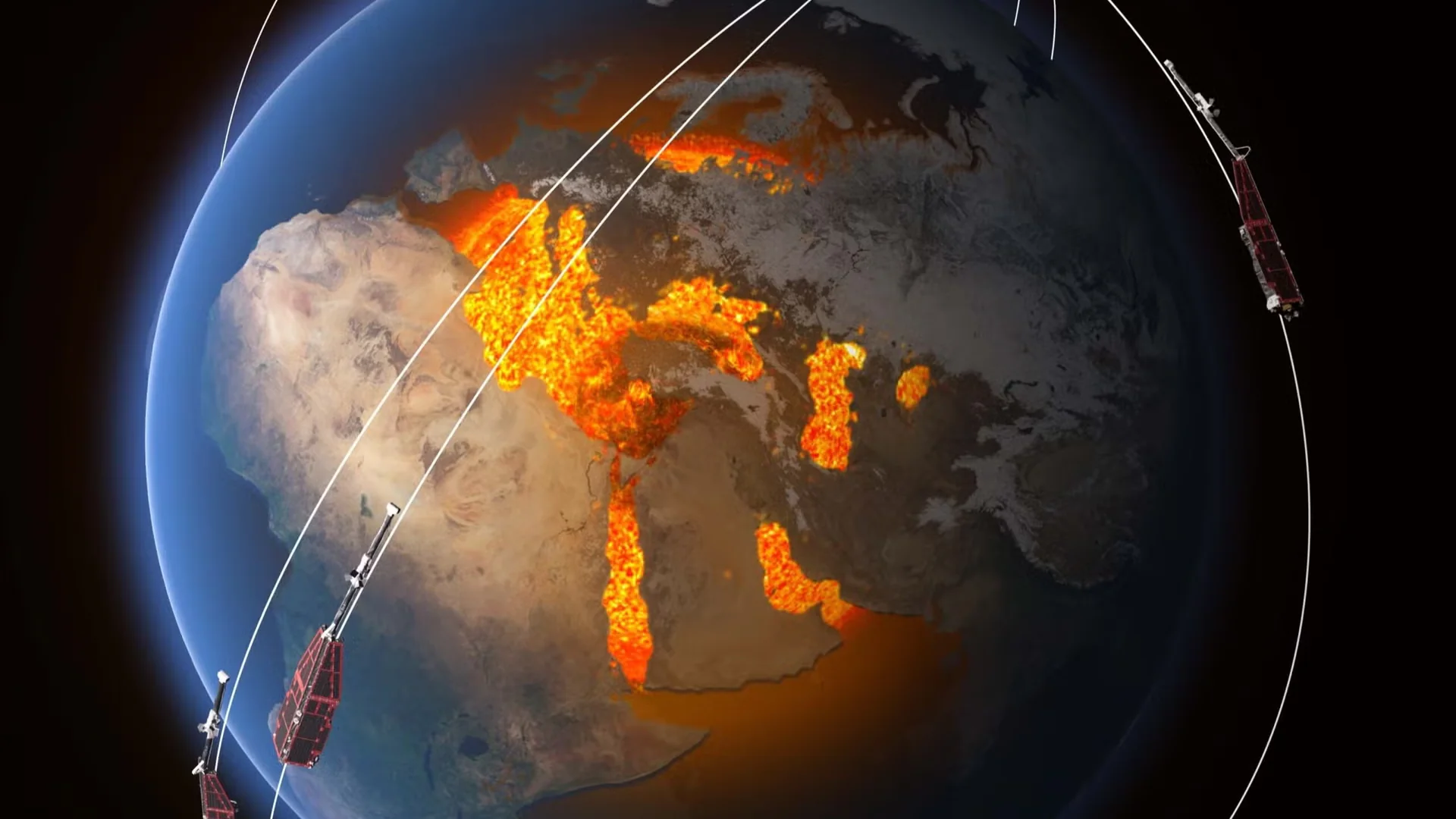
A peer-reviewed analysis of nearly three decades of satellite and ground magnetic-field data finds that a broad region of Earth's outer core beneath the equatorial Pacific abruptly switched from weak westward flow to strong eastward flow in 2010. The study, published in the Journal of Studies of Earth's Deep Interior, confirms the reversal happened — but stops short of explaining why.
Satellite and Ground Magnetic Data From 1997 to 2025 Pin the Reversal to 2010
Earth's outer core is a shell of liquid iron roughly 2,200 kilometers down. Its motion generates the planet's magnetic field, and small year-to-year changes in that field — the secular variation — let researchers work backward to estimate how the fluid is flowing at the core-mantle boundary, on the assumption that magnetic diffusion is negligible over periods shorter than a century. The research team, led by University of Edinburgh PhD candidate Frederik Dahl Madsen, combined ground-observatory records with data from four satellite missions — Denmark's Ørsted, Germany's CHAMP, and ESA's Swarm and CryoSat — covering 1997 through 2025.
For most of that record, core-surface flow trends westward, tied to a large planetary gyre that sits off-center from Earth's rotation axis and does not reach the equatorial Pacific. That pattern held until 2010, when the Pacific region broke from it: flow there flipped from weakly westward to strongly eastward, and by around 2012 the eastward flow was fully established.
Principal Component Analysis Separates the Steady Planetary Gyre From the Pacific Anomaly
To check whether the Pacific shift was a genuine, distinct feature of the flow field rather than an artifact of one model run, the authors ran a principal component analysis (PCA) on the flow models built from three separate modelling techniques. PCA reorders a complex, noisy signal into a small number of independent modes, ranked by how much of the total variation each one explains. Here, the first component — the long-standing westward gyre and its associated high-latitude jet — accounted for roughly 90 percent of all modelled flow variance across the 1997-2025 window. The second component isolated the Pacific overturn on its own. Together, the two components captured more than 99 percent of the total variance.
That split matters for how confident a reader should be in the result. It means the Pacific reversal is not a diffuse smear across many weak modes — it is concentrated almost entirely in one clean, separable signal, distinct from the background gyre. Flow models built from secular-variation inversion are not unique in principle; different assumptions about the core (frozen-flux, tangential geostrophy, and similar constraints) can produce different flow patterns from the same magnetic data. What strengthens this result is that the reversal shows up consistently across three independent modelling approaches, not just one.
The Eastward Surge Has Been Weakening Since 2020, and Researchers Don't Yet Know What Happens Next
The same models suggest the eastward flow beneath the Pacific has been losing strength since 2020, though the paper does not publish a dated numeric trajectory for that decline, so no chart is included here. Madsen said the finding "raises new questions about the behavior of Earth's deep interior," and the open question is whether the reversal was a short-lived fluctuation, part of a recurring oscillation, or the start of a new stable pattern in core circulation — something continued satellite monitoring should help settle. ESA Swarm mission scientist Elisabetta Iorfida, who was not part of the study team, described the result as evidence that "regional changes can emerge rapidly within just a decade," pushing back on the assumption that the outer core's large-scale circulation is close to fixed.
Timing Overlaps With Inner-Core Seismic and Length-of-Day Changes, but the Paper Treats It as a Hypothesis, Not a Cause
The paper does connect the Pacific reversal to other things happening deep inside Earth around the same period — a change in inner-core behavior inferred from geodesy and seismology, and disruptions to periodic length-of-day signals — but it is explicit that this is a hypothesis, not a demonstrated mechanism. The authors state they "hypothesise" that deep-interior changes triggered the flow shift, language that signals correlation in timing rather than proven causation. That distinction is the most important caveat in the study: a reversal beneath the Pacific is now well documented across independent models and nearly 30 years of data, but what caused it — and whether it connects to the planet's inner core at all — remains open.

Study Finds a 'Geometric Grammar' in 60,000-Year-Old Engraved Ostrich Eggshells
A PLOS ONE study of 1,275 engraved lines on Howiesons Poort ostrich eggshells finds 83.4% run parallel, with orthogonality the strongest structural signal.

A Cell-Inspired Nanoreactor Boosts Solar Hydrogen Peroxide Output by Relaying Protons Instead of Pumping Them
Chinese researchers built a hollow CdS@polydopamine nanoreactor whose catechol/quinone shell relays protons, lifting H2O2 photosynthesis to 3,238 μmol g⁻¹ h⁻¹.

Four Bones, 3,013 Screened: Confirming Tyrannosaurus rex Tooth Marks in a Wyoming Bonebed
A study of 3,013 Wyoming dinosaur bones found just 4 with tooth-mark spacing matching T. rex, after a CT scan ruled out a false crocodile-bite lead.

A 350-Study Review Questions Whether More Protein Really Means Healthier Aging
A Cell Press Blue review of 350+ studies ties lower protein intake to FGF21 activity and slower aging — but leucine findings still conflict.
Comments (0)
Please sign in to join the discussion.
No comments yet.
Be the first to share your perspective on this topic.