
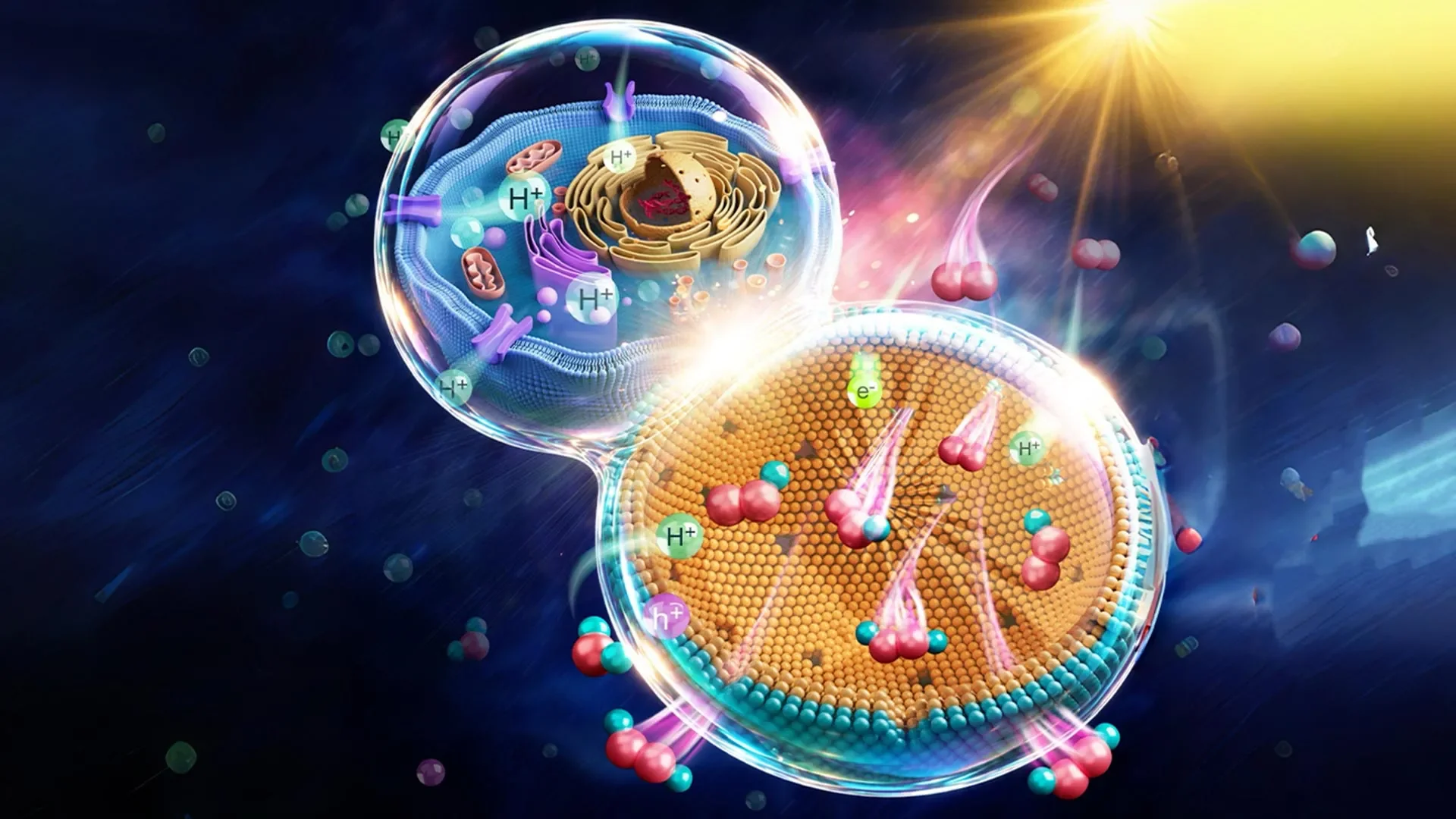
A hollow cadmium sulfide sphere wrapped in a thin polydopamine shell has produced hydrogen peroxide under visible light at a rate its developers say beats many previously reported photocatalysts, according to supporting data published alongside a new paper in the Journal of the American Chemical Society.
A shell built around an empty cavity, not a solid core
The catalyst starts as a solid silica sphere, gets coated in cadmium sulfide, then has that silica core dissolved away in sodium hydroxide, leaving a hollow CdS shell. A final step deposits a roughly 7-nanometer layer of polydopamine — the polymer behind the dark coating in mussel-adhesive research — onto that hollow shell to make the finished catalyst, referred to in the supporting information as hCdS@PDA.
Coating the hollow CdS in polydopamine measurably closes off some of its internal surface. BET analysis put the surface area at 56.9 square meters per gram for bare hollow CdS, dropping to 22.0 square meters per gram once the polydopamine shell was added, with pore volume falling from 0.17 to 0.12 cubic centimeters per gram over the same comparison. Losing surface area would normally be read as a step backward for a catalyst, since more surface generally means more reactive sites. The paper's proposed explanation is that the coated cavity instead behaves as a confined reaction chamber — trapping reactants and photons near the CdS core rather than letting them diffuse away — though the supporting information does not include a direct measurement isolating that confinement effect from the shell's chemistry.
A catechol-quinone switch, tracked with heavy hydrogen
The paper's central mechanistic claim is that a catechol/o-benzoquinone pair embedded in the polydopamine shell works as a proton relay — cycling between protonated and deprotonated forms to shuttle protons toward the reaction rather than storing or pumping them outright. To test where the reaction's protons actually came from, the authors ran the catalysis in heavy water (D2O) instead of ordinary water and measured the resulting hydrogen-to-deuterium ratio by NMR. That ratio climbed from 0.263 for polydopamine sitting in oxygen-free D2O in the dark, to 0.279 once oxygen was introduced, to 0.306 for the complete hCdS@PDA system under both oxygen and light. A separate solvent-swap experiment found H2O2 production continued largely unaffected in acetic acid but dropped sharply in acetonitrile, a solvent that cannot donate protons — pointing to water, not the organic solvent, as the proton source. Isotope-labeling with heavy oxygen (18O2) showed 81.4 percent of the oxygen recovered from decomposed H2O2 was the labeled 18O2 isotope, consistent with dissolved oxygen gas being the source of the peroxide's oxygen atoms.
Coating six unrelated materials to see whether the chemistry travels
To check whether the polydopamine shell's contribution is specific to CdS or transferable, the researchers applied the same coating procedure to six other photocatalyst substrates — a resorcinol-formaldehyde resin, an aminophenol-formaldehyde resin, bulk carbon nitride, titanium dioxide, and zinc-indium sulfide, among others. Measuring the mass gained after coating, the polydopamine loading landed in a fairly narrow band across every substrate: 14.4 weight percent on hollow CdS, down to 7.4 weight percent on carbon nitride, with the rest clustered between 10.7 and 12.2 weight percent. The supporting information describes color changes and smoother nanosheet edges after coating for each material, indicating the polymer deposits broadly rather than depending on a specific surface chemistry unique to CdS. The SI does not report H2O2 yields for these six coated control substrates, so this comparison speaks to the coating's generality, not to whether it improves performance on materials other than CdS.
Measuring up against a decade of reported H2O2 photocatalysts
The paper's own supporting information places hCdS@PDA's rate of 3,238 micromoles of H2O2 per gram of catalyst per hour, under light above 420 nanometers, alongside dozens of previously reported organic, inorganic and heterojunction photocatalysts compiled from the literature in a comparison table. Restricted to systems reporting output in a broadly similar range, hCdS@PDA's figure sits ahead of a cadmium sulfide nanorod system (2,974.7 micromoles per gram per hour), a resorcinol-based resin catalyst called RF-DHAQ-2 (1,820), a covalent organic framework labeled TPB-DMTP-COF (1,650), an iridium-linked framework called BTT-H3 (1,588), and a porphyrin-based system, SA-TCPP (1,150). The same table also lists several systems reporting far higher raw output — one above 60,000 micromoles per gram per hour — a reminder that headline yield numbers depend heavily on solvent, light source and measurement conditions, and are not directly comparable across studies without matching those variables. The paper also reports an apparent quantum efficiency of 11 percent at 420 nanometers and a solar-to-chemical conversion efficiency of 1.2 percent under simulated sunlight, both measured for hCdS@PDA in pure water.
The overall case the supporting data builds is cumulative rather than singular: lower surface area paired with higher yield, isotope tracers pointing to water and dissolved oxygen as the reactants' sources, a coating that behaves consistently across unrelated materials, and a yield figure that holds up against a comparable slice of prior literature. None of those threads by itself proves the "proton relay" framing the authors and their institution's press materials use, but together they describe a catalyst whose performance gains track more closely with its shell chemistry and confined geometry than with raw surface area — the variable that would normally be expected to dominate.
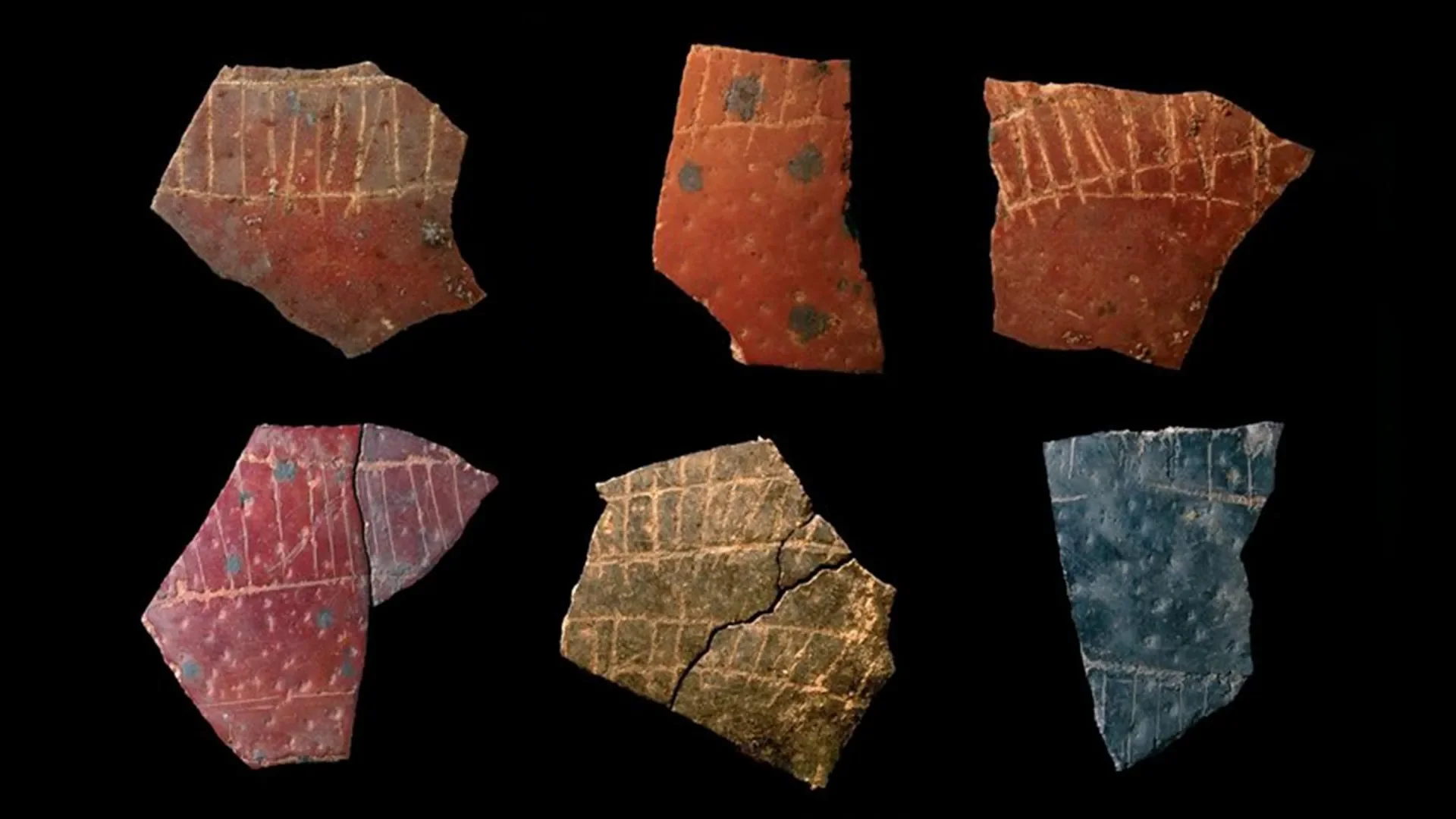
Study Finds a 'Geometric Grammar' in 60,000-Year-Old Engraved Ostrich Eggshells
A PLOS ONE study of 1,275 engraved lines on Howiesons Poort ostrich eggshells finds 83.4% run parallel, with orthogonality the strongest structural signal.

Earth's Molten Core Reversed Direction Beneath the Pacific in 2010 — and Scientists Still Don't Know Why
A new PCA study of 1997-2025 satellite and ground data confirms Earth's outer core flow beneath the Pacific flipped eastward in 2010.

Four Bones, 3,013 Screened: Confirming Tyrannosaurus rex Tooth Marks in a Wyoming Bonebed
A study of 3,013 Wyoming dinosaur bones found just 4 with tooth-mark spacing matching T. rex, after a CT scan ruled out a false crocodile-bite lead.

A 350-Study Review Questions Whether More Protein Really Means Healthier Aging
A Cell Press Blue review of 350+ studies ties lower protein intake to FGF21 activity and slower aging — but leucine findings still conflict.
Comments (0)
Please sign in to join the discussion.
No comments yet.
Be the first to share your perspective on this topic.