
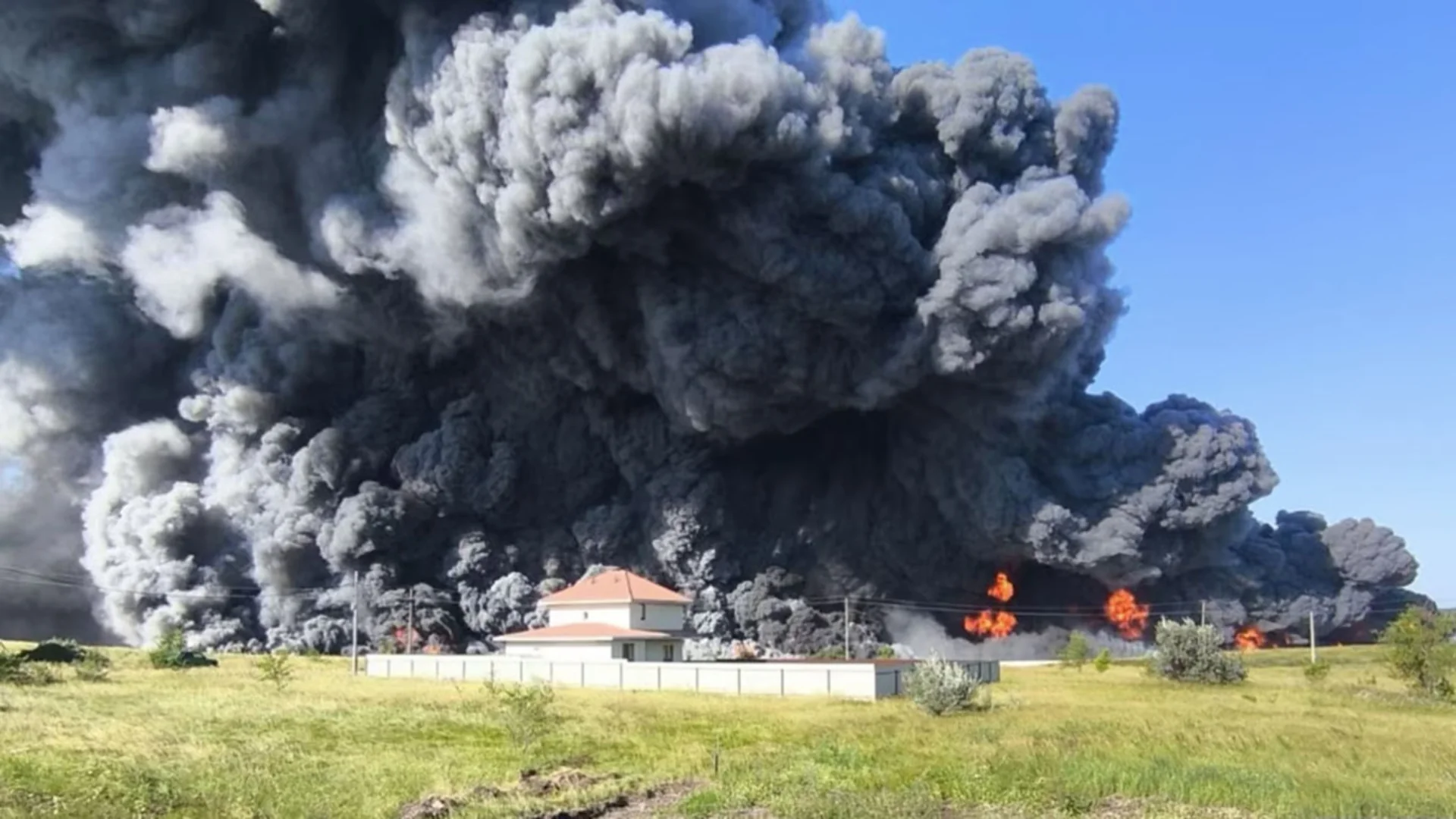
Since July 18, Ukrainian drones have struck Wildberries warehouses across Russia in near-nightly waves, and a Reuters review of satellite imagery now puts the damaged or destroyed storage space at more than 1.18 million square meters — over a fifth of the retailer's total capacity.
Ukraine's Drone Campaign Has Damaged More Than a Fifth of Wildberries' Warehouse Space
Wildberries, often described as Russia's Amazon, is one of the country's largest employers and runs a network of roughly 98,000 pick-up points across Russia and neighboring countries. Attacks on around 20 of its sites since mid-July have sparked major fires and disrupted logistics across the country's vast geography, and at least 13 people have been killed in the strikes. A separate tally cited by Ukrainian military sources put the toll at 16 of the company's 26 largest logistics hubs disabled, affecting more than 60% of its major distribution centers. Ukraine says the marketplace has supplied goods usable by the Russian military and frames the strikes as part of a wider effort to raise the cost of the war for ordinary Russians; Ukraine denies targeting civilians. Small operators are already feeling the effect: one Moscow franchisee running a Wildberries pick-up point told Reuters his sales have roughly halved over the past month because deliveries have all but stopped, and the business he once ran profitably is now losing money and up for sale.
The Seller-Payment Float That Turns a Sales Slump Into a Solvency Threat
Wildberries collects payment from a buyer the moment an order is placed but pays the seller only weeks later, and in the interim that money functions as the company's own working capital. The arrangement works as long as turnover keeps growing, because a steady stream of new buyer payments covers the older obligations coming due. Once turnover falls, as it has since deliveries were disrupted, new inflows stop covering expenses, the company starts posting losses, and payments to sellers fall further behind — which pushes sellers into their own cash problems. That structural feature is a key reason analysts at Russian business outlet The Bell, whose reporting was relayed by Meduza, expect the damage to outlast the physical rebuilding of any single warehouse.
The Bell's Estimates Put Company and Seller Losses in the Tens of Billions of Rubles
Market sources cited by The Bell put Wildberries' own direct losses from the strikes at more than 100 billion rubles, and as high as 200 billion rubles in a worst case — a figure inflated by the fact that the company itself owned roughly one in ten of the products listed on its platform. Damage to sellers from the warehouse strikes alone was separately estimated at 215 to 280 billion rubles as of early August, before accounting for attacks that have followed since. Both figures are market-source estimates rather than audited disclosures, and The Bell's sources said the plan for supporting the company remains unclear even though authorities are not expected to let it collapse. Separately, restoring the warehouses damaged in the campaign's earlier weeks was estimated in late July to cost up to 35.8 billion rubles, a bill insurers are unlikely to cover in full. Sberbank, Russia's largest lender, said in late July it may need to raise loan-loss provisions after the strikes weakened the credit quality of online retailers and vendors, with roughly 300 companies seeking to restructure loans. A source close to the Kremlin told Reuters the wave of financial strain would extend to small and mid-size businesses uninvolved in the war, warning bluntly, "there will be a wave of bankruptcies." Wildberries has responded by expanding discounts, granting sellers payment deferrals, and making initial voluntary compensation payments to more than 97,000 affected sellers, and it says it is seeking partners to open new storage hubs — even as the retailer's overall debt load, which had already surpassed 1.3 trillion rubles by the end of 2025, is expected to grow further. The strain sits within a broader slowdown in Russia's war economy that predates the Wildberries campaign but is now visibly compounded by it.
Aerial Strikes Have Rarely Turned Russians Against Their Own Government, Researchers Say
Whether the campaign advances Ukraine's broader goal of pressuring Moscow toward a ceasefire is contested. An anonymous Russian commentator writing in The Moscow Times — the outlet withholds bylines from Russia-based contributors because Russian law bars cooperation with the "undesirable" publication — argued that hitting civilian-facing businesses risks the opposite effect, citing research by political scientist Robert Pape suggesting that bombing campaigns against enemy territory have historically provoked resentment toward the attacker rather than uprisings against the targeted population's own leadership. The piece described Russians as tired and angry but conscious of their own powerlessness to change government policy, and warned that "bringing the war home" could deepen cynicism toward both sides rather than move the war closer to a resolution. The argument is a judgment about political psychology, not a measurable outcome, and it sits alongside the fact that Ukraine has continued to face large-scale Russian missile and drone barrages of its own — including an attack on the Kyiv region on August 5 that killed 17 people — even as Kyiv has accepted an unconditional ceasefire proposed by the United States and Moscow has not. That impasse is unfolding as Western-brokered peace efforts have stalled on other tracks, leaving both the military and economic pressure campaigns to run in parallel with no clear endpoint.

Could AI Create a "Permanent Underclass"? What the Data Actually Shows
Stanford payroll data show AI-exposed 22-25 year-olds losing jobs at 3.8% a year, while wages diverge by income. What that means for a 'permanent underclass.'


Netanyahu Rejects Trump-Backed Gaza Plan, Citing Disarmament Sequence
Israel's PM rejected the U.S.-backed 15-point Gaza plan Sunday, demanding Hamas disarm fully before any IDF withdrawal, deepening a sequencing standoff.


The Slow Squeeze: Three Systems Under Strain, Moving at Different Speeds
Atmospheric CO2 levels, East Asian demographic exhaustion, and the AI capital race are converging on different clocks. An examination of how climate limits, human reproduction, and state infrastructure face simultaneous systemic strain without a single coordinating hand.

UOB Sells UOBAM to Allianz Global Investors for S$555 Million
UOB Group has agreed to sell UOB Asset Management to Allianz Global Investors for S$555 million while keeping a long-term distribution tie for wealth clients.
Comments (0)
Please sign in to join the discussion.
No comments yet.
Be the first to share your perspective on this topic.