
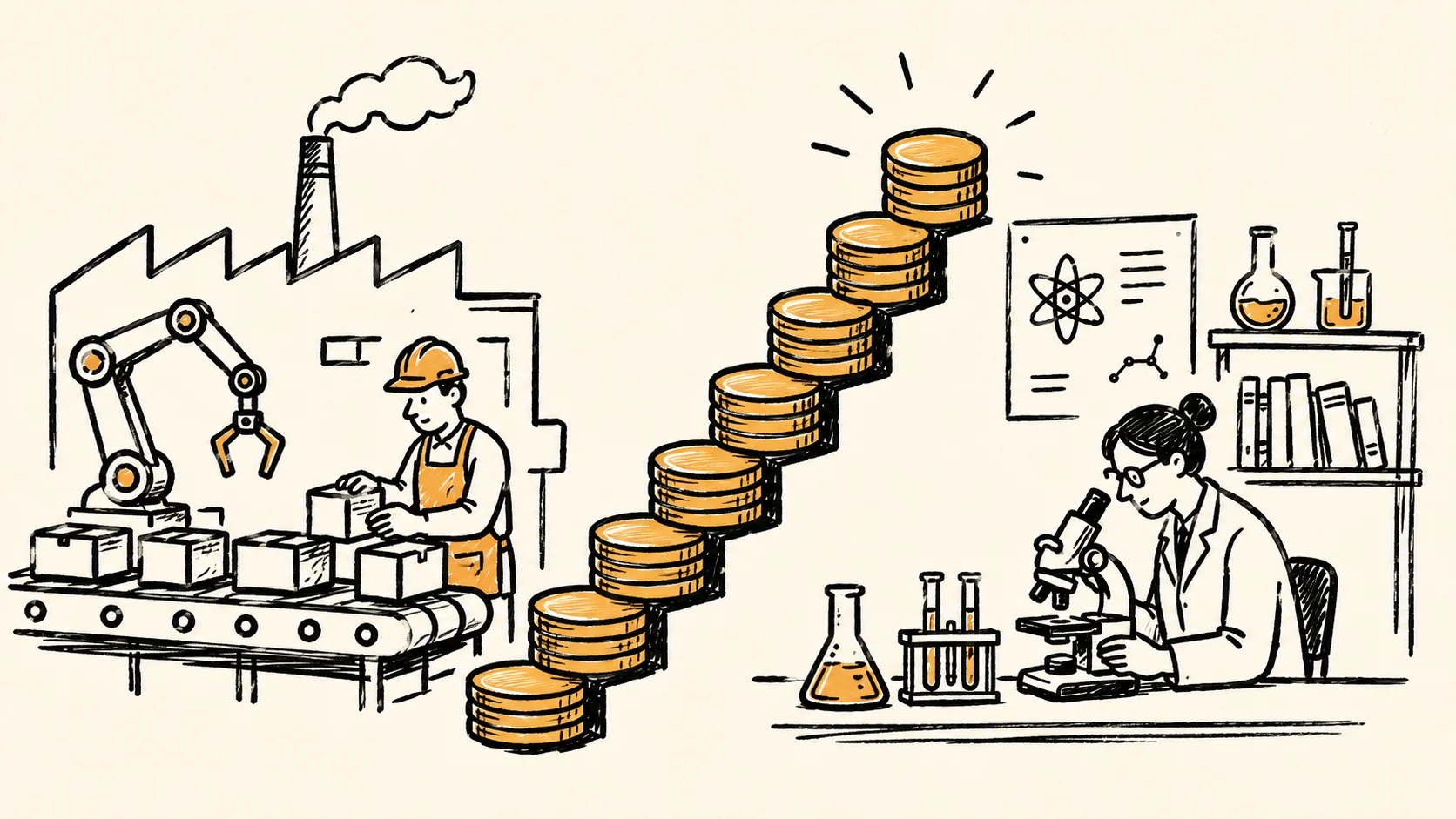
Getting a country from poor to middle-income is, historically, the easy part. Getting it from middle-income to rich is the part almost nobody manages.
What Getting Stuck at Middle Income Actually Looks Like
Picture a country's workforce the way you'd picture a graduating class. Early on, almost every student can get hired doing the same kind of work: assembly, stitching, basic construction — jobs that pay more than farming did, which is why the country's income climbs quickly at first. That's the easy stage. The problem shows up later, when wages have risen enough that the country is no longer the cheapest place to sew a shirt, but its workforce, universities, and institutions haven't yet produced the kind of higher-skill work — chip design, software, specialized manufacturing — that pays enough to keep incomes climbing. The country is now too expensive for the old jobs and not yet ready for the new ones. That gap is the middle-income trap.
The World Bank defines it using GNI per capita bands, and as of the most recent classification, roughly 75% of the world's population lives inside them.
Vietnam crossed into the lower-middle band in 2011. Its own stated target — reaching upper-middle status by 2030 — sits at the far edge of that same band.
Only 34 Economies Have Made the Jump Since the 1990s
The World Bank's _2024 World Development Report_ puts a hard number on how rare this transition is: since the 1990s, only 34 middle-income economies have reached high-income status. The other 108 have not. The report's own framing calls this a race against demographics, debt, and trade tensions that are all getting worse, not better.
The economies that made the jump mostly followed what the report calls the "3i strategy" — a sequence, not a single policy. Poor countries grow mainly by investing in basic infrastructure and factories. Once wages start rising, growth has to shift toward "infusion": importing and adapting technology and management practices that already exist elsewhere, rather than inventing them from scratch. Only in the final stage — upper-middle income — does a country need genuine innovation, meaning it starts pushing the technological frontier rather than following it.
South Korea is the report's headline example. Its per capita income went from about $1,200 in 1960 to roughly $33,000 by 2023 — a climb that Singapore, Hong Kong, and Taiwan made through a similar sequence of investment, then adopted technology, then homegrown innovation, each timed to the country's stage of development. Japan reached high-income status earlier still, through the same underlying pattern of moving up the value chain before wage costs closed the door on labor-intensive exports.
Notably, the Bank's own count of 108 includes major economies most people wouldn't think of as "stuck," including China, Brazil, Türkiye, and India — so the trap isn't a synonym for poverty. It's a synonym for a growth rate that has flattened out well short of rich-country levels. It's also worth flagging that this framing has real critics: some economists argue there's no distinct "trap" at all, pointing out that middle-income countries have grown faster than everyone else on average since the mid-1980s.
Where the Path Narrows for Vietnam
Vietnam is a useful case precisely because it has done the first stage well and is now hitting the harder second one. Three decades of roughly 6.5% average GDP growth, UNDP notes, lifted the country to lower-middle-income status while it was still exporting mostly garments, footwear, furniture, and electronics assembly — the "infusion" stage the World Bank describes, built on foreign investment and imported technology rather than homegrown innovation.
The strain shows up in the numbers UNDP cites on where Vietnam under-invests relative to the neighbors it's trying to catch up to. Public spending on higher education trails the world average by roughly ten percentage points and sits at about half the level of regional peers like Malaysia. Research and development spending tells the same story more sharply.
UNDP's own assessment is blunt about the mechanism: Vietnam has hundreds of public research institutes, but they're small, under-resourced, and lack clear performance targets, with weak links to both international and domestic private firms. That's a structural gap, not a talent gap — the same report praises Vietnam's literacy rates and secondary-education system as regional leaders. The bottleneck sits specifically at the tertiary and research level, which is exactly the layer the "innovation" stage of the 3i model depends on.
The Same Trap Shows Up in Individual Careers
The country-level pattern has an individual-level mirror. Just as a country can get stuck doing the same labor-intensive work indefinitely, a person can get stuck in the same routine, easily-replaced job indefinitely — not for lack of intelligence, but for the same structural reason: the jump to higher-value work requires deliberate investment in skills, networks, or capital that routine work doesn't generate on its own. Economic literacy — understanding how to price your own labor, when to specialize, when a credential actually changes your options — plays roughly the role that "infusion" plays for a country: it's the bridge between doing more of the same and doing something worth more.
This is visible in how younger workers in exactly this kind of economy are responding. The AI skills mismatch already showing up in Vietnam's youth job market is, in miniature, the national R&D gap: graduates with credentials that don't match the higher-value roles employers are trying to fill. It's also part of why a growing share of Gen Z say they'd rather found a company than take a job — building something new is one of the few individual paths that mimics a country's own "innovation" stage, rather than waiting for an employer to create the higher-value role first.
None of this makes escaping the trap — for a country or a person — a matter of working harder at the same job. Every economy that has made the jump did it by changing what kind of work its people were doing, not by doing more of the old kind. That's a slower, less comfortable strategy than it sounds, which is exactly why so few have managed it.

Trump's New 10%–12.5% Tariffs Take Effect on 60 Nations, Draw an Immediate Lawsuit
New Section 301 tariffs of 10%-12.5% hit 60 countries on July 24, replacing lapsed duties. Two small businesses sued hours later in U.S. trade court.

Inside the Fed's Growing Hawkish Camp as a July Rate Decision Looms
Dallas Fed's Logan is pushing for higher rates weeks after a weak June jobs report. Here's what's driving the split before the July 29-30 FOMC meeting.

Dallas Fed's Lorie Logan Becomes First Official to Call for a Rate Hike Under Warsh
Dallas Fed's Lorie Logan cites 3.4% core inflation and AI-driven demand to back a hike, splitting the FOMC ahead of its July 28–29 meeting.

UnitedHealth's Adjusted EPS of $6.38 Beats Estimates by 30% as It Sheds Members for Margin
UnitedHealth posted $6.38 adjusted EPS in Q2 2026, beating estimates by 30%, as medical costs eased to 86.7% and full-year guidance rose to $19.50–$20.00.
Comments (1)
Please sign in to join the discussion.
The key takeaway that surprised me most was how few countries (just 34) have actually made the leap from middle to high income since the 1990s. The core bottleneck usually isn't early-stage execution, but shifting from low-cost manufacturing to an R&D/innovation-driven economy.
I'd love to hear your thoughts — especially from those living in or observing economies currently navigating this transition. Does the "3i framework" (Investment, Infusion, Innovation) hold up from your perspective?