
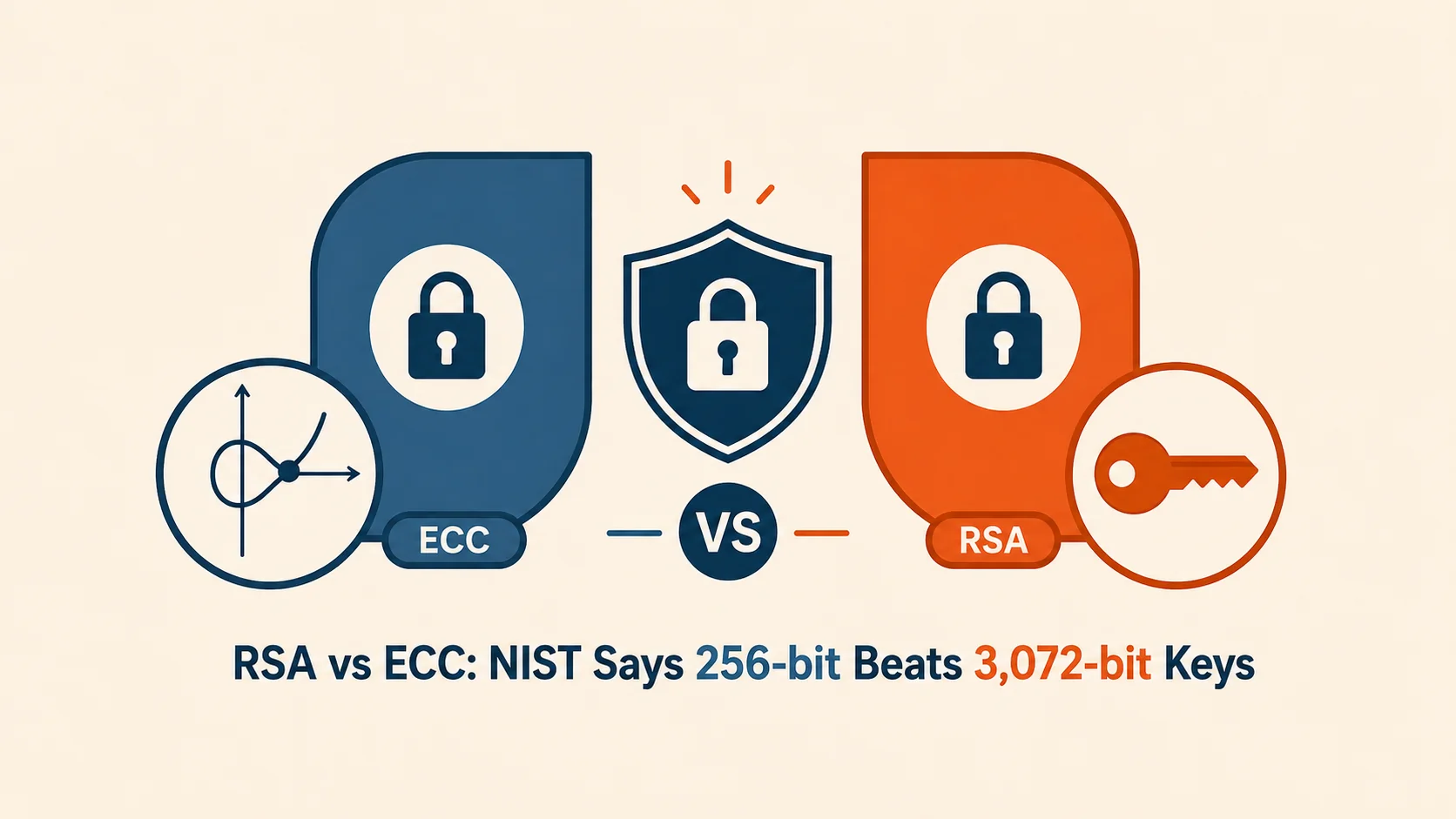
A 256-bit elliptic curve key and a 3,072-bit RSA key protect data to roughly the same standard, according to NIST's own comparison table. That twelvefold gap in length is not a rounding quirk. It comes from two different math problems, and it is why most new TLS certificates, messaging apps, and blockchains now default to elliptic curve cryptography (ECC) instead of RSA.
The Math Problem Each Algorithm Bets On
RSA's security rests on integer factorization: multiplying two large prime numbers is fast, but recovering those primes from their product is slow, even for a powerful computer. Public and private RSA keys are built from that asymmetry. Breaking an RSA key means factoring a very large number.
ECC rests on a different asymmetry, the elliptic curve discrete logarithm problem. Given a point on a curve and the result of multiplying it by a secret number, finding that secret number is computationally hard, far harder per bit than factoring is. That difference in hardness-per-bit is the entire reason ECC keys can be so much shorter than RSA keys while offering comparable protection.
Neither problem has a known efficient classical solution. Both are decades-old, peer-reviewed, and implemented in every major cryptographic library. The difference between them is not soundness. It is how much computational effort a given key length actually buys.
How NIST Measures 'Equivalent' Security
Security strength is not measured in raw key bits. It is measured in the number of operations an attacker needs to break the key, expressed as an equivalent symmetric-key strength. NIST Special Publication 800-57 Part 1 Revision 5 lays out the comparison directly: an RSA-2,048 key provides about 112 bits of security strength, matching a 224-bit ECC key. Move up to 128-bit strength, the level NIST expects new systems to target beyond 2030, and RSA needs 3,072 bits where ECC needs 256.
The gap does not stay constant. It widens every time the target strength goes up.
Reading the same table across all four rows shows the pattern clearly. Going from 112-bit to 256-bit strength multiplies the RSA key length by about 7.5 times, from 2,048 to 15,360 bits. The ECC key length over that same range grows by only about 2.3 times, from 224 to 521 bits. RSA's key-length cost scales much faster than its security gain; ECC's scales close to linearly. That divergence, not just the single 256-versus-3,072 comparison usually quoted, is what pushes systems planning for higher security margins toward ECC rather than a larger RSA key.
Why Servers Sign Faster With ECC
Shorter keys are not just a storage convenience. RSA's core operation is modular exponentiation on very large integers, and that computation gets slower as the integer grows. ECC's core operation, scalar multiplication on a curve, stays comparatively cheap even as the security target rises.
Cloudflare has published its own measurements of the gap. Its Keyless SSL documentation reports that a single core on a 3.0GHz Intel Xeon processor can perform over 10,000 ECDSA signing operations per second, against roughly 200 RSA signing operations per second on the same hardware. In an earlier benchmark, Cloudflare's engineering team found ECDSA signing more than 20 times faster than RSA-2048 even on an older, unoptimized cryptography library, before either algorithm had assembly-level speedups.
That throughput difference explains why Cloudflare, Google, and other large operators moved their default TLS certificates to ECDSA P-256 years ago. On a server handling hundreds of thousands of new connections a day, the signing operation is often the single most expensive step in a TLS handshake. Cutting its cost by an order of magnitude changes how many servers a given workload requires.
Where RSA Still Wins
None of this makes RSA obsolete. RSA has been deployed since the late 1970s, and every browser, operating system, and embedded TLS stack built since then understands it natively. ECC support is close to universal in modern software but still incomplete in older hardware, some payment terminals, and certain government and industrial systems built to older standards. Code signing, in particular, still leans on RSA because signed binaries can remain valid for a decade or more, and broad long-term tool compatibility matters more there than raw signing speed.
| Property | RSA | ECC |
|---|---|---|
| Hard problem | Integer factorization | Elliptic curve discrete logarithm |
| Key size at 128-bit security | 3,072 bits | 256 bits |
| Relative signing speed | Baseline | Roughly 20 to 50 times faster per Cloudflare's benchmarks |
| Compatibility | Universal, including legacy systems | Near-universal in current software, gaps in older hardware |
| Typical use today | Code signing, legacy PKI, some embedded systems | TLS certificates, SSH, Signal Protocol, Bitcoin and Ethereum signatures |
Systems that need both compatibility and performance commonly run a dual-certificate setup: an RSA certificate for older clients and an ECDSA certificate for everything else, with the server presenting whichever one the connecting client supports. Cloudflare, Amazon, and Google all use this model in production rather than picking one algorithm exclusively.
What Shor's Algorithm Means for Both
RSA and ECC share a weakness that neither algorithm can fix on its own. A sufficiently capable quantum computer running Shor's algorithm could solve both the factoring problem behind RSA and the discrete logarithm problem behind ECC, collapsing the advantage either one holds over the other today. Key length would not help; a quantum attack scales differently than a classical one.
NIST finalized its first three post-quantum cryptography standards, FIPS 203, FIPS 204, and FIPS 205, on August 13, 2024, with an effective date of August 14, 2024. FIPS 203 defines ML-KEM as a replacement for RSA and ECC key exchange, and FIPS 204 defines ML-DSA as a replacement for RSA and ECDSA signatures. Neither standard existed when most of today's TLS infrastructure, SSH keys, and code-signing certificates were issued, which means the current RSA-versus-ECC choice is a near-term decision, not a permanent one. A cryptographically relevant quantum computer capable of running Shor's algorithm at the necessary scale does not yet exist, and estimates of when one might vary widely across the research community. What is settled is the direction: organizations issuing long-lived certificates or embedding keys in hardware with a multi-year service life now have a documented target to migrate toward, rather than an open question about what comes after RSA and ECC.
Comments (0)
Please sign in to join the discussion.
No comments yet.
Be the first to share your perspective on this topic.