
When a downturn hits, the instinct is to save more. John Maynard Keynes named the flaw in that instinct the paradox of thrift: if every household cuts spending at the same time, the extra saving can disappear at the level of the whole economy, leaving total saving lower than when the cutting started.
The Mechanics: One Household's Saving Becomes Everyone's Income Loss
Keynes laid out the idea in his 1936 book, described on Wikipedia's paradox of thrift entry, arguing that recessions are driven by shortfalls in demand rather than by a lack of productive capacity. In that framework, saving is a leakage from the circular flow of spending: one person's expenditure is another person's income, so an economy-wide summary from the Corporate Finance Institute notes that a rise in the aggregate saving rate reduces consumption, which reduces the total output businesses can sell.
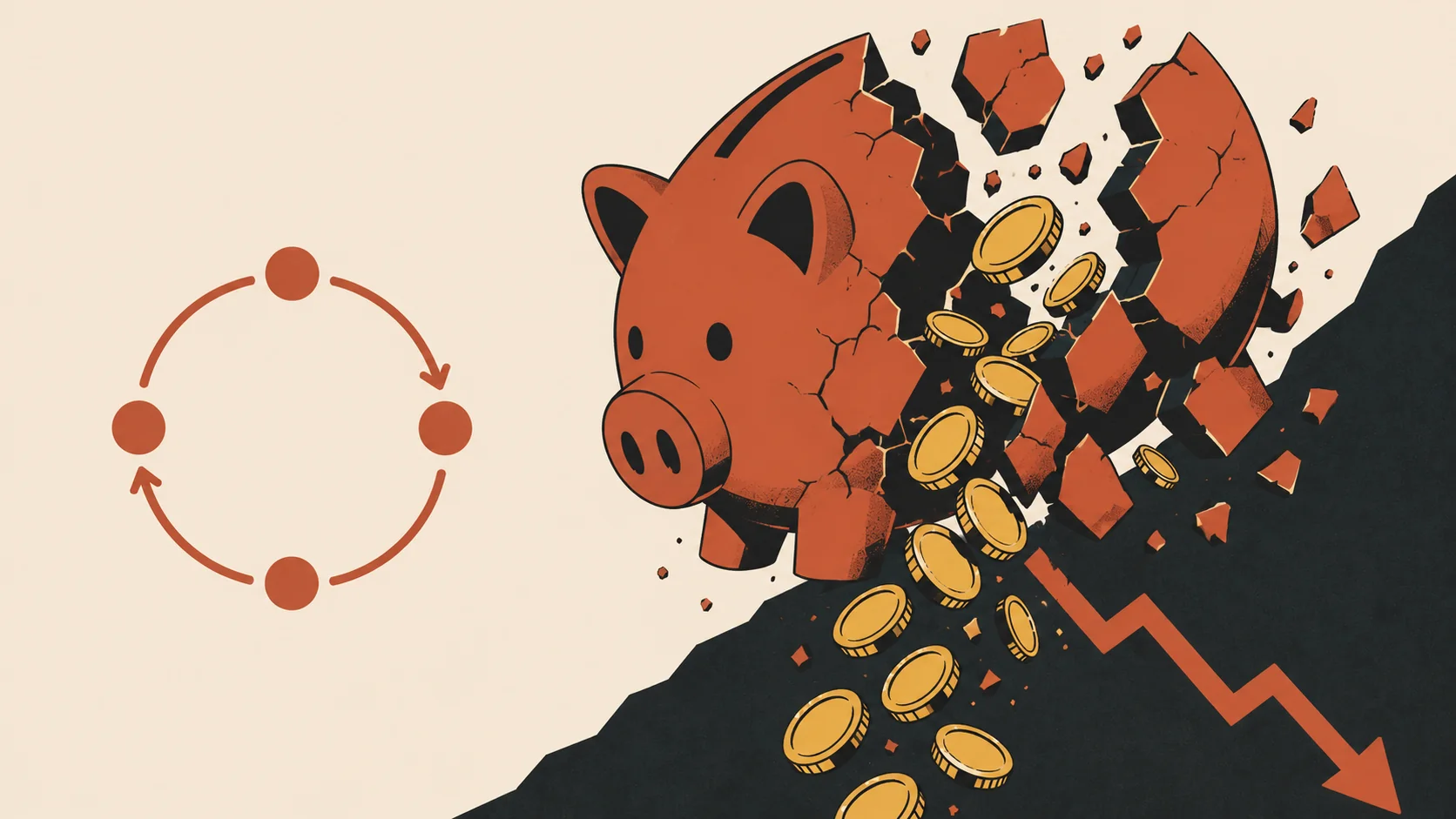
For a single household, saving more during uncertain times is sound. The paradox appears when the behavior scales. As spending falls, business revenue falls with it. As revenue falls, firms produce less and employ fewer people. As employment falls, household income falls economy-wide, including for households that never changed their own saving decision. The loop below traces that chain from the first decision to the final result.
Two Real U.S. Recessions Put the Theory to the Test
The paradox is a model, but the underlying saving behavior it describes shows up in actual data. Before the 2007-08 financial crisis, Britannica's account of the paradox puts the typical U.S. household saving rate at 2.9%. By 2011, with unemployment still high and the Federal Reserve cutting rates to encourage spending, that rate had risen to 5%, households pulling back even as policy pushed the other way.
The pandemic produced a far sharper version of the same pattern. The Kansas City Fed's research bulletin reports the saving rate at 7.2% in December 2019, then a record 33.7% in April 2020 as spending collapsed under lockdowns and stimulus checks landed at the same time. By October 2020 it had eased back to 13.6%, still roughly double its pre-pandemic level.
| Episode | Saving-rate move | Main driver | Where it stood most recently |
|---|---|---|---|
| 2007-09 recession | 2.9% to about 5% by 2011 | Job losses and tighter credit prompting precautionary saving | Rate normalized over several years |
| 2020 pandemic recession | 7.2% (Dec 2019) to 33.7% (Apr 2020) | Business closures plus stimulus payments arriving as spending options disappeared | Fell to 13.6% by Oct 2020, then kept declining |
Both episodes show the same signature: saving rises fastest exactly when the economy can least afford lower spending. Here is how that rate has actually moved since 2005, based on BEA's Personal Saving Rate series:
Where the Theory Breaks Down, and What the Current Numbers Add
The paradox of thrift is not accepted without dispute. A tutor2u analysis of the theory's critics points to arguments from economists including Friedrich Hayek: falling prices during a downturn can themselves revive demand, saving can fund investment through financial markets rather than sitting idle, and the model assumes a closed economy, so a country that can export its way out of weak domestic demand escapes the trap the paradox describes. The scale of saving needed to actually damage an economy is also disputed, critics argue real-world saving swings are often too small to trigger the full effect the theory predicts.
The current data point to a related, less-discussed wrinkle. The Congressional Research Service's household-saving brief puts the 2005-2024 average saving rate at 5.9%, with the rate down to 3.8% by December 2024. BEA's more recent monthly figures put it at just 3.0% in July 2026, below that 20-year average and a small fraction of the pandemic peak. That is not a data point any single cited source states as a conclusion: put next to each other, it means households have largely spent down the saving buffer the pandemic built up, leaving less of a cushion if a new downturn arrives and testing, again, whether the same collective instinct to pull back kicks in once income is actually at risk.
The Middle-Income Trap Has Two Growth Engines, and the Handoff Between Them Isn't Automatic
The middle-income trap isn't one problem: it's the handoff between labor-intensive growth and a knowledge economy, and automation is making it harder.

How the Dollar Left Gold Behind in 1971
In August 1971, Nixon ended the dollar's gold convertibility, closing Bretton Woods and starting the fiat-money era that still shapes inflation debates today.

Iran's Currency Crash Collides With a New Round of US Financial Sanctions
Iran's rial fell to 2.02 million per dollar as Treasury's Bessent unveiled sanctions on shipping, oil, gold and crypto tied to Tehran's trade network.
China Taps Its $28 Trillion Capital Markets to Fund an AI Race With the US
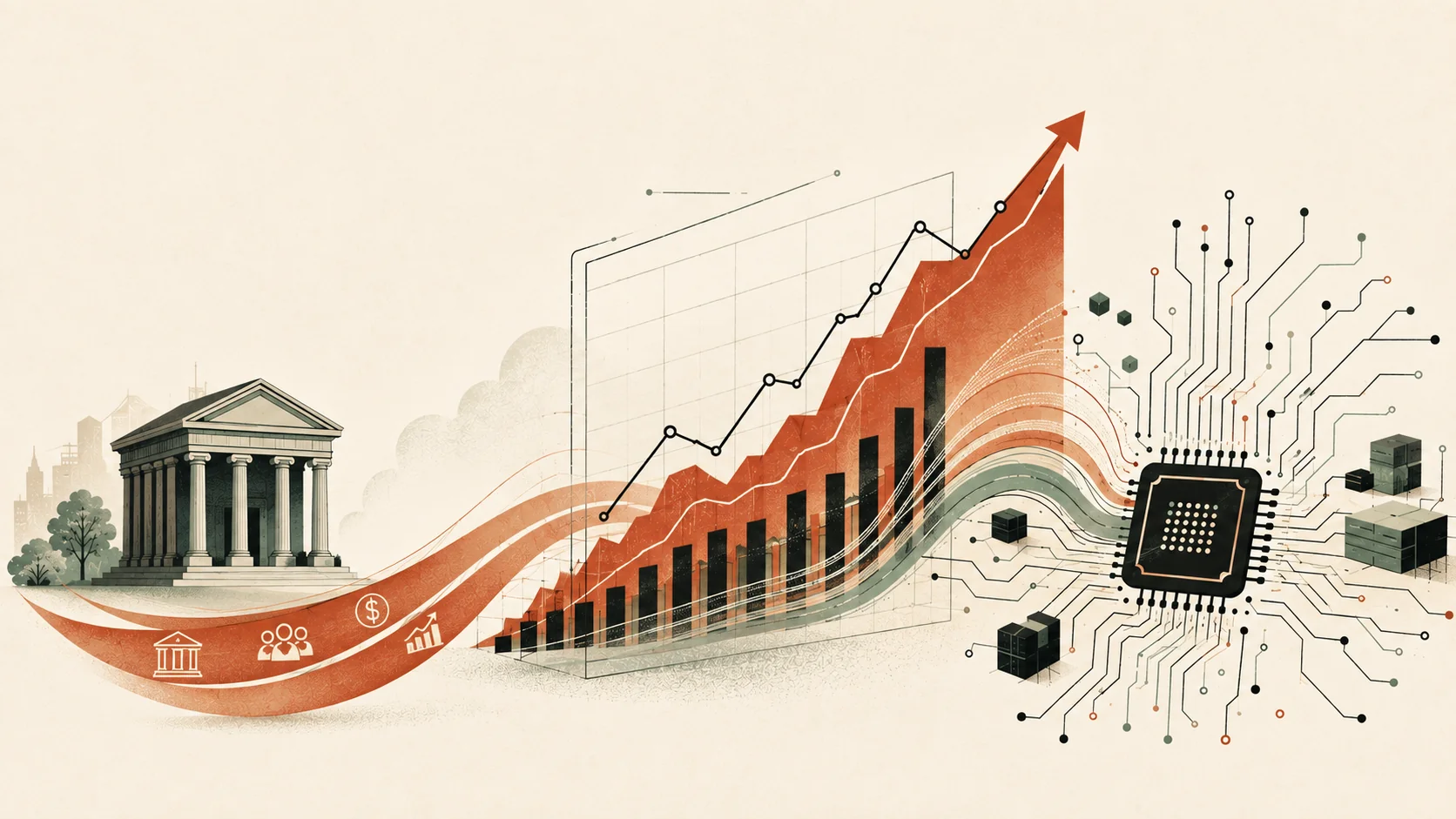
CXMT's 500%-plus Shanghai debut made it China's top listed firm, capping Beijing's shift from subsidies to stock and bond markets to fund its AI buildout.
Comments (0)
Please sign in to join the discussion.
No comments yet.
Be the first to share your perspective on this topic.