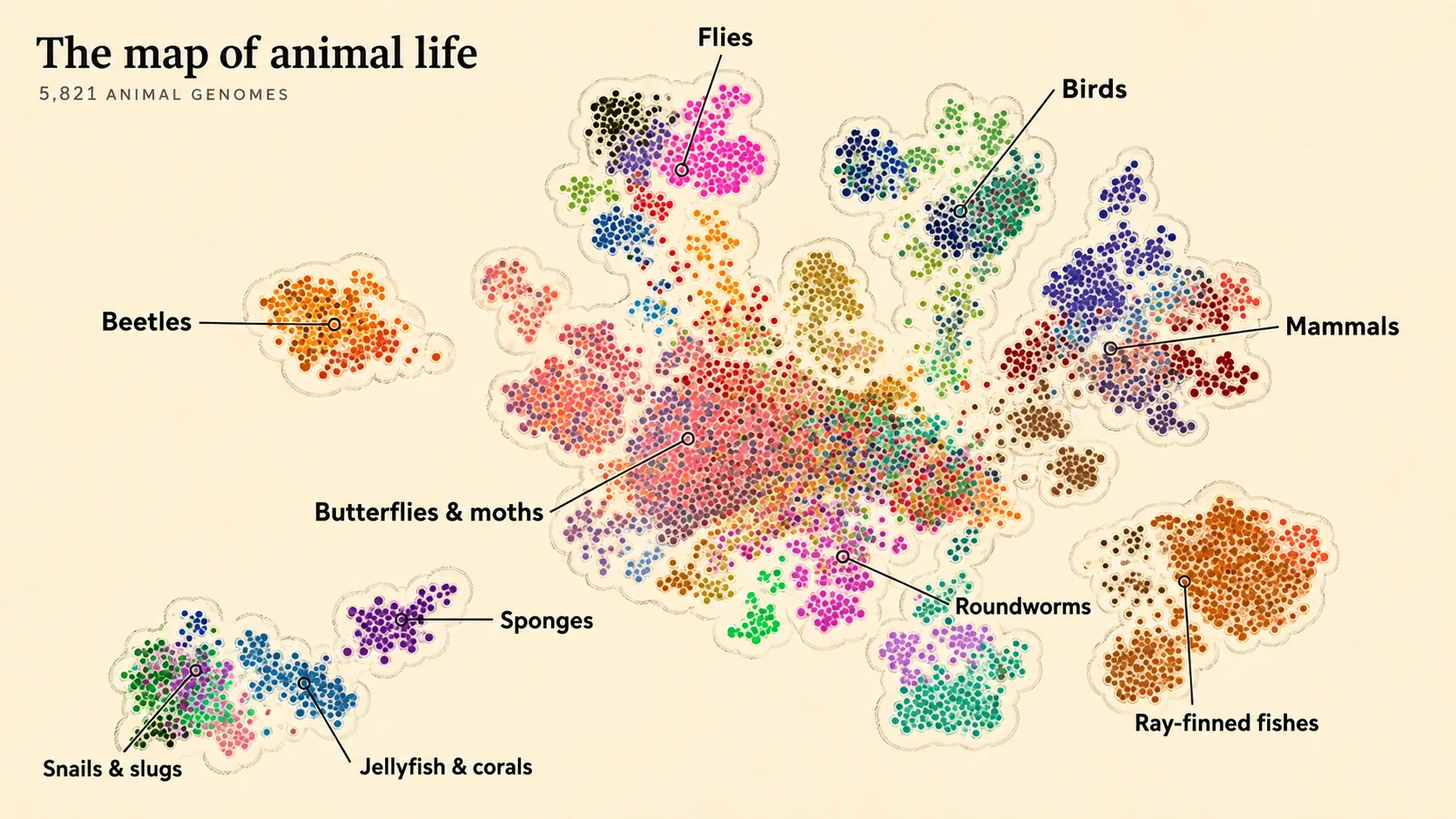
Every one of the 406 mathematically possible ways two ancestral animal chromosome fragments can fuse has now turned up somewhere in the animal kingdom. That is the headline finding from a comparison of 5,821 chromosome-scale genomes spanning 4,454 species and 19 animal phyla, published in Science Advances by a University of Vienna-led team headed by Darrin Schultz and Oleg Simakov.
How Fusion-With-Mixing Locks In a New Chromosome
The researchers call the underlying process fusion-with-mixing. When two ancestral chromosomes fuse, their genes do not simply sit side by side on the new chromosome. Repeated chromosomal inversions gradually shuffle genes from the two original chromosomes into a single, intermingled sequence over millions of years. Once that shuffling has run its course, the arrangement cannot be sorted back into its two starting pieces.
The team's earlier modeling put numbers on how fast this mixing happens. Direct measurements from four cephalopod genomes show inversion rates of 4.29 to 29.2 per million years, implying that a 1,000-gene chromosome would need roughly 34 to 233 million years to reach a fully shuffled state after fusion. Smaller chromosomes mix faster, since there are fewer genes to shuffle into place. That size dependence helps explain why some ancient fusions, such as the four small elements that combined into a single linkage group early in chordate evolution, remain only partly traceable in living animals today.
Because the mixing process cannot run in reverse, each fusion event becomes a durable marker of shared ancestry once it has gone to completion. The team has previously used this property to help resolve the sibling group to all other animals, and the new dataset extends the same logic across nearly the entire animal tree of life.
All 406 Ancestral Fusion Combinations Have Now Turned Up
To reach that conclusion, the researchers built a framework they call evolutionary genome topology, which projects the chromosome structure of thousands of genomes onto a single map rather than comparing genomes one pair at a time. Each of the 29 ancestral linkage groups present in the last common animal ancestor, which lived more than 600 million years ago, can combine with any other linkage group in 406 possible pairs. According to the study, the full dataset now contains evidence of all 406 pairings having occurred in at least one lineage, though the authors note that the combinatorial potential within a fused chromosome, as opposed to between chromosomes, remains far from exhausted.
The resulting map groups genomes by how mixed their chromosome architecture has become. Molluscs and cnidarians, whose chromosomes stay closest to the ancestral layout, cluster in one region of the map. Heavily rearranged lineages, including mosquitoes and their dipteran relatives, sit in isolated pockets near the edges. The University of Vienna singles out mosquitoes, glass sponges, and earthworms as examples of clades whose chromosome architecture has few close parallels among other animals, a pattern the researchers say could help flag lineages that warrant closer conservation attention.
Fusions Clustered Around the Cambrian Explosion
An earlier, open-access version of the analysis, posted to bioRxiv ahead of peer review, put numbers on when these fusions actually happened across deep time. Averaged across the animal tree, the rate of ancestral linkage-group fusions rose through the end-Ediacaran period and peaked near the start of the Cambrian at roughly one fusion every 8 million years. The rate then dropped and grew more variable, running at about one fusion every 32, plus or minus 16, million years from the end of the Cambrian through the close of the Mesozoic.
That preprint dataset covered 3,631 genomes from 2,291 species, smaller than the 5,821 genomes and 4,454 species analyzed in the published version, so the exact rate figures could shift once the larger dataset is fully reprocessed under the same method. The preprint also reported a correlation between fusion rates and species origination or extinction that ran in opposite directions in protostomes and in vertebrates, a discrepancy the authors attribute to different underlying mechanisms, such as population bottlenecks in one group and post-duplication rediploidization in the other, rather than a single universal driver. A correlation across million-year time bins does not establish that chromosome fusions caused any particular extinction or origination event.
The practical use the researchers propose is a shared coordinate system for comparing the fast-growing pile of chromosome-scale animal genomes, one that could help prioritize unusual lineages for deeper study and test whether chromosome rearrangements track shifts in gene regulation or development. Whether that promise holds will depend on extending the map to the many animal groups that still lack a chromosome-scale genome assembly altogether.
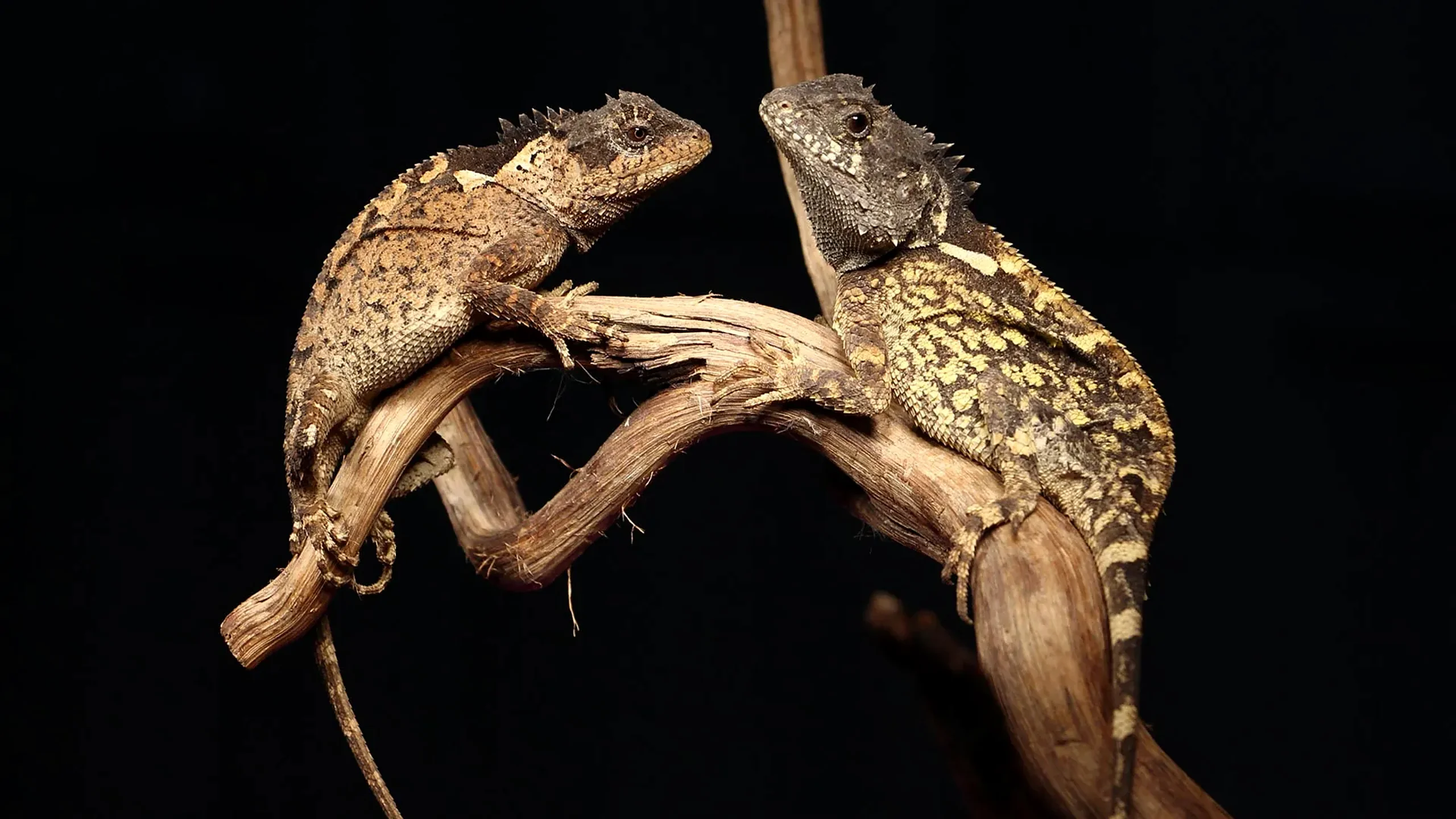
New Mountain Horned Dragon Species Discovered in Thailand, Named After House of the Dragon's Syrax
Researchers describe Acanthosaura syrax, a new Thai lizard found above 1,300 meters in Mae Wong forest, with COI distance up to 28% from its closest kin.
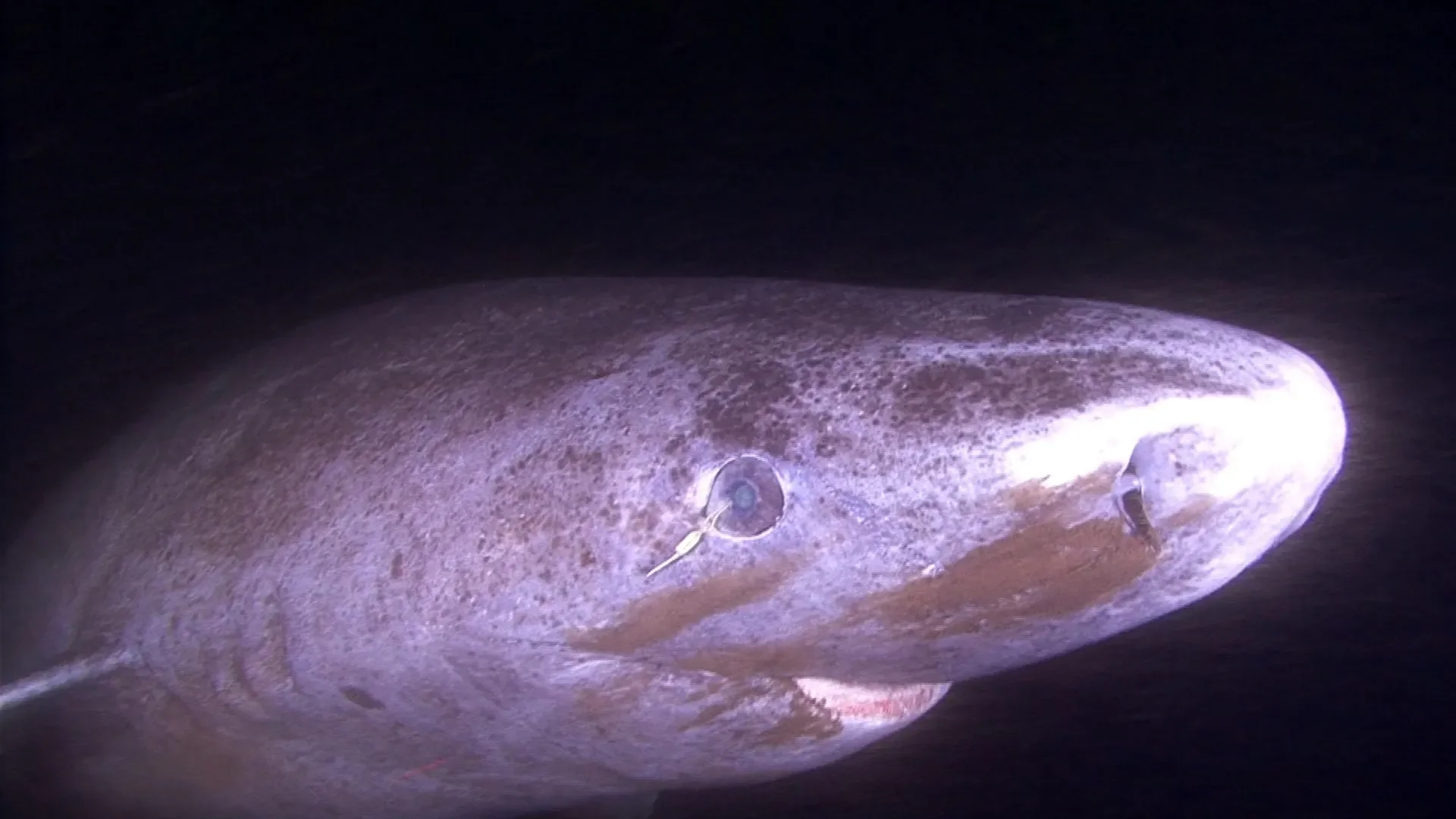
Greenland Sharks Keep Working Eyes for Centuries, New Study Finds
A Nature Communications study of century-old Greenland sharks finds intact retinas, working rod vision, and no visible sign of age-related eye decline.
Comments (0)
Please sign in to join the discussion.
No comments yet.
Be the first to share your perspective on this topic.