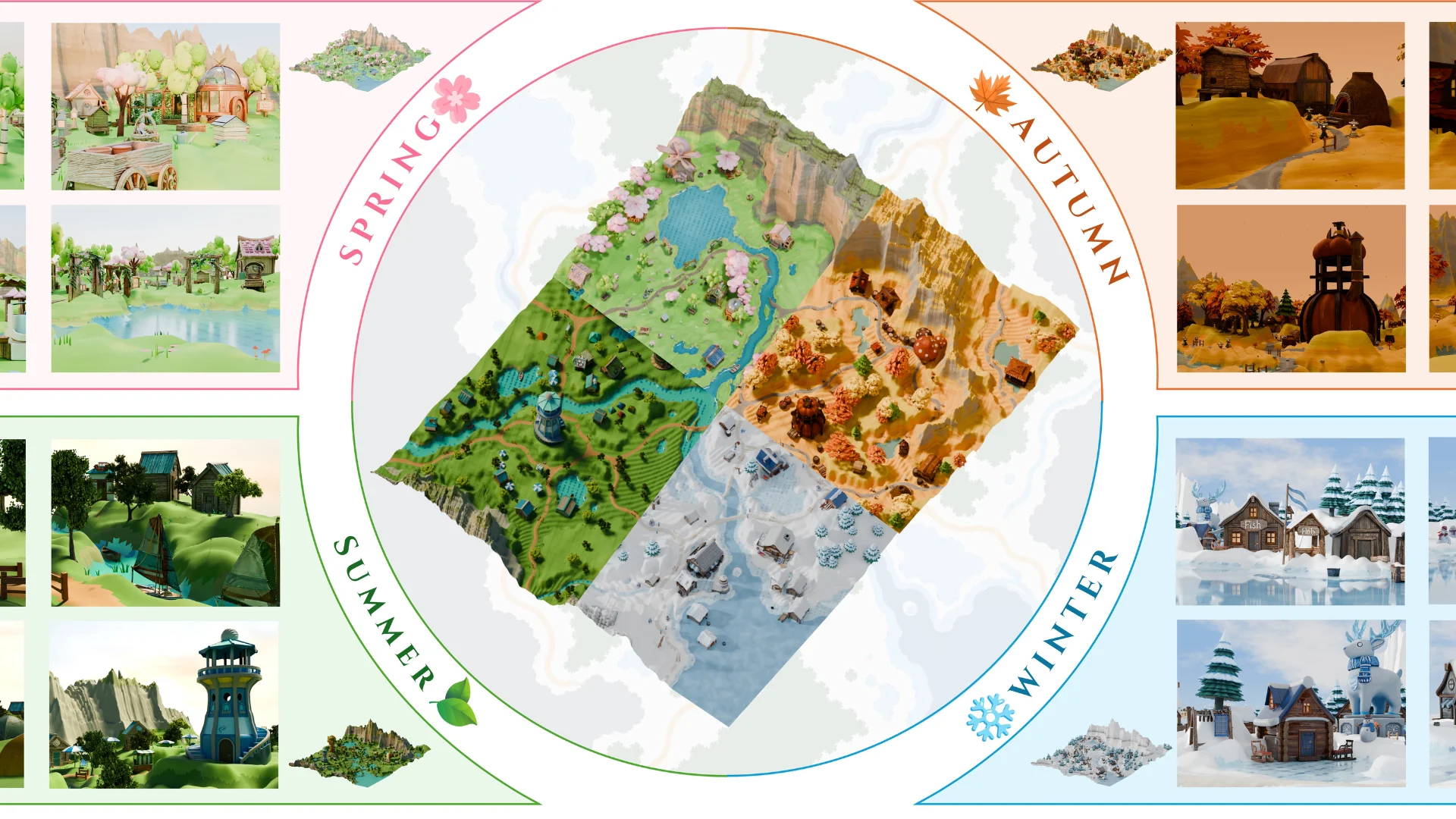
Tencent Hunyuan's WorldClaw paper describes a three-stage agent pipeline that turns a single open-ended prompt into a terrain-scale 3D world of independently editable objects, and includes a self-reported comparison against five other text-to-3D-world systems.
A Three-Agent Pipeline Moves From Scene Plan to Terrain to Object Placement
WorldClaw is described in the paper as a fully agentic, coarse-to-fine framework for generating open 3D worlds from a single prompt. The system runs three sequential stages rather than generating a scene in one pass. An intent analysis agent first extracts only the constraints a user actually specified, without inventing details. A separate scene planning agent then fills the remaining gaps and produces a structured scene specification covering regions, terrain, object categories, materials, and spatial relationships.
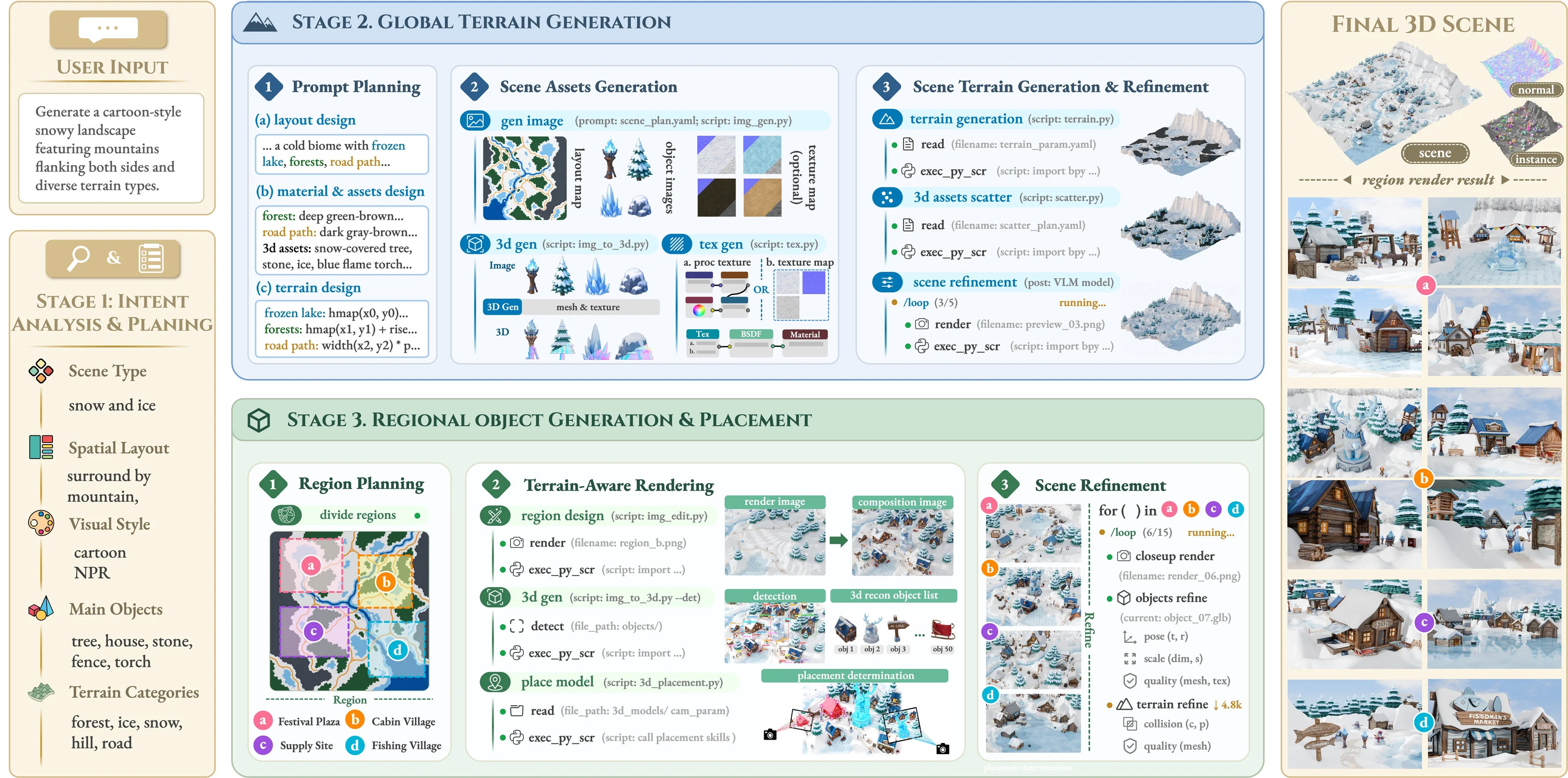
That specification feeds a terrain planning agent, which outputs numeric terrain parameters, a semantic layout map, and reusable 3D asset prototypes. WorldClaw builds an initial height field as a weighted composite of noise and geomorphic operators such as peaks, dunes, terraces, and erosion, then scatters assets according to regional density rules. A render-based refinement agent connects to Blender through BlenderMCP, an implementation of the Model Context Protocol, and inspects renders to fix boundary transitions, material scale, and asset placement before the world moves to the third stage.
SAM3 and SAM3D Extract Objects From a 2D Composition Image, Not Native 3D Diffusion
The paper's third stage is where WorldClaw's approach diverges most clearly from native 3D diffusion models. Rather than generating meshes directly in 3D, the system renders the terrain that already exists, generates a terrain-conditioned 2D composition image with an image-editing model, and then segments individual objects out of that flat image using text-guided SAM3. Each segmented object is reconstructed as a 3D mesh with SAM3D, its scale calibrated by matching image-space bounding boxes, and its 3D placement recovered by intersecting rays between the object-camera and terrain-camera coordinate systems.
A scene refinement agent then makes two passes. One corrects object pose, scale, and quality, optionally re-conditioning Hunyuan3D on the coarse mesh. The other corrects terrain-object contact problems such as floating, penetration, or unstable support, using local co-deformation and re-rendering after each edit until checks pass or an iteration budget runs out. It is a practical route around a hard problem: placing a 2D-plausible composition into a physically coherent 3D scene without a model that reasons about 3D geometry end to end. Tencent's earlier HunyuanWorld 1.0 release took a different route, warping 2D image and depth layers into meshes rather than segmenting and reconstructing individual objects, according to earlier third-party coverage of that release.
Tencent's Own Comparison Places WorldClaw Against Five Rival Systems on Three Axes
Section 3.3 of the paper's full text evaluates WorldClaw against five other text-to-3D-world systems, SynCity, Marble, MajutsuCity, WorldGen, and GPT-5.6 Sol acting as a coding agent, using a shared medieval-village prompt. This is a self-reported comparison run by the WorldClaw authors, not an independent benchmark, and the paper reports no numeric scores, only qualitative descriptions per method.
Those descriptions show a consistent pattern. Each prior method scores well on at most two of terrain organization, content richness, and free-viewpoint editability, and falls short on the third. Marble produces high per-view visual fidelity but has no explicit region-level terrain organization and does not expose independently controllable object assets. WorldGen, which the paper calls the baseline closest to WorldClaw on downstream usability, produces a coherent, traversable village with stable local structure, though its terrain stays relatively flat and content variation is limited. GPT-5.6 Sol, evaluated here as a coding agent assembling full 3D layouts, produces explicit and independently controllable geometry but relies on simple geometric primitives and repeated object shapes that the paper itself describes as blockout-like.
The Paper Discloses Dependence on Claude Opus 4.8, GPT-Image-2, and Hunyuan3D
The authors are direct about where the system currently breaks down. Section 5 of the paper states that current open-source LLMs often struggle to generate procedural terrain and material code that is both executable and consistent with the scene specification, and that open-source image models often fail to produce usable semantic layout maps or preserve object appearance and pose. Final scene quality is bounded by the underlying 3D generation backbone, Hunyuan3D, and the authors write that reliably validating the pipeline currently requires proprietary systems including Claude Opus 4.8, GPT-Image-2, and Hunyuan3D. Multiple stages depend on LLM-generated code for terrain and material construction, which the paper itself flags as a stability risk rather than a solved problem.
That dependency sits alongside a separate point worth flagging for anyone evaluating WorldClaw as a project to build on. The public GitHub repository currently contains only the Vite and React source behind the project's static web page, not an inference codebase or model weights, and shows 20 stars and no forks as of this writing. A commenter on a Hacker News discussion of the paper called the SAM3 and SAM3D-based object extraction the most interesting part of the pipeline, and described the rest as familiar procedural-content-generation-plus-agent territory, a characterization the paper's own related-work section, which cites Infinigen, xCube, BlockFusion, and MLLM-agent scene builders like Holodeck and SceneWeaver as prior approaches, does not really contest.
For context on the agent model itself, recent independent benchmark comparisons of Claude's Opus tier give some sense of what capability level WorldClaw's authors are currently building on top of.

Could AI Create a "Permanent Underclass"? What the Data Actually Shows
Stanford payroll data show AI-exposed 22-25 year-olds losing jobs at 3.8% a year, while wages diverge by income. What that means for a 'permanent underclass.'

Claude Opus 5 Edges Past Fable 5 on the Artificial Analysis Intelligence Index
Anthropic's Claude Opus 5 scored 61 on the Artificial Analysis Intelligence Index at launch, edging past Fable 5's 60 while cutting cost per task 26%.
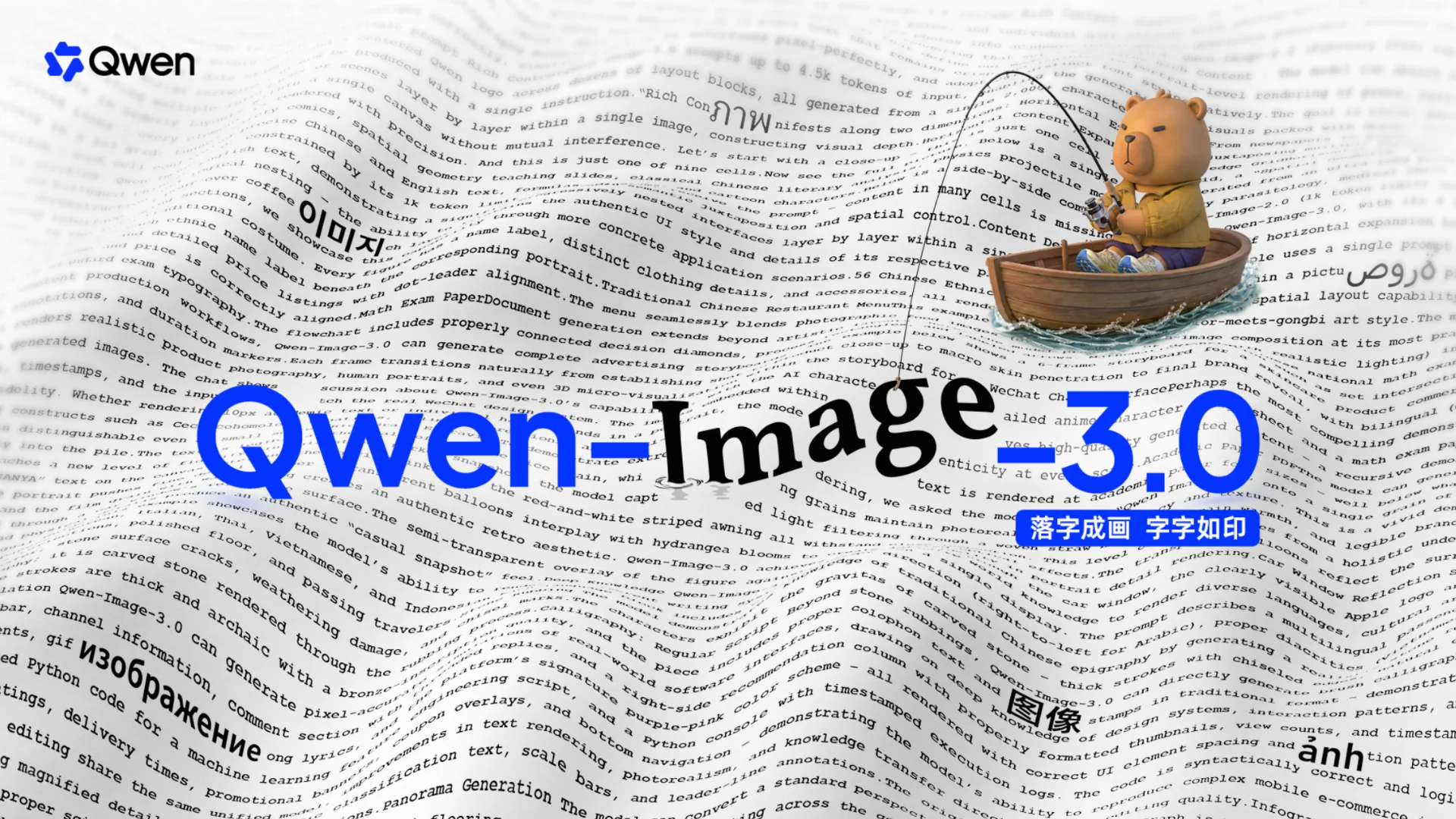
Qwen-Image-3.0 Claims 4.5K-Token Prompts, Ships No Benchmarks
Alibaba's Qwen-Image-3.0 accepts 4,500-token prompts, 4.5x its predecessor, but launched without a technical report, benchmark score, license, or weights.

Kimi K3 Debuts as the First Open 3-Trillion-Parameter Model, Trailing Fable 5 and GPT 5.6 Sol
Moonshot AI's Kimi K3 is the first open 2.8-trillion-parameter model, beating open rivals on benchmarks but trailing Claude Fable 5 and GPT 5.6 Sol overall.
Comments (0)
Please sign in to join the discussion.
No comments yet.
Be the first to share your perspective on this topic.