

Diamond has been treated as a non-piezoelectric material since the early 1900s. A team at the University of Hong Kong has now measured a stable voltage response from ultrathin polycrystalline diamond membranes as they bend, a signal that shouldn't exist under the century-old classification.
A Property Diamond Wasn't Supposed to Have
The result comes from a team led by Zhiqin Chu in HKU's Department of Electrical and Computer Engineering and Yuan Lin in its Department of Mechanical Engineering, published in a study in Science Advances. Bulk single-crystal diamond has a symmetric carbon lattice, and that symmetry is exactly why a century of materials science ruled it out as a piezoelectric candidate: a symmetric crystal has no preferred direction for internal charge to separate under strain, so mechanical deformation produces no net voltage.
The HKU group sidestepped that assumption by changing the geometry rather than the chemistry. Using a recently developed edge-exfoliation method, they produced polycrystalline diamond membranes thin and flexible enough to bend substantially, something a bulk diamond crystal cannot do without fracturing. Bending those membranes generated a stable, repeatable voltage. The team ran mechanical cycling tests under multiple controlled conditions specifically to rule out triboelectric artifacts from friction or contact, which is a standard failure mode for reported piezoelectric measurements on thin films, and the signal held up.
The effect turned out to depend on how thin the membrane was. Response peaked in membranes roughly 5 micrometers thick, where the team measured a piezoelectric voltage coefficient, denoted g33, of about 82.2 millivolt-meters per newton. That is the coefficient that governs how much voltage a material produces per unit of applied mechanical stress, the figure that matters for a self-powered sensor rather than for an actuator driven by an external voltage. Diamond has no established g33 baseline to improve on, since it was never classified as piezoelectric at all, but the measured value is worth placing next to materials that were built for this job.
The diamond membrane's coefficient clears dense PZT and a representative lead-free ceramic by roughly two to four times, which supports the paper's own framing that it surpasses many conventional piezoelectric materials. It still falls short of poled PVDF film, whose coefficient commonly runs from about 200 to 400 millivolt-meters per newton. Diamond's advantage was never going to be raw voltage output against a material optimized for exactly that; it is durability, chemical inertness, and biocompatibility that PVDF and PZT don't offer.
Grain Boundaries, Not the Diamond Lattice, Do the Work
A symmetric crystal cancels out internal polarization by definition, so the voltage had to be coming from somewhere the lattice isn't perfectly symmetric. The team's first-principles calculations point to the grain boundaries, the internal interfaces where individual diamond crystallites meet inside the polycrystalline membrane. Those boundaries break the local symmetry that keeps bulk single-crystal diamond electrically inert under strain.
According to the calculations, charge polarization accumulates at the grain boundaries as bending increases, and that accumulation creates a measurable potential difference between the membrane's top and bottom surfaces. The effect isn't a property of diamond's carbon lattice being quietly piezoelectric all along; it is a property of the boundaries between grains, present only because the membrane is polycrystalline rather than a single flawless crystal. That is also why membrane thickness matters: thinner membranes bend further under the same applied force, straining more grain boundaries more severely, up to the point where the roughly 5-micrometer thickness in this study maximized the measured response.
The Gap Between a Bent Membrane and a Working Device
The paper's own framing points toward energy harvesting, intelligent sensing, and wearable electronics, and the HKU release adds implantable medical devices to that list, citing diamond's biocompatibility, chemical stability, and non-toxicity as reasons a piezoelectric diamond membrane could serve as a self-generating power source or deformation sensor inside the body. Those are real properties diamond already has independent of this finding, which is why the application list is more than speculation.
What the study demonstrates is a repeatable voltage signal from a bent membrane under controlled lab conditions, measured with cycling tests designed to rule out artifacts. What it does not yet show is performance inside an actual device: the paper does not report long-term fatigue behavior across many thousands of bending cycles, nor how grain size and boundary density, which the mechanism identifies as the source of the effect, could be engineered to raise or tune the coefficient further. Those are the next steps between a laboratory measurement and a component an implant or a wearable sensor could actually use.
Diamond's non-piezoelectric classification held for more than a century because nobody had a reason to test it on a membrane thin enough to bend past its historical assumptions. This result doesn't overturn diamond's known mechanical and chemical properties. It adds one it wasn't supposed to have.
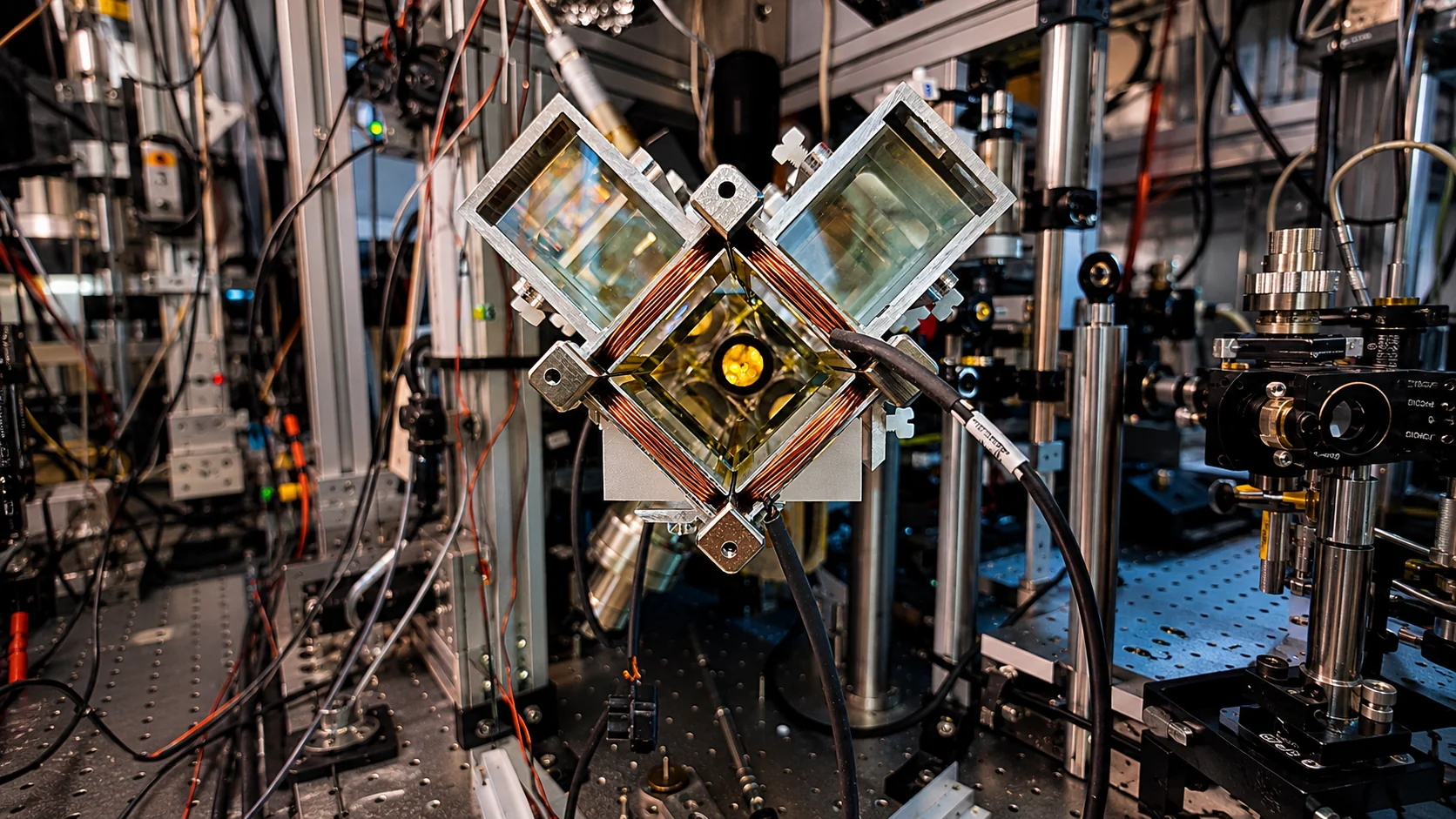
A Cold-Atom Interferometer Finally Measures the Quantum Phase of Free Fall
Physicists in Israel measured the quantum phase of a free-falling atom for the first time, confirming Einstein's equivalence principle in the quantum realm.

A Reshaped Pulse Could Cut Magnetic Memory's Switching Energy Nearly 100-Fold
Edinburgh physicists simulated optimal-control pulses that cut magnetic-memory switching energy from 91.2 to 0.94 nanojoules, still unverified in hardware.
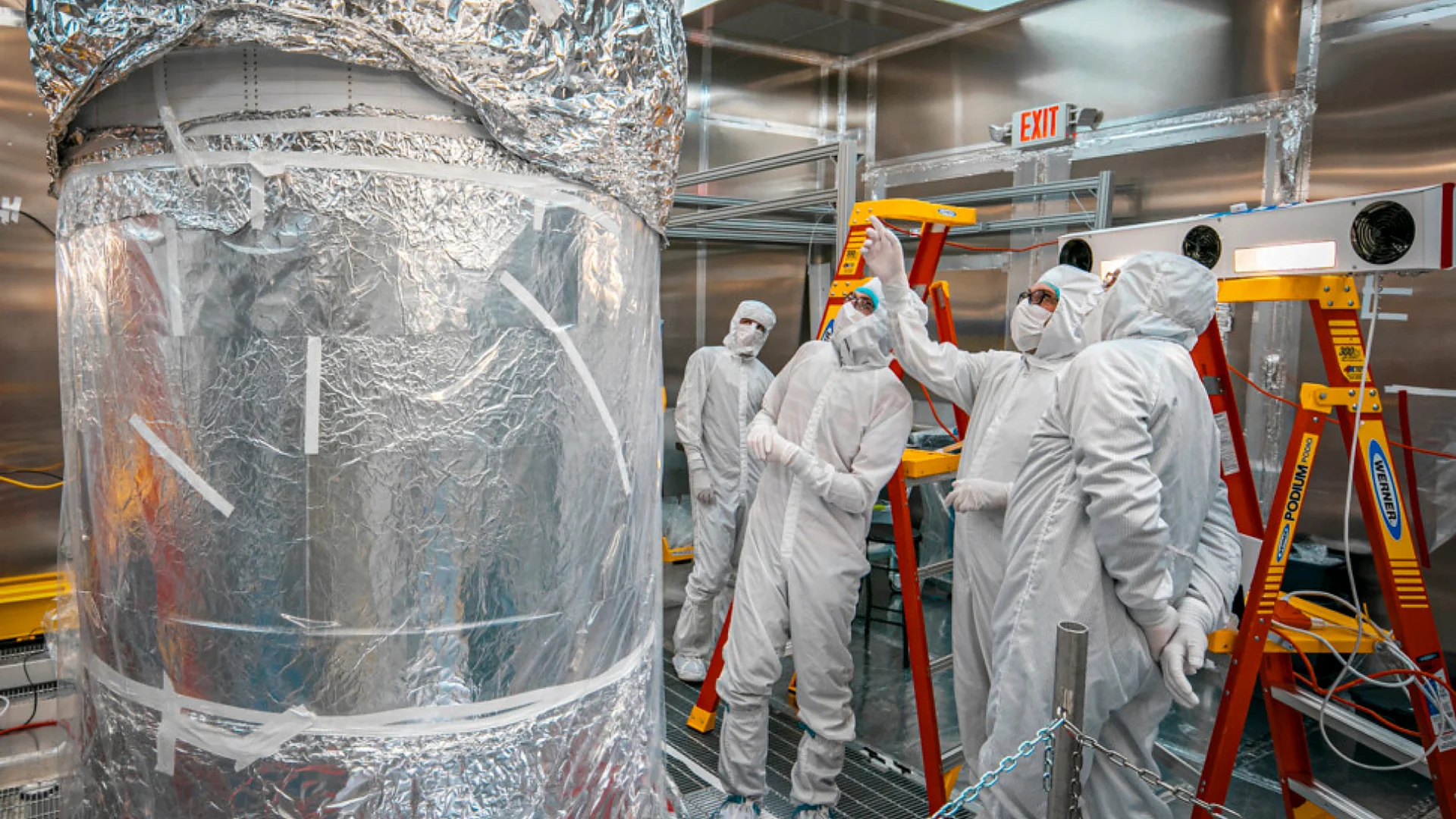
LUX-ZEPLIN's 248 keV Event: A Single Signal Reopens the Dark Matter Hunt
LUX-ZEPLIN recorded one 248 keV xenon recoil at 2.6σ global significance, its strongest dark matter hint yet, and theorists are already racing to explain it.
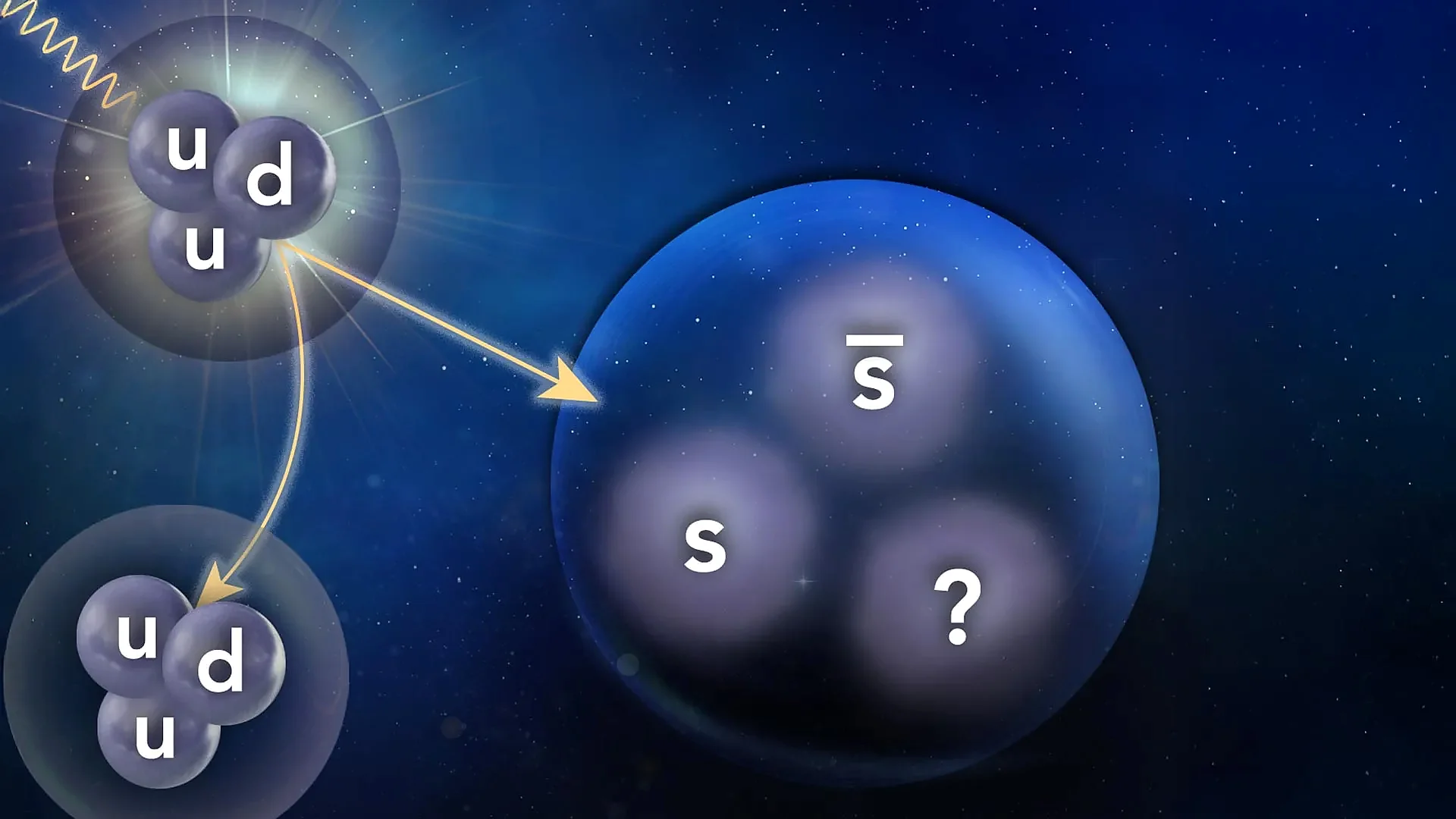
GlueX Searched for Y(2175) in Photoproduction and Found Two New Structures Instead
GlueX ran the first photoproduction search for Y(2175)/φ(2170); the state didn't appear, but two unexpected φπ+π− structures did, one at 5σ significance.
Comments (0)
Please sign in to join the discussion.
No comments yet.
Be the first to share your perspective on this topic.