
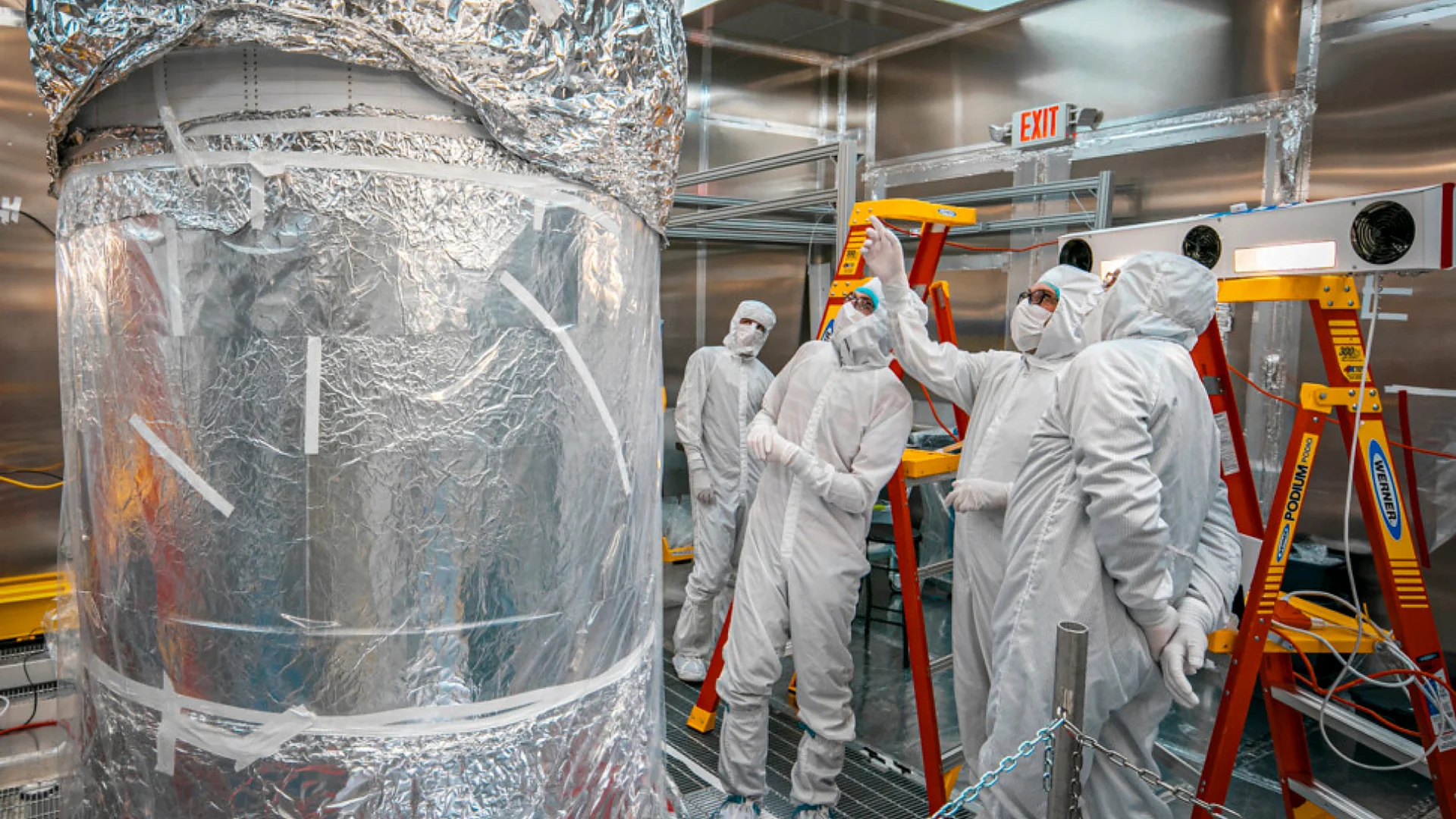
The LUX-ZEPLIN (LZ) collaboration has reported a single nuclear recoil event that its own background model struggles to explain. The event appears in a preprint posted to arXiv on September 2, 2026, describing a search through an extended recoil-energy window using 2.84 tonne-years of exposure in LZ's underground xenon detector. The collaboration is not calling it a discovery.
A 248 keV Recoil in a Region Where LZ Expected Almost Nothing
The event registered at 248 ± 23 (stat) ± 23 (sys) keV, inside a nuclear-recoil energy window LZ extended up to roughly 270 keV specifically to catch dark matter models whose recoil spectra push past the standard picture, including effective-field-theory and inelastic scattering scenarios. A profile likelihood ratio test found tension with the background-only hypothesis in the region where the event landed, a part of the detector's range where known background sources are expected to be rare.
LZ sits nearly a mile underground at the Sanford Underground Research Facility in Lead, South Dakota, shielded from cosmic rays by rock overburden. The experiment uses 10 tonnes of ultrapure liquid xenon and is run by an international team of roughly 250 scientists across 39 institutions, managed by the U.S. Department of Energy's Lawrence Berkeley National Laboratory. It has spent its operating life producing progressively tighter null results. This is a different kind of finding: not a smaller exclusion region, but one candidate event.
| LZ campaign | Exposure | What was reported |
|---|---|---|
| First published WIMP search (2022) | 60 live days, 5.5-tonne fiducial mass | Excluded spin-independent cross sections above 5.9×10⁻⁴⁸ cm² at 30 GeV/c², no candidate events |
| Combined WIMP search (2025, Phys. Rev. Lett. 135, 011802) | 4.2 tonne-years, 280 live days | World-leading exclusion above 2.2×10⁻⁴⁸ cm² at 40 GeV/c², no candidate events |
| Extended-window search (2026, arXiv:2609.02823) | 2.84 tonne-years | One 248 keV candidate event, 2.6σ global significance |
Read against that record, the shift is the headline. Years of increasingly stringent limits, each one a clean null result, are followed by a single event the collaboration says it cannot dismiss as ordinary background.
Why 3.4σ Local Significance Becomes 2.6σ Global
The paper's own statistics carry the caution built into the result. Testing the event against the best-supported interaction model gives a local significance of 3.4σ. Once the analysis accounts for the fact that it tested several different dark matter interaction models and recoil-energy hypotheses against the same single event, rather than one model chosen in advance, the significance drops to a global figure of 2.6σ.
That correction, known as the look-elsewhere effect, exists because checking many possibilities against one data point makes an ordinary coincidence more likely to look significant somewhere in the search. Physicists conventionally require 5σ before calling something a discovery. Neither number here reaches that bar, and the collaboration's presentation reflects that directly.
A Wave of Theoretical Interpretations Arrived Within Days
LZ spokesperson Rick Gaitskell, a physicist at Brown University, described the collaboration as intrigued by an event that landed where dark matter is expected and where competing backgrounds are low, while stressing that one event alone does not justify getting ahead of the data. The Department of Energy's account of the result and Brown University's release both frame the announcement the same way: worth sharing with the field, not worth claiming as detection.
Outside theorists reacted quickly. Independent physicists quoted in Science News' coverage of the reaction called it the most interesting development in recent memory while cautioning that a single event leaves the underlying explanation genuinely open. Within days, multiple preprints proposed different models to fit the same recoil energy: a Higgsino dark matter interpretation tied to electroweak interactions, outlined by Katherine Freese and a co-author; a fermionic dark matter absorption model predicting a roughly 247 MeV particle mass; an axion-portal pseudoscalar interaction; and a survey of which effective-field-theory operators could naturally produce a recoil this far out on the kinematic range LZ tested. None of these papers has independent experimental support beyond the same one event, and each depends on assumptions, such as the shape of the galactic dark matter halo's high-speed tail, that are themselves not fully settled.
What Would Actually Confirm or Kill This Signal
A real dark matter interaction, unlike an unmodeled background fluctuation, should leave other fingerprints as LZ keeps collecting data. Several of the new interpretations predict effects like annual modulation, a seasonal rise and fall in expected event rate tied to Earth's motion through the galaxy's dark matter halo, that a single event cannot establish or rule out. More exposure from LZ's ongoing run is the most direct near-term test.
Beyond that, a next-generation detector called XLZD, which would combine the LZ and XENON collaborations' expertise into a far larger xenon target, is designed to reach sensitivities well past what LZ can achieve alone. If the interaction behind the 248 keV event is real, a larger detector should eventually produce more of them at a rate the statistics can no longer wave off as a look-elsewhere artifact. Until then, the honest description of where things stand is the one LZ itself chose: an interesting result worth the field's attention, not a discovery.
A Cold-Atom Interferometer Finally Measures the Quantum Phase of Free Fall
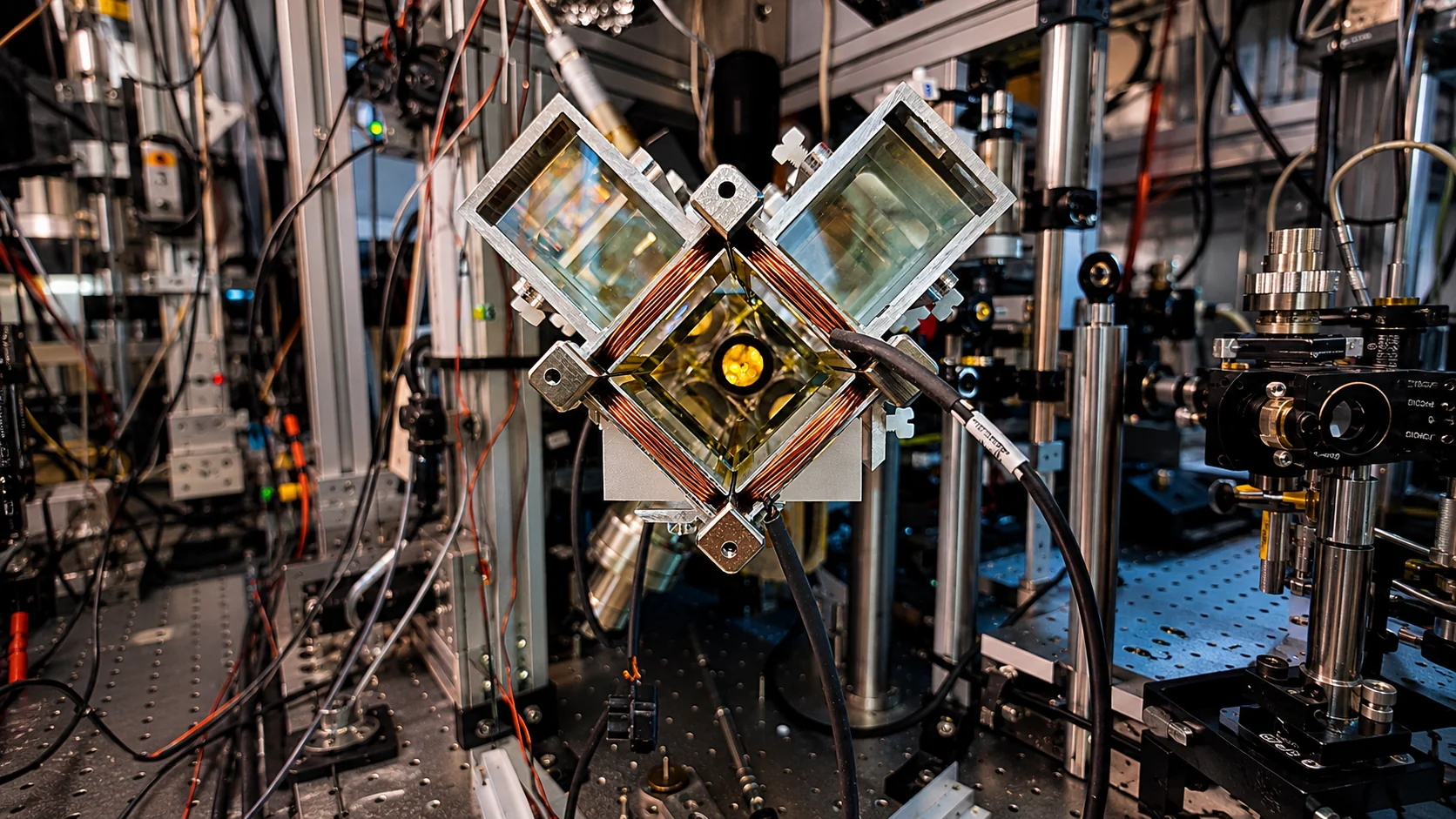
Physicists in Israel measured the quantum phase of a free-falling atom for the first time, confirming Einstein's equivalence principle in the quantum realm.

A Reshaped Pulse Could Cut Magnetic Memory's Switching Energy Nearly 100-Fold
Edinburgh physicists simulated optimal-control pulses that cut magnetic-memory switching energy from 91.2 to 0.94 nanojoules, still unverified in hardware.
GlueX Searched for Y(2175) in Photoproduction and Found Two New Structures Instead
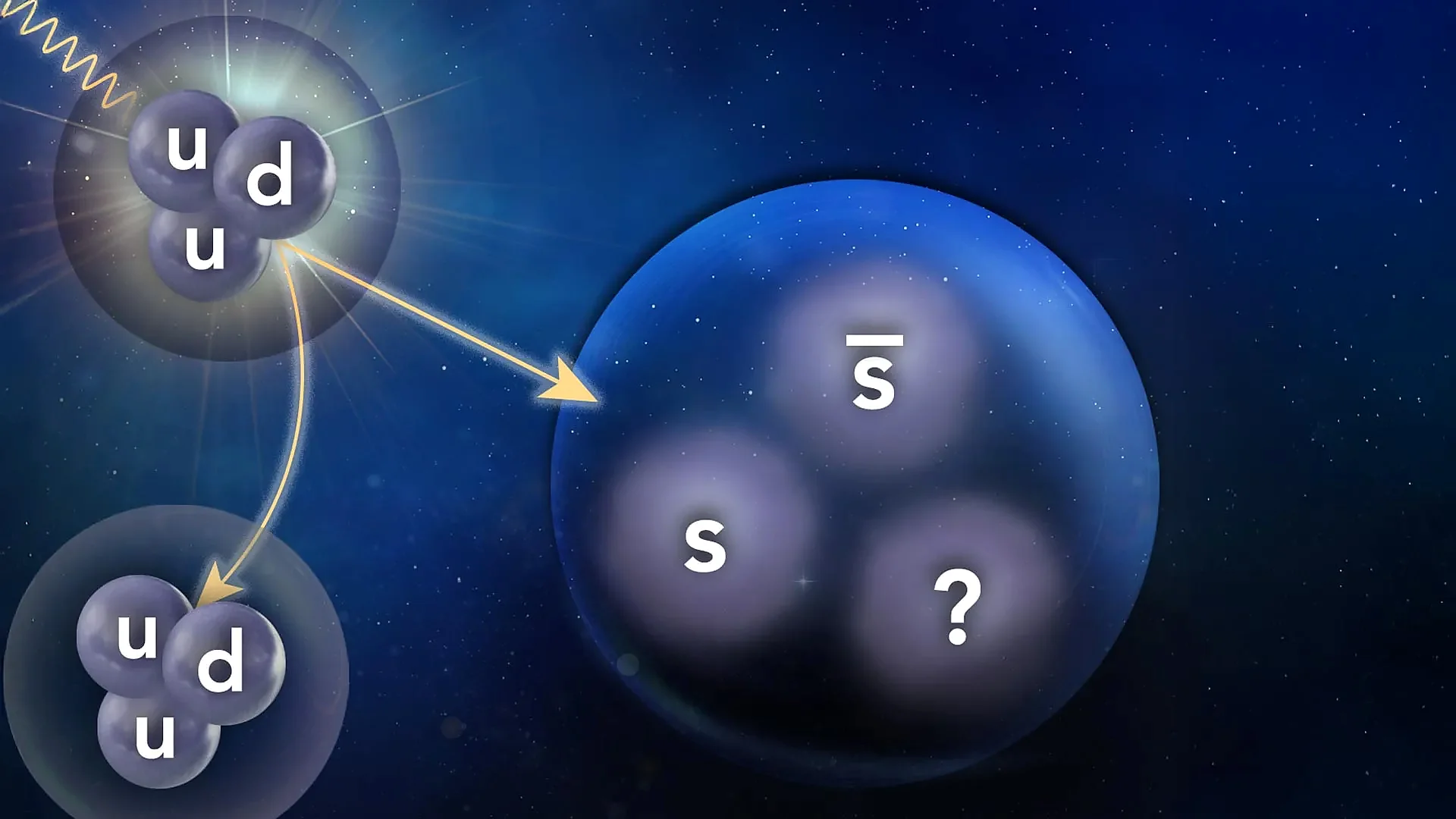
GlueX ran the first photoproduction search for Y(2175)/φ(2170); the state didn't appear, but two unexpected φπ+π− structures did, one at 5σ significance.

Inside IBM's 15-Minute Quantum Run That Comes With Its Own Fidelity Proof
IBM and UChicago ran a 70-qubit circuit in about 15 minutes and certified a 0.284 fidelity lower bound using quantum codes instead of trust assumptions.
Comments (0)
Please sign in to join the discussion.
No comments yet.
Be the first to share your perspective on this topic.