
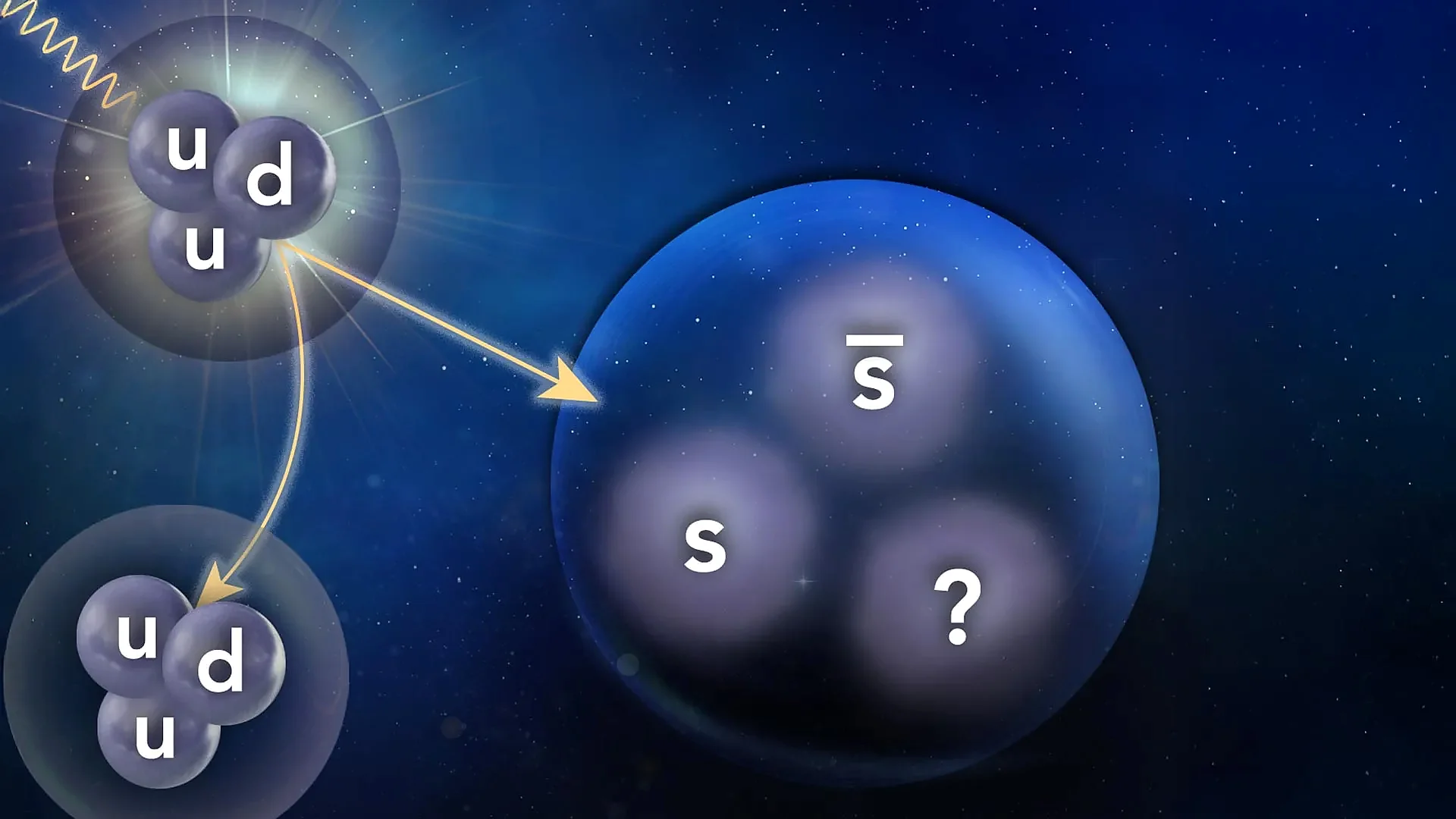
Physicists at Jefferson Lab set out to confirm a two-decade-old candidate exotic particle using a beam of photons instead of colliding electrons. The particle didn't show up. Two other structures did.
A Photon Beam's First Look at the φ(2170) Puzzle
Since 2006, four separate electron-positron collider experiments have reported a bump near 2.17 GeV in the mass spectrum of strange-quark final states. First seen by BaBar in initial-state radiation events, and later confirmed by BES, Belle, and BESIII, the state was originally labeled Y(2175) and has since been renamed φ(2170) by the Particle Data Group. Every one of those sightings came from e⁺e⁻ annihilation. No experiment had ever looked for it in photoproduction, where a high-energy photon strikes a proton directly.
The GlueX Collaboration at Jefferson Lab's Hall D closed that gap. Using the Continuous Electron Beam Accelerator Facility, GlueX converts an electron beam into a linearly polarized photon beam by passing it through a thin diamond wafer, then fires the photons at a liquid-hydrogen target. The analysis draws on 334 inverse picobarns of data collected across three run periods in 2017 and 2018, using photons with energies between 8.0 and 11.6 GeV, as reported in the peer-reviewed measurement.
Theoretical work had predicted that φ(2170) should appear in photoproduction with a cross section near 1 nanobarn at 8 GeV beam energy, though that estimate applies to a different decay channel, ηφ, than the one GlueX measured. The collaboration's own earlier work suggested a comparable or larger branching fraction into the φππ channel used here, which is why the group chose it.
Reconstructing φππ From 334 Inverse Picobarns
GlueX reconstructed the exclusive reaction γ+p→φ(1020)π⁺π⁻p by identifying its five-particle final state, K⁺K⁻π⁺π⁻p, and fitting it to a four-constraint kinematic hypothesis that enforces energy and momentum conservation. Events were required to carry a photon energy above 8 GeV and a squared momentum transfer below 1 GeV², cuts chosen to suppress contamination from baryon resonances on the target proton. A further cut on the π⁺p mass removed background from the Δ++ baryon, and a missing-mass-squared window confirmed each event was fully reconstructed with nothing left undetected, a selection chain laid out in full in the collaboration's open-access preprint.
The φ(1020) signal itself was extracted from the K⁺K⁻ mass spectrum using a sum of two Voigtian functions, a lineshape that combines the natural Breit-Wigner width of the resonance with the detector's Gaussian resolution. Reconstruction efficiency, determined bin by bin from simulated events, ranged from 4 to 6 percent across the φππ mass range studied. Background checks using simulated non-resonant events found no channel that mimics a φ(1020) peak, giving the collaboration confidence that the signal it fit was real.
With the φ(1020) yield extracted, GlueX measured the differential cross section as a function of the φπ⁺π⁻ invariant mass across 40 bins spanning 1.4 to 3.2 GeV, each 45 MeV wide. That spectrum, not a single cross section number, is what the search for φ(2170) was built on.
No φ(2170) at Its Cataloged Mass, But Two Other Bumps
Two peak-like structures stood out against an otherwise featureless background: one near 1.8 GeV, the other near 2.2 GeV. GlueX tested the higher-mass bump two different ways.
The first test fixed the structure's mass and width to the Particle Data Group's averaged values for φ(2170): 2163 plus or minus 7 MeV, with a width of 100 MeV. Under that assumption, the fit found a production cross section of 142 picobarns with a combined statistical and systematic uncertainty large enough that the signal reached only 1.9 to 2.0 standard deviations, well short of anything resembling a discovery. The fit quality was also poor, with a reduced chi-squared of 1.94, meaning the PDG lineshape simply does not describe the shape GlueX measured near 2.2 GeV. Because no significant signal emerged, the collaboration reports a 90-percent-confidence upper limit of 272 picobarns on φ(2170) production in this channel, the first such limit from any photoproduction experiment.
The second test swapped in a different set of resonance parameters, ones measured by BESIII in the K⁺K⁻ channel rather than the PDG average: a mass of 2239.2 MeV and a width of 139.8 MeV. Those values are quoted by the PDG in its writeup on φ(2170) but excluded from its official average because they come from a single measurement. With this input, the higher-mass structure resolved into a real signal, at a mass of 2.24 GeV and a statistical significance of about 5 standard deviations, the conventional threshold physicists use to call a result a discovery. Jefferson Lab's own announcement of the result refers to this structure informally as Y(2240). The lower-mass bump near 1.82 GeV, which the lab calls X(1830), reached roughly 3 standard deviations, short of discovery level but well above a statistical fluctuation.
How the New Masses Stack Up Against Two Decades of e⁺e⁻ Measurements
| Source | Mass (MeV/c²) | Width (MeV) | Production process |
|---|---|---|---|
| PDG average for φ(2170) | 2163 ± 7 | 100 (+31/−21) | e⁺e⁻ annihilation, combined |
| BESIII, K⁺K⁻ channel | 2239.2 ± 13.4 | 139.8 ± 24.0 | e⁺e⁻ → K⁺K⁻ |
| GlueX, this work | ≈2240 (2.24 GeV) | not quoted in the published abstract | γp → φ(1020)π⁺π⁻p |
No single one of GlueX's sources states this comparison outright; it comes from lining up the PDG's catalog entry against the BESIII measurement the PDG excluded from its own average, against GlueX's new photoproduction number. The pattern that emerges is specific: GlueX's structure sits close to the BESIII K⁺K⁻ value and far from the PDG average, in the same direction BESIII's own result already diverged from the rest of the field. A structure produced by a completely different mechanism, a photon striking a proton rather than two leptons annihilating, landing near the same outlier mass is a stronger hint that the K⁺K⁻ measurement, not the wider PDG average, better describes whatever is really there near 2.24 GeV.
Theorists have offered several competing pictures for what that object might be: a hybrid meson built from a strange quark-antiquark pair bound by excited gluon fields, a four-quark tetraquark made of two strange quarks and two strange antiquarks, a loosely bound baryon-antibaryon pair, a resonance built from φ(1020) and f₀(980) mesons sticking together, or simply a conventional but highly excited φ meson in the quark model's 3S or 2D states. None of those interpretations can be distinguished from a mass and width measurement alone. GSI physicist Klaus Goetzen, one of the paper's corresponding authors, noted that reconciling measurements across very different experiments is harder than it sounds, because states with similar masses may or may not be the same particle. Frank Nerling, his co-author, framed the broader moment plainly: nuclear physicists are again facing what he called "a zoo of so-called exotic states."
What GlueX Still Doesn't Know About the New Structures
Neither X(1830) nor Y(2240) has a measured spin or parity. The GlueX fits establish that something produces excess φπ⁺π⁻ events at those two masses, not what quantum numbers that something carries or which of the competing quark models, if any, describes it. Settling that will require an amplitude analysis that separates the angular distributions of the decay products, a more involved measurement than the mass-spectrum fit reported here.
The result also leaves φ(2170) itself unresolved as a photoproduction target. GlueX's 272-picobarn upper limit rules out production at the PDG's assumed lineshape at a meaningful level, but it does not rule out the state existing with the BESIII K⁺K⁻ parameters, since that is precisely the hypothesis the 5σ structure appears to support. William & Mary physicist Justin Stevens, the GlueX spokesperson, described the result as an opening rather than a conclusion for the collaboration's hadron spectroscopy program, pointing to additional GlueX data still waiting to be analyzed beyond the 2017–2018 run periods used here.
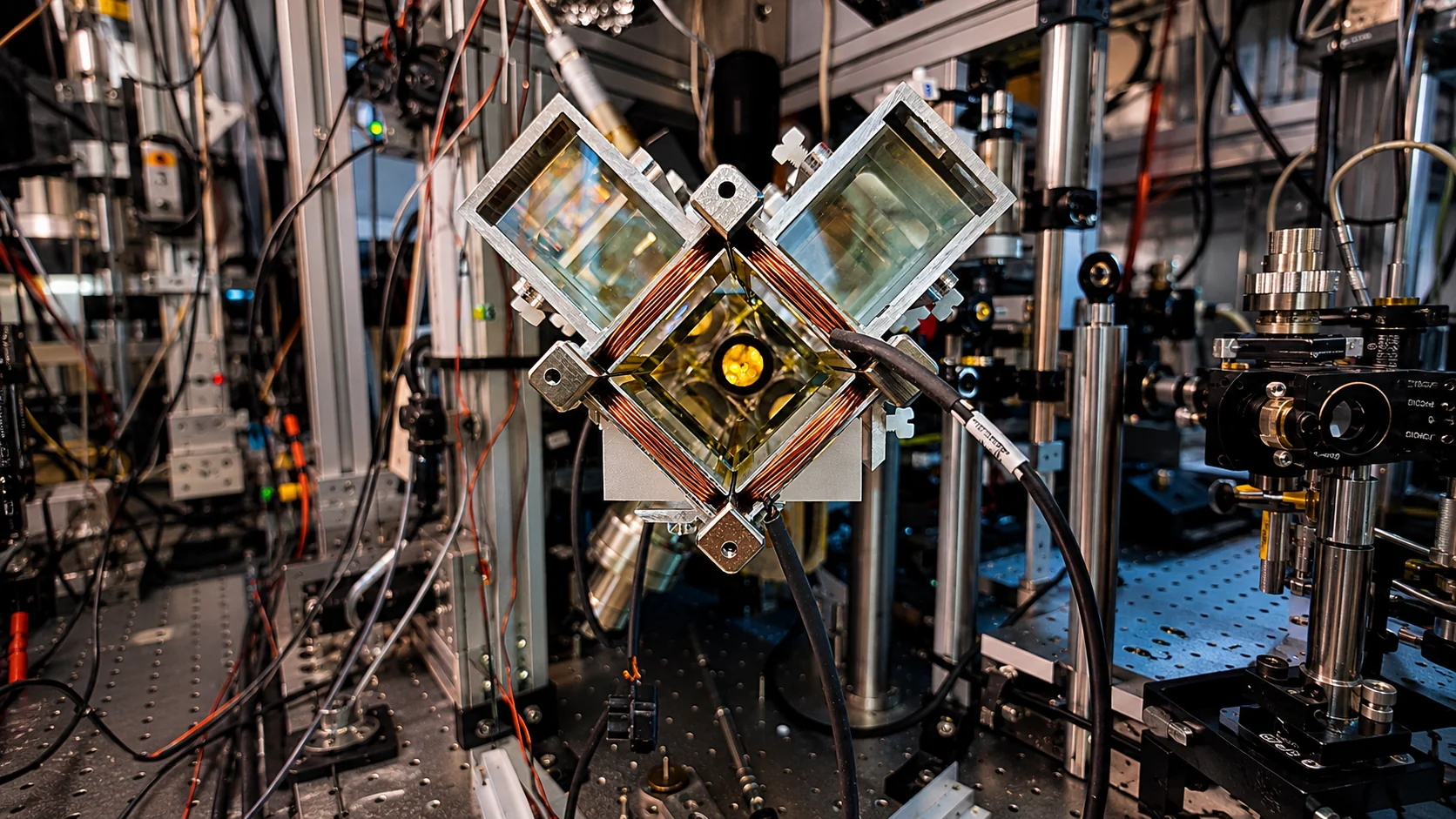
A Cold-Atom Interferometer Finally Measures the Quantum Phase of Free Fall
Physicists in Israel measured the quantum phase of a free-falling atom for the first time, confirming Einstein's equivalence principle in the quantum realm.

A Reshaped Pulse Could Cut Magnetic Memory's Switching Energy Nearly 100-Fold
Edinburgh physicists simulated optimal-control pulses that cut magnetic-memory switching energy from 91.2 to 0.94 nanojoules, still unverified in hardware.
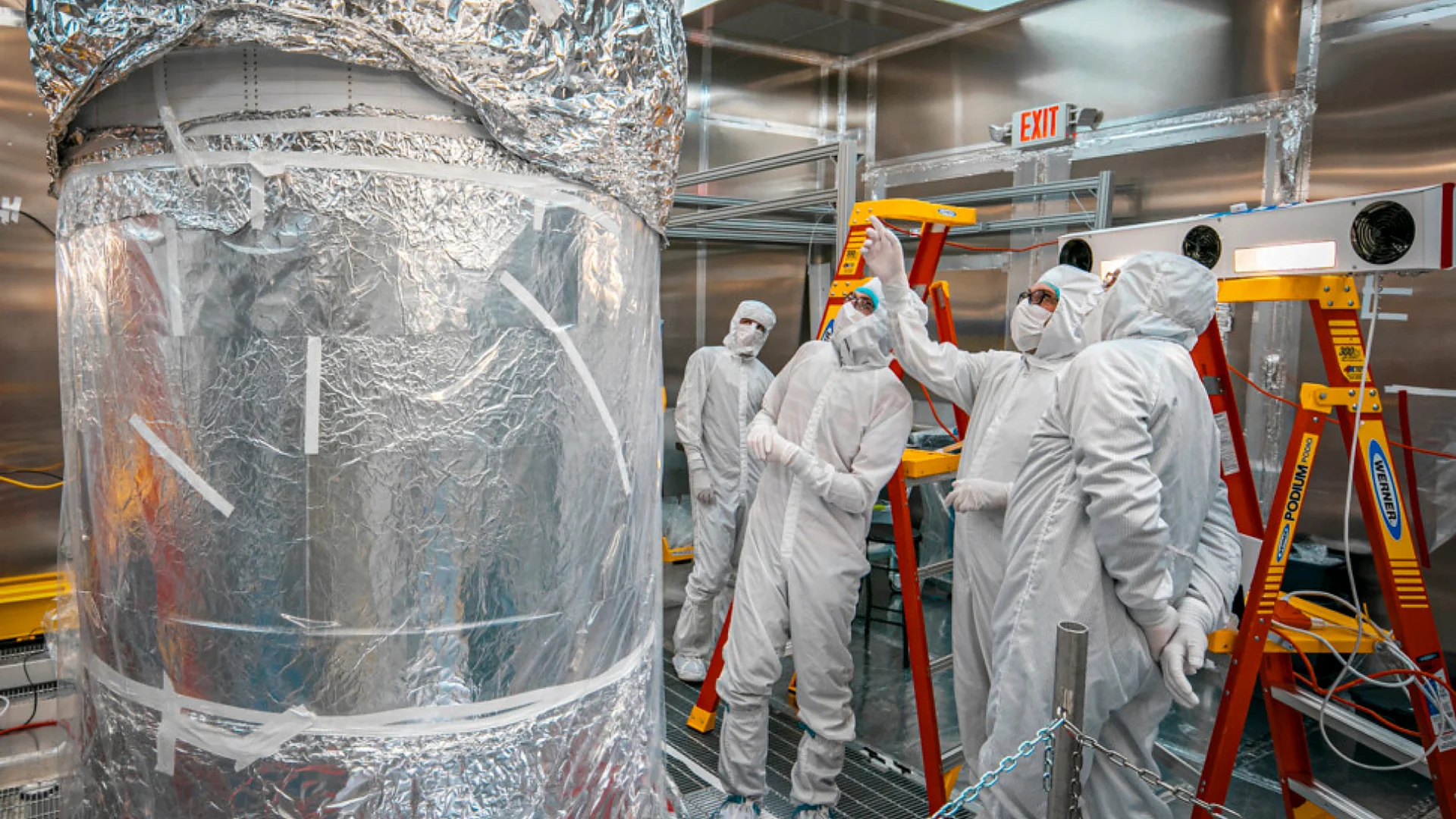
LUX-ZEPLIN's 248 keV Event: A Single Signal Reopens the Dark Matter Hunt
LUX-ZEPLIN recorded one 248 keV xenon recoil at 2.6σ global significance, its strongest dark matter hint yet, and theorists are already racing to explain it.
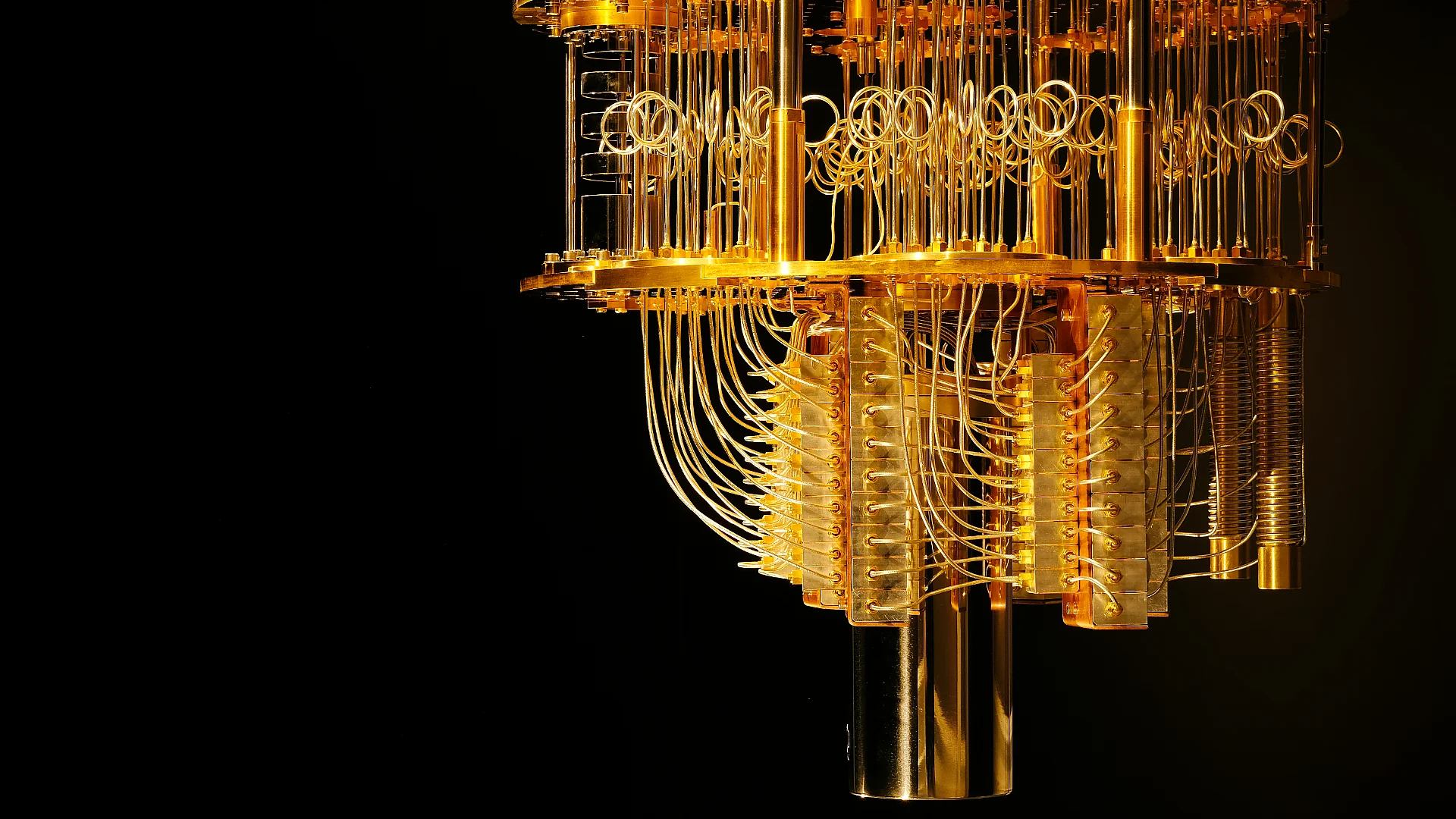
Inside IBM's 15-Minute Quantum Run That Comes With Its Own Fidelity Proof
IBM and UChicago ran a 70-qubit circuit in about 15 minutes and certified a 0.284 fidelity lower bound using quantum codes instead of trust assumptions.
Comments (0)
Please sign in to join the discussion.
No comments yet.
Be the first to share your perspective on this topic.