
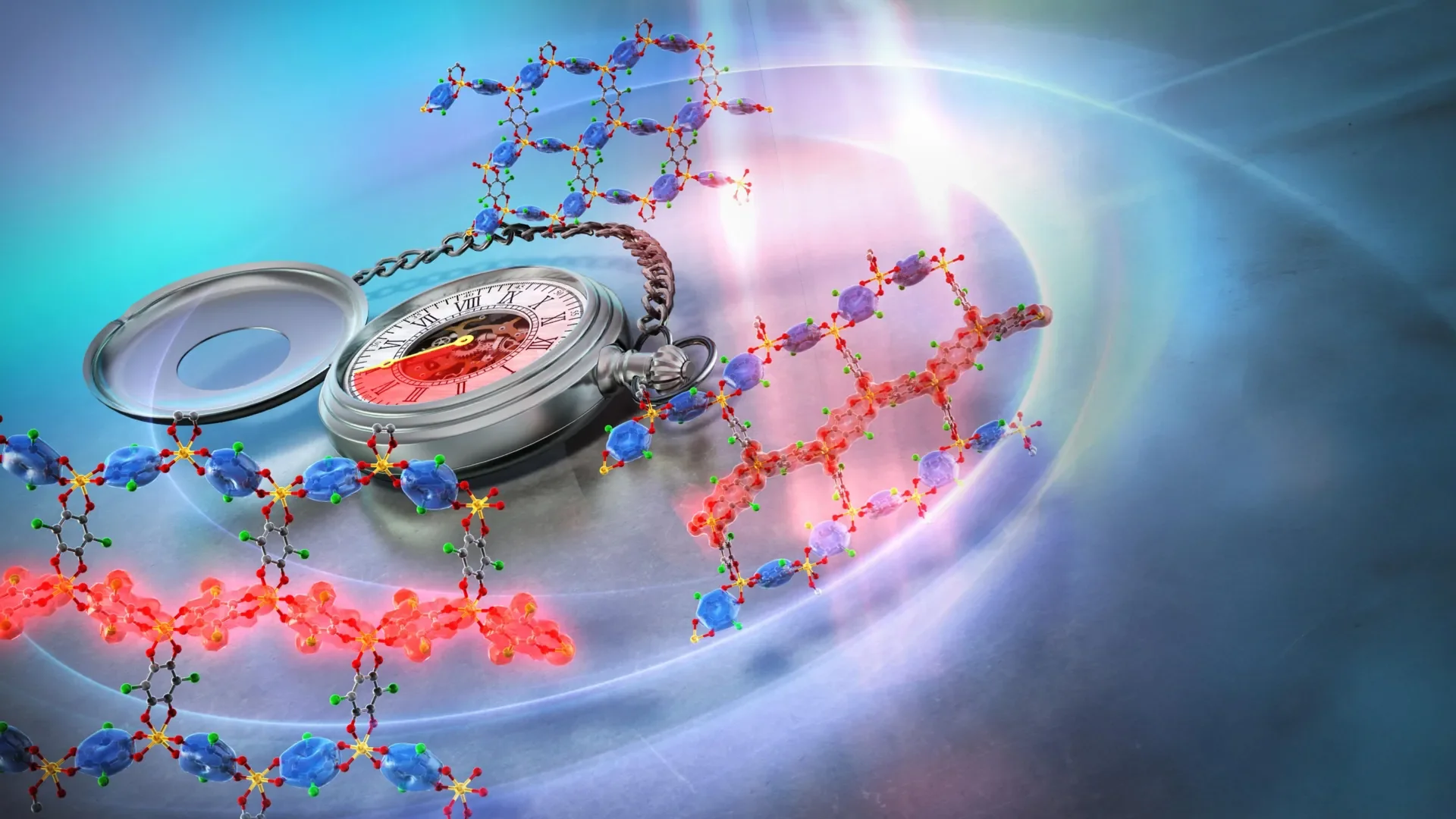
Japanese physicists tracked a metal-organic framework as a laser pulse pushed it into a new electronic state, resolving an intermediate step that ultrafast instruments had not directly captured before.
A New Optical Absorption Band Appears Within 30 Femtoseconds
Researchers at the Institute of Science Tokyo, Tohoku University, and Nagoya Institute of Technology — led by Tadahiko Ishikawa with then-doctoral student Samiran Banu — fired six-femtosecond laser pulses at a donor-acceptor-type metal-organic framework (MOF) and measured how its reflected light changed in the instants afterward, according to the study published in Physical Review Letters on July 22, 2026. Within about 30 femtoseconds, the reflectance spectrum shifted and a new optical absorption band appeared, the signature the team identifies with a photoinduced hidden (PH) state.
A femtosecond is a millionth of a billionth of a second, fast enough that the earliest stages of this kind of transition have mostly sat beyond the reach of conventional pump-probe instruments. The appeal of finding states like this is practical: a light pulse can in principle switch a material's properties on roughly the same timescale it takes the state itself to form, rather than through heating, cooling, or an applied voltage. The sub-10-fs resolution used here let the team resolve that sequence into the three measurements below.
A Bond-Order Wave Forms Before the Hidden State Does
Model calculations accompanying the measurements indicate the material does not jump directly from its ground state to the PH state. Immediately after absorbing a photon, it passes through a short-lived transient electronic state in which the strength of bonding between neighboring sites oscillates, stronger at some sites and weaker at others in a repeating pattern that physicists call a bond-order wave. Small shifts in atomic position follow, and the combination settles into the hidden state inside the 30-fs window the reflectance data captured.
Time-frequency analysis of the same data found spectral weight moving between phonon modes near 500 and 600 cm⁻¹ during the transition, evidence that specific lattice vibrations are coupled to the electronic reorganization rather than simply accompanying it as background noise. Ishikawa, the study's corresponding author, said the team "found that the photoinduced hidden state forms within 30 fs through a previously unknown intermediate electronic state."
The Resulting State May Be Electrically Polar
The model calculations indicate the PH state is metastable and stabilized by the bond-order-wave-driven lattice modulation, and that it may be polar, meaning positive and negative charge become unevenly distributed across the material. The authors describe this as suggestive of electronic ferroelectricity, a form of polarization that arises from electron behavior rather than a conventional shift in the crystal's ionic lattice. Ishikawa said the approach "could help design materials that can be efficiently controlled using light," since identifying the intermediate step gives researchers a specific target for tuning how a material responds to a given pulse.
MOFs, built by linking metal ions with organic linker molecules, are more structurally adjustable than most crystals studied in ultrafast physics, which the authors present as a reason to treat MOFs as a broader platform for finding this kind of nonequilibrium electronic state, rather than a one-off result specific to this compound.
What the Femtosecond Snapshot Does Not Yet Show
The electronic-ferroelectricity claim is a model-based interpretation of the polar PH state, not a separately measured polarization: the authors describe the state as suggestive of electronic ferroelectricity rather than as confirmed by a direct polarization measurement, and no independent experimental test of that specific claim has been reported. What the reflectance measurements establish directly is the roughly 30-fs timescale and the identity of the coupled phonon modes near 500 and 600 cm⁻¹. What remains inferred, rather than directly measured, is the microscopic picture connecting the two — the bond-order wave as the mechanism linking the intermediate electronic state to the final hidden state.
A Cold-Atom Interferometer Finally Measures the Quantum Phase of Free Fall
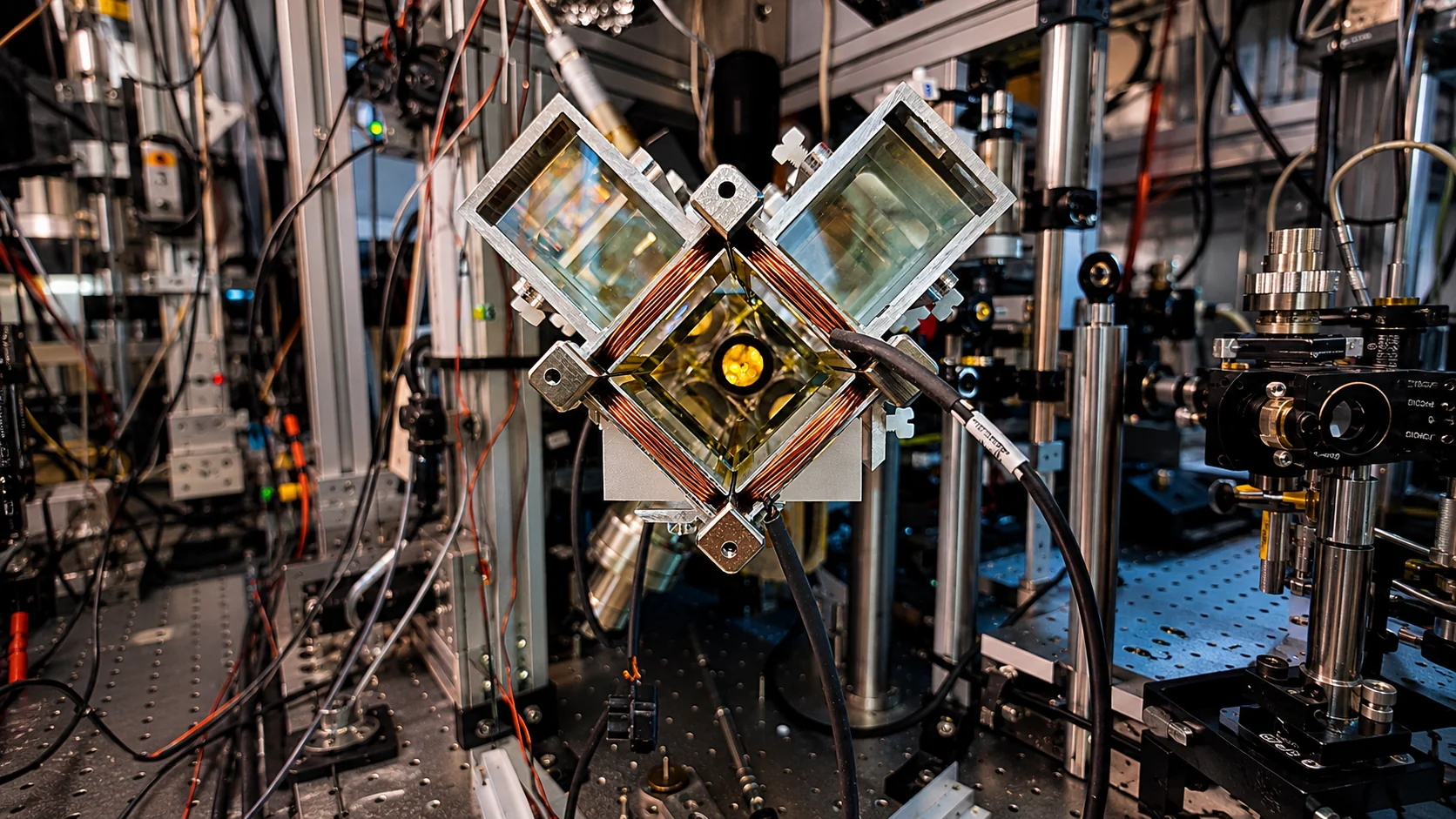
Physicists in Israel measured the quantum phase of a free-falling atom for the first time, confirming Einstein's equivalence principle in the quantum realm.

A Reshaped Pulse Could Cut Magnetic Memory's Switching Energy Nearly 100-Fold
Edinburgh physicists simulated optimal-control pulses that cut magnetic-memory switching energy from 91.2 to 0.94 nanojoules, still unverified in hardware.
LUX-ZEPLIN's 248 keV Event: A Single Signal Reopens the Dark Matter Hunt
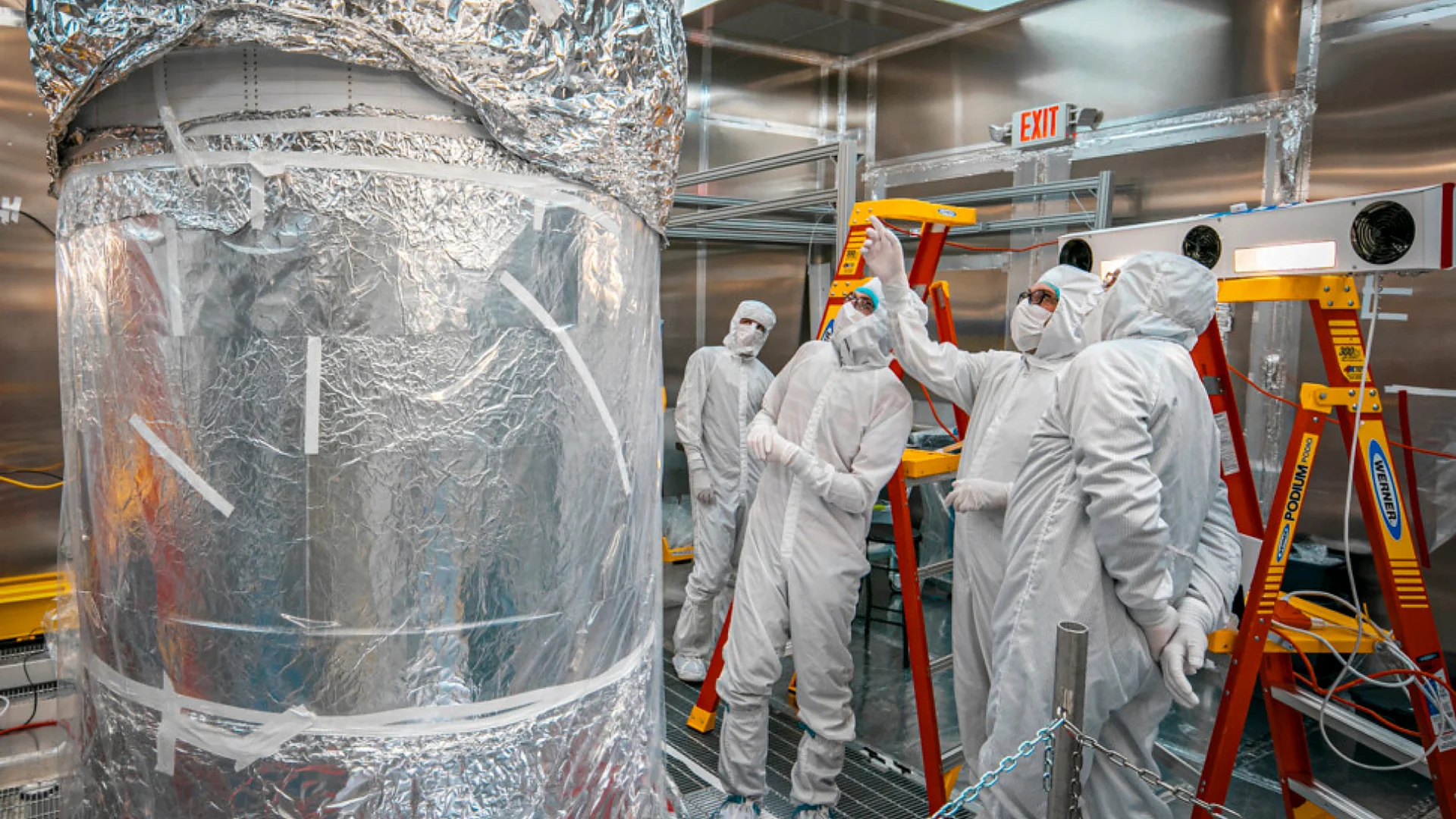
LUX-ZEPLIN recorded one 248 keV xenon recoil at 2.6σ global significance, its strongest dark matter hint yet, and theorists are already racing to explain it.
GlueX Searched for Y(2175) in Photoproduction and Found Two New Structures Instead
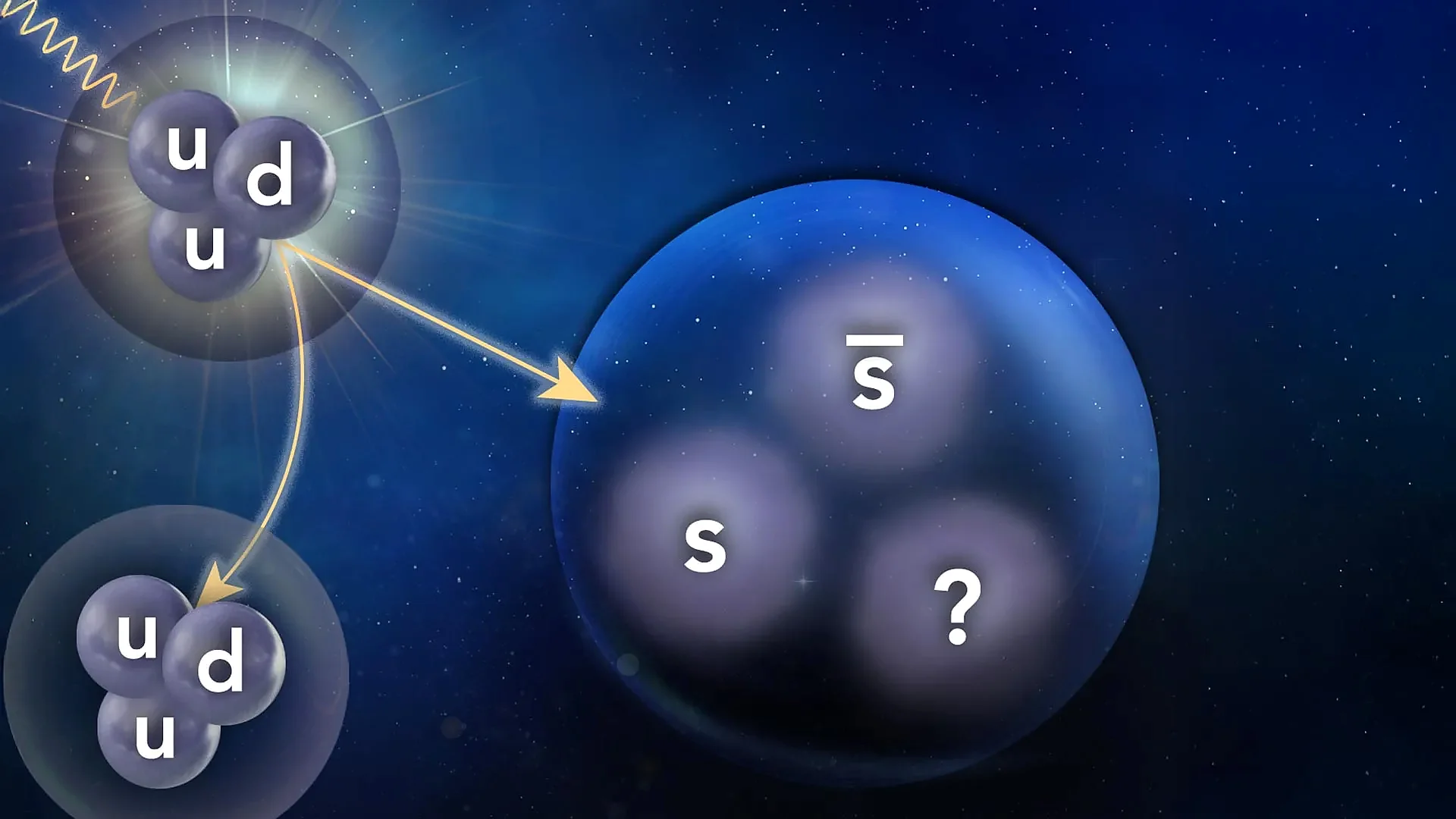
GlueX ran the first photoproduction search for Y(2175)/φ(2170); the state didn't appear, but two unexpected φπ+π− structures did, one at 5σ significance.
Comments (0)
Please sign in to join the discussion.
No comments yet.
Be the first to share your perspective on this topic.