
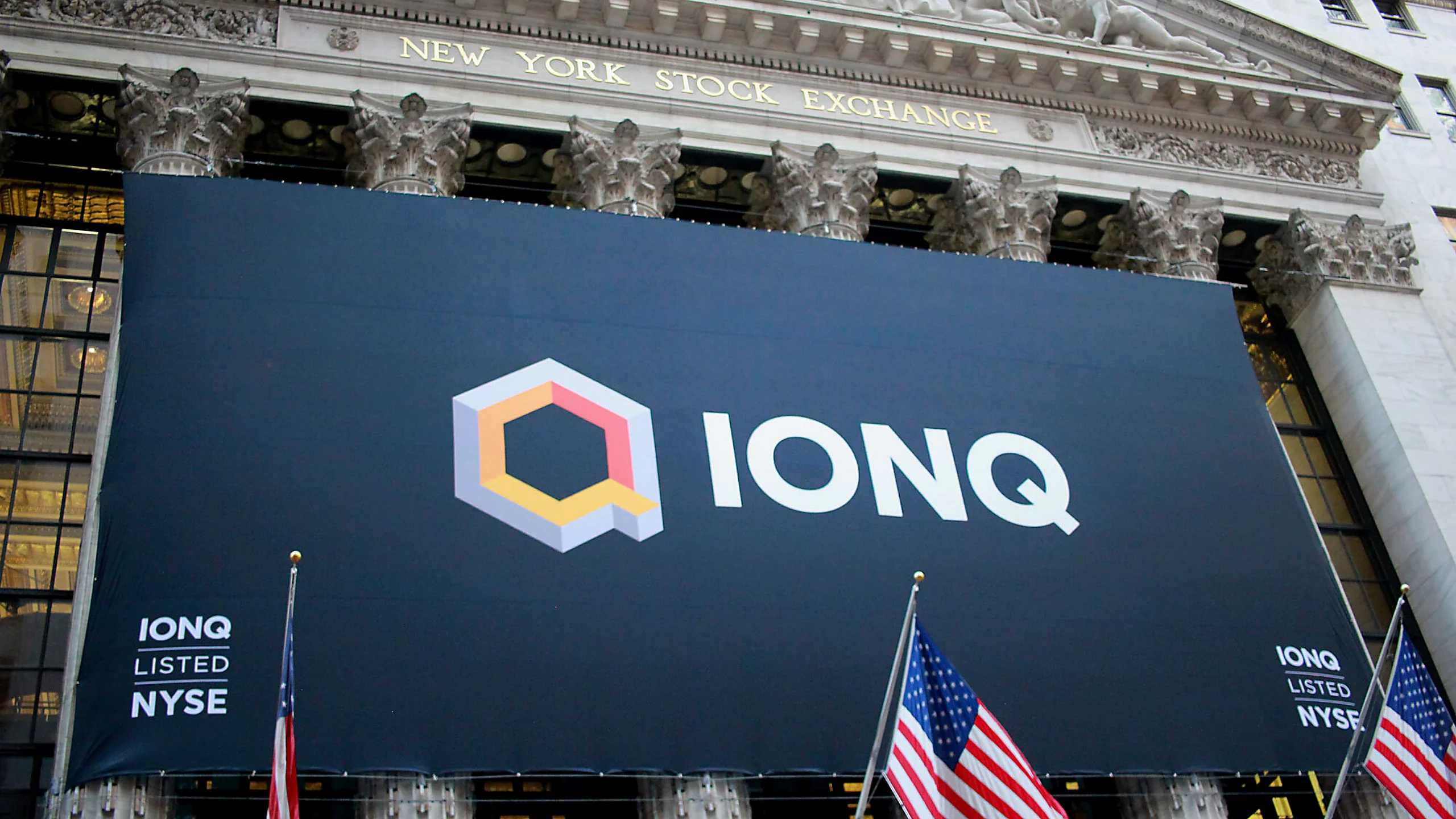
IonQ posted record second-quarter revenue and raised its full-year guidance again, yet the stock trades well below the peak it set last October. The gap between those two numbers is the story.
Record Second-Quarter Revenue Outran IonQ's Own Guidance
IonQ reported second-quarter 2026 revenue of $80.1 million, up 287% from $20.7 million a year earlier, according to the company's earnings release and an accompanying 8-K filing with the SEC. Revenue rose 24% from the prior quarter's $64.7 million, the company's fifth straight quarter of sequential records.
The mix diversified along with the growth. International customers made up about half of the quarter's revenue, commercial enterprise clients accounted for roughly 60%, and multi-product deals contributed about a quarter of the total, according to a breakdown published by Quantum Computing Report. Remaining performance obligations, a measure of contracted future work, grew to $485 million from $122 million, a 297% increase the company cited as evidence of forward demand.
On the strength of the quarter, IonQ raised its standalone 2026 revenue guidance to a range of $280 million to $290 million. That figure excludes SkyWater Technology, the chip manufacturer IonQ bought for $1.8 billion in a deal that closed July 31.
Annualizing the second quarter alone puts IonQ on a roughly $320 million run rate, above the top of its own full-year range. That says less about the guidance being overly cautious than about how much of the year's growth arrived early; a single strong quarter does not guarantee the next one repeats it, and management's own range already builds in that uncertainty. The acceleration is clearest when the three most recent quarters sit side by side.
IONQ Shares Have Given Back Nearly Half Their Rally
IonQ's stock moved in the opposite direction of its revenue. Shares hit a 52-week high of $84.64 on October 13, 2025, according to price data compiled by FinanceCharts, then fell to a 52-week low of $25.89 on March 30, 2026. The stock closed at $44.86 on August 21, 2026, per Morningstar's pricing data — 47% below the high and 73% above the low.
The decline tracks a broader pullback in quantum computing stocks. Rigetti Computing and D-Wave Quantum both fell alongside IonQ in mid-August as Treasury yields climbed toward 4.7%, according to market coverage tracked on CNBC's IonQ quote page. Against that backdrop, Motley Fool contributor Keithen Drury called IonQ his favorite pure play in quantum computing and argued the pullback makes now a reasonable time to buy, a personal view from a Fool writer who discloses a position in the stock, not a consensus among the analysts who cover it. The chart below places the high, the low, and the most recent close on the same timeline.
Losses, Dilution and the Distance to a Fault-Tolerant Machine
The growth came with a large accounting loss. IonQ reported a GAAP net loss of $1.87 billion for the quarter, or $5.08 per share, which its filing attributes mostly to a $1.58 billion non-cash charge from revaluing outstanding warrants. Adjusted EBITDA, which strips out that charge along with stock compensation, was negative $120.3 million.
The company held about $3.0 billion in cash and investments at quarter-end; that falls to roughly $2.0 billion on a pro forma basis once the SkyWater acquisition is factored in. The deal brings semiconductor fabrication in-house, a move that mirrors the broader push toward onshore chip manufacturing for AI and quantum hardware that other hardware makers are pursuing.
On the technology itself, IonQ says its two-qubit gate fidelity now reaches 99.99%, and it is testing a 256-qubit system it aims to bring into service in 2027, on the way to a longer-term goal: a fault-tolerant computer built from 10,000 qubits, the scale the company says is the minimum needed for a reliable advantage over classical supercomputers. That target sits years out, and combined financial guidance that includes SkyWater has not yet been issued. The trajectory matches a wider pattern across the industry, as quantum computing shifts from lab-scale research toward commercial infrastructure.
Analysts disagree on what that trajectory is worth today, though the disagreement is more about degree than direction. Average price targets differ by tracker: StockAnalysis.com puts the mean across 13 analysts at $67.68, other trackers show figures from roughly $65 to $74 depending on which analysts are included, and even the low end of that range sits above IonQ's recent close. DA Davidson set the outlier low point, a $35 target, when it downgraded the stock from buy to neutral in August 2025 citing limited visibility into the business, and analyst-tracking data show that target still stands. The spread illustrates how differently the market is pricing a business with real, fast-growing revenue against one still years from the milestone it says quantum computing needs to reach mainstream use. The four figures below come from the same earnings report and the analyst notes that followed it.

Loss Aversion Is About 2 on Average, and Near 1 for Small Stakes
The largest loss aversion meta-analysis puts the average coefficient at 1.955, below the textbook 2.25. See how stakes, task design and trading data shift it.

Cash Conversion Cycle Explained: How Dell Reached −37 Days While Nike Sits Near 100
Worked cash conversion cycle examples from Dell and Nike filings, plus U.S. and European Hackett benchmarks, showing which of the three inputs drives the result

DeFi vs. TradFi: Where Cheaper Payment Rails Meet Different Liquidity Risks
DeFi vs TradFi compared: banks average 14.99% on $200 cross-border transfers, a stablecoin pilot priced 1.60% to 2.50%, and liquidity risk differs by design.

Why Credit Card Rates React to the Fed Faster Than Mortgages Do
How a central bank's overnight policy rate moves through prime rate, credit cards, mortgages and savings accounts at very different speeds.
Comments (0)
Please sign in to join the discussion.
No comments yet.
Be the first to share your perspective on this topic.