
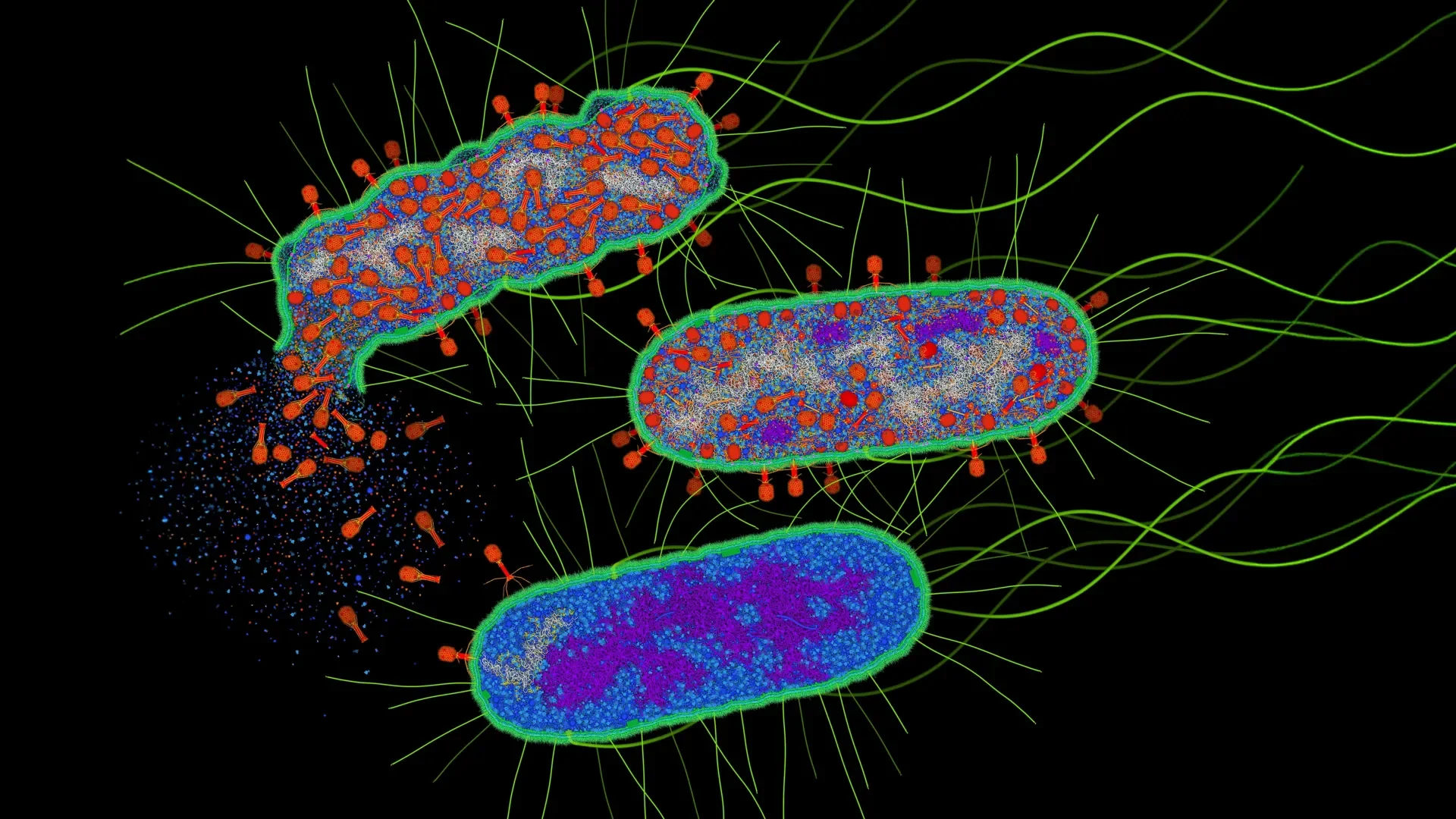
Bacteria that carry CBASS immunity face a timing problem. The pathway ends in cell death, so it has to fire when a virus is replicating inside the cell and never earlier. A study published in Science, with Sam Hobbs of University of Utah Health as first author, identifies the cue: a phage's own prohead protease cuts an exposed loop in a bacterial immune enzyme, and the cut switches the enzyme on.
CBASS stands for cyclic oligonucleotide-based antiphage signaling systems. Each one centers on a cGAS/DncV-like nucleotidyltransferase (CD-NTase), which synthesizes a cyclic nucleotide signal that activates an effector protein. The infected cell then goes dormant or dies, which shields its neighbors. A survey of 38,000 bacterial and archaeal genomes found more than 5,000 CBASS systems, and the pathway shares ancestry with the cGAS-STING route in animal immunity. For most CD-NTases, what they detect had stayed unknown.
T4's prohead protease gp21 is enough to switch on EcCdnG
The experiments in the bioRxiv preprint used E. coli phage T4 and a type II CBASS operon built around the CD-NTase EcCdnG. T4 carries anti-CBASS proteins that mask the trigger, so the team worked with a variant lacking acb1 and acb2. That variant was highly sensitive to the operon. Inactivating EcCdnG, the regulators Cap2 and Cap3, or the DNase effector Cap5 each restored phage replication.
To find the trigger, the researchers mixed lysate from infected cells with lysate from cells expressing the operon. They read out EcCdnG's product, 3′2′-cGAMP, with a Cap5-based biosensor that cuts a DNA plasmid. Activation appeared only with infected lysate, and only from samples taken 14 minutes after infection or later. The T4 prohead forms at roughly 12 minutes, so the earliest positive time point sits within about two minutes of that event.
A search among proteins made at that stage showed that expressing gp21, the prohead protease, was sufficient to trigger CBASS-dependent toxicity in cells. A gp21 variant with a disabled active site (H85A/S140A) lost the effect. Purified EcCdnG then met four unrelated proteases: proteinase K, trypsin, Glu-C and chymotrypsin. Each one set off 3′2′-cGAMP synthesis, and the response was more than 50 times as potent as earlier laboratory conditions built on high enzyme concentration, pH above 8.5 or manganese.
An LPE motif in a disordered loop marks where EcCdnG is cut
When trypsin activated EcCdnG, the enzyme was cleaved into a fragment of about 28 kDa. An AlphaFold3 model placed a disordered, surface-exposed loop of about 30 amino acids exactly where such a cut would fall. Changing all four trypsin sites in that loop to glutamine (K184Q, K197Q, K214Q, K218Q) removed the response to trypsin and left the response to proteinase K intact. The mutant enzyme therefore still works and still reacts to proteases that cut elsewhere.
gp21 favors cuts after glutamate within I/LxE motifs, and the loop contains an LPE motif. Alanine substitutions at P211 or the neighboring Y213 weakened the operon's defense against the T4 variant by more than 100-fold. Those same mutants kept defending against Bas51, a phage from the Vequintavirinae family. The change altered what the operon recognizes without disabling it.
A quadruple mutant that swapped every glutamate in the loop for glutamine (E190Q, E194Q, E212Q, E215Q) stopped responding to gp21 and lost defense against T4 while still restricting Bas51. The single E212Q change did not abolish defense, which the authors link to gp21's weaker action on noncanonical xxE motifs. They describe the loop as a molecular tripwire.
Two consequences follow from the Bas51 results. Edits to the loop reroute which phages an operon detects, so the loop acts as a recognition filter. Bas51 detection must also run through something other than these residues, and the preprint does not identify it.
About 24% of CBASS operons carry a loop in the same position
CD-NTases fall into clades A through H. The authors clustered sequences, combined experimental and AlphaFold3 structures, and searched each cluster for a loop in the same three-dimensional position as EcCdnG's. About 24% of all CBASS operons contain a CD-NTase with such a loop. It appears in nearly all sequences of clades A and G and in about 18% of clade D, across more than 1,300 enzymes. Loop sequences share little similarity between clades, yet each is framed by the same conserved secondary-structure elements.
The team purified 12 representatives and tested them with proteinase K. Seven of the nine enzymes predicted to carry a loop made nucleotide signal, including the Vibrio cholerae DncV and Enterobacter cloacae CdnD enzymes that anchor much of the field's model work. All three clade D enzymes without a predicted loop stayed silent. Counting both groups, 10 of 12 enzymes behaved as the loop annotation predicted, or 83%.
The finding fits earlier evidence from the same research group. A screen of 975 type I operon-phage pairings found that escaper phages carried mutations in virion assembly proteins, and that the Bas13 prohead protease interacted with the CD-NTase EcCdnD12 and triggered CBASS-dependent growth arrest.
How loop cleavage becomes enzyme activity remains unmapped
With about 24% of operons carrying the loop, roughly three-quarters must be explained by other cues or by loops this search did not define. The preprint's reference list includes a 2023 Nature study reporting a bacterial cGAS that senses a viral RNA, so protease detection is one trigger among several.
The structural step between cutting and catalysis is the largest gap. The authors propose that cleavage may help the enzyme oligomerize or release inhibitory folate metabolites, and they list defining those transitions as future work. Cap2 and Cap3 were dispensable for protease activation in vitro yet required for restricting phage in cells, which suggests roles in localization or scaffolding. Because gp21 shuts itself off through auto-proteolysis, the in vitro experiments used foreign proteases, and direct cleavage of the loop by gp21 was not part of the reconstitution.
The authors also point to a parallel in animal immunity, where the NLRP1 and CARD8 inflammasomes detect viral protease activity. The University of Utah Health release says the work could guide phage therapies built to evade bacterial immune systems. The experiments themselves were laboratory assays in E. coli and its phages, so any therapeutic use is a projection from the researchers.

Nine-Day Carcass Feeding Nearly Tripled Zoo Lions' Eating Time and Raised Pacing
Lions at an Australian safari park fed whole carcasses every nine days ate nearly three times longer, rested more, and paced more in month two of a 2026 study.
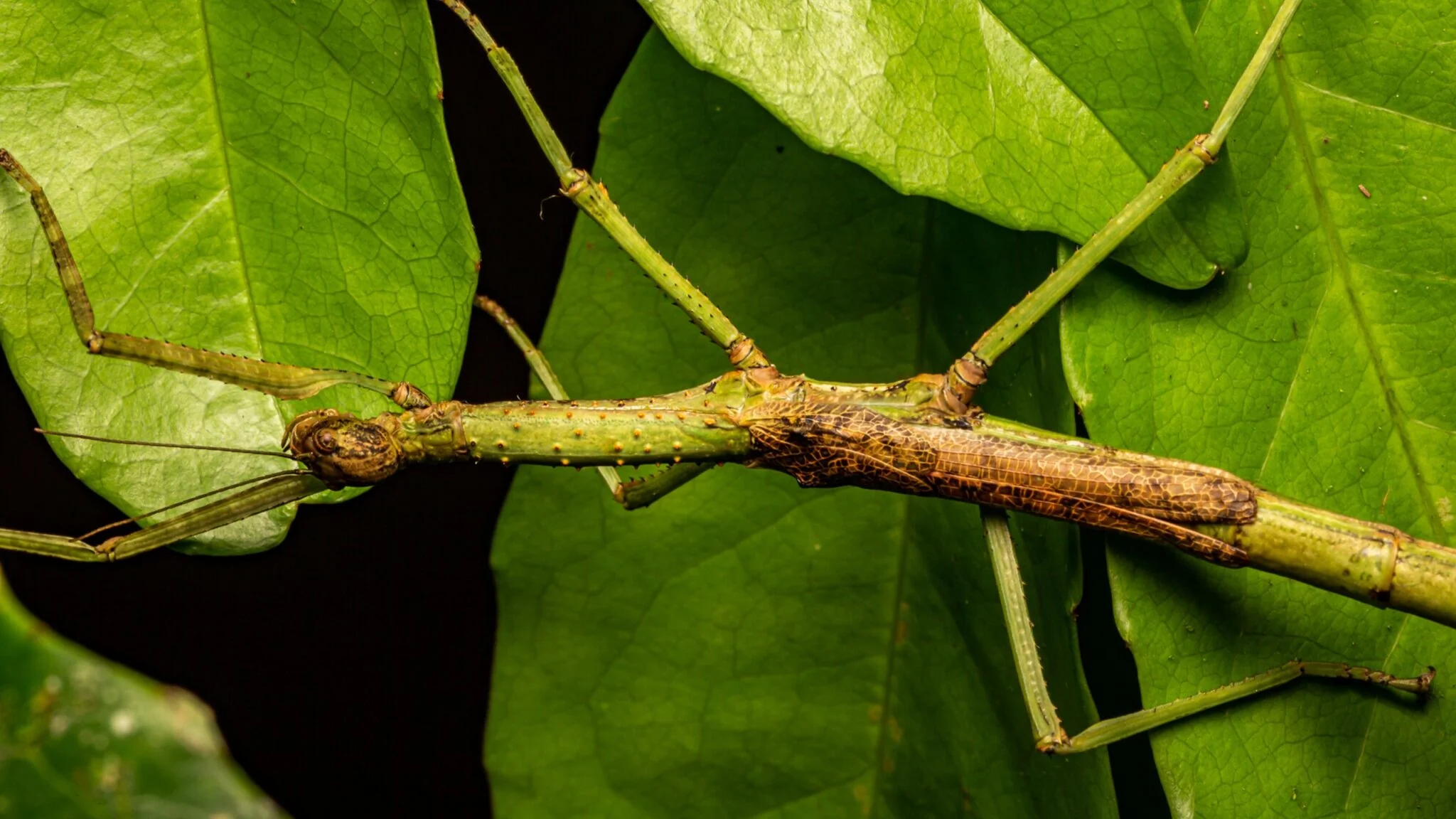
DNA Review Splits Australia's Anchiale Stick Insects From Two Species Into Five
Anchiale stick insects in Australia are five species, not two: a 2026 DNA and museum review adds A. robusta and A. mabiensis, the latter with ringed egg lids.
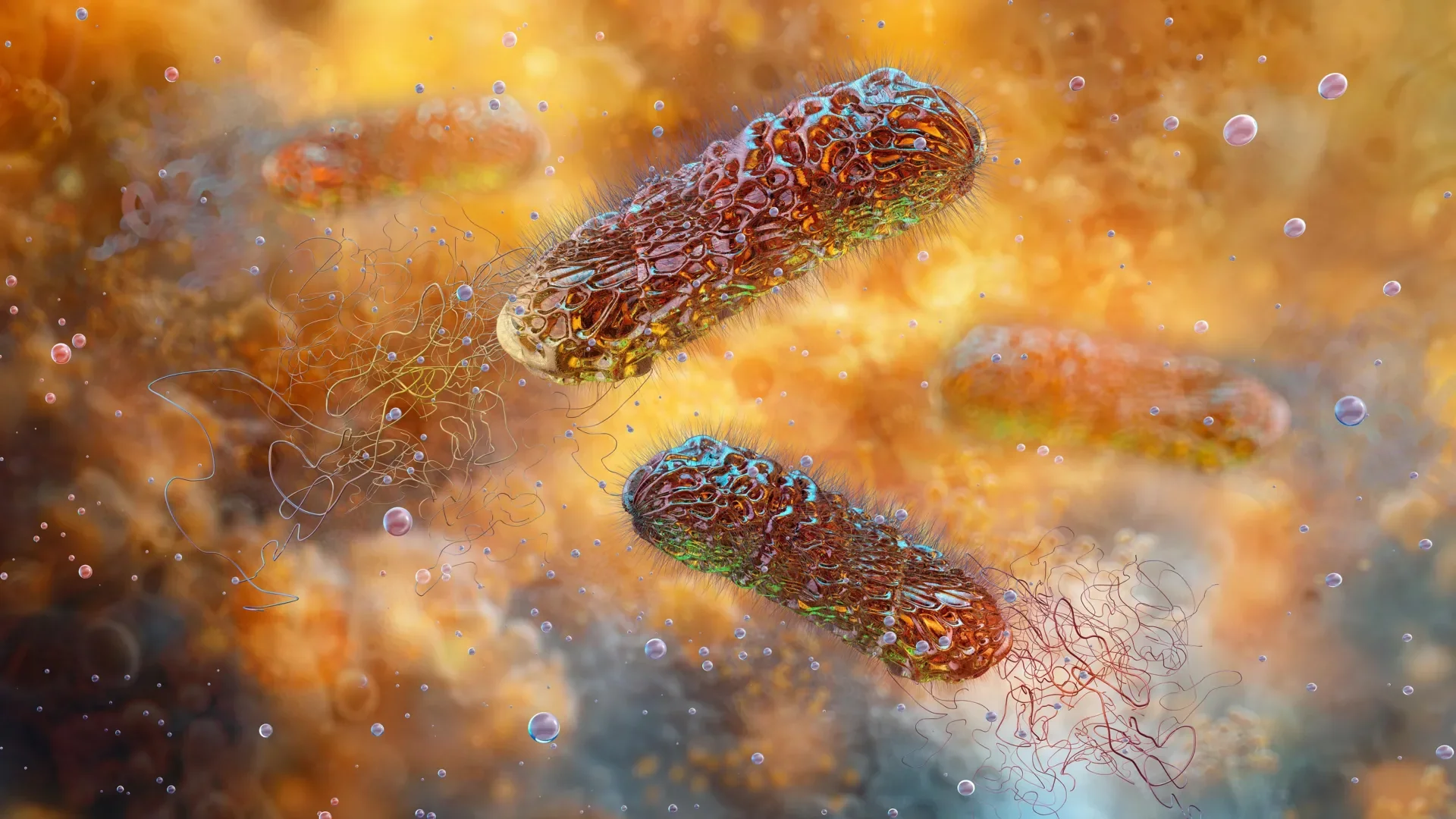
One Arginine Lifted Ancient Lactoferricin, and the Human Peptide Trails Older Versions Against Staph
Resurrected lactoferrin ancestors show a 100,000-fold S. aureus viability drop, beating the modern human peptide's 100-fold effect, PLOS Biology reports.

14 Tail Vertebrae Put Diplodocus in Spain. Experts Split on Certainty
Diplodocus in Spain: 14 tail vertebrae from Teruel are the first formal European record. Three of five experts back the ID; two call the tail too thin.
Comments (0)
Please sign in to join the discussion.
No comments yet.
Be the first to share your perspective on this topic.