
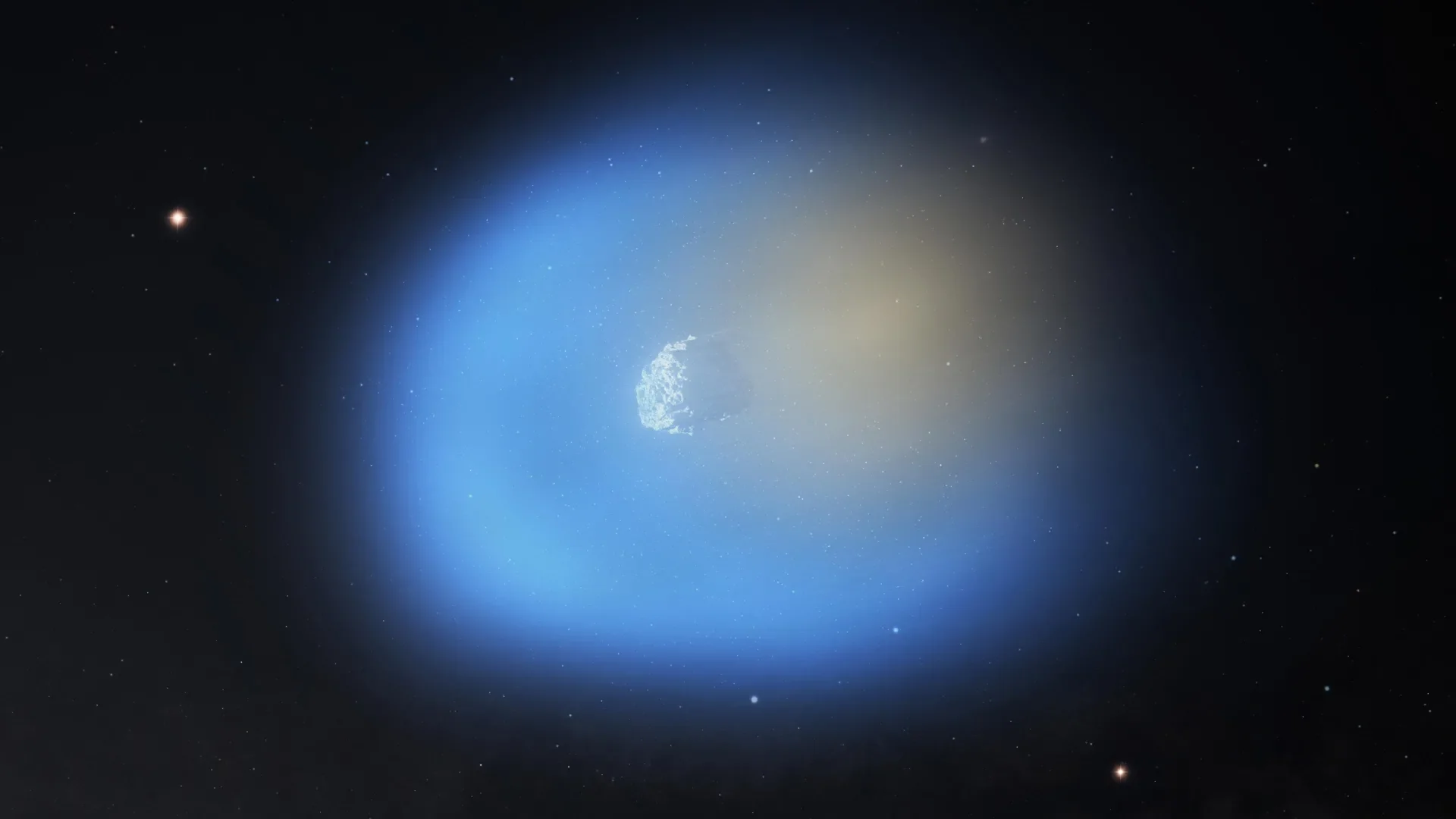
Radio observations of interstellar comet 3I/ATLAS have found it releasing far more methanol than hydrogen cyanide, a ratio among the highest ever recorded in any comet studied at radio wavelengths. The findings come from a peer-reviewed study led by American University physicist Nathan Roth, published in The Astrophysical Journal Letters using data the Atacama Large Millimeter/submillimeter Array (ALMA) collected with its Atacama Compact Array. The team mapped methanol on four nights between August 28 and October 1, 2025, and hydrogen cyanide on two nights, September 12 and 15, as the comet closed in on the Sun across heliocentric distances of 2.6 to 1.7 astronomical units.
A Methanol-to-HCN Ratio Rivaled by Only One Solar System Comet
On September 12, the team measured a CH3OH/HCN production-rate ratio of 124, with an uncertainty of +30/−34. Three days later, on September 15, the ratio had dropped to 79, with an uncertainty of +11/−14. Because both molecules were mapped with the same instrument over an overlapping period, the ratio is a direct, internally consistent measurement rather than one assembled from separate telescopes or campaigns. According to the NRAO announcement of the results, only one solar-system comet has measured higher: C/2016 R2 (PanSTARRS), an already-unusual object previously put at a ratio near 280, with an uncertainty of ±72, by Biver and colleagues in 2018.
Most solar-system comets studied at radio wavelengths carry far lower methanol-to-HCN ratios, so 3I/ATLAS stands out even before it's weighed against an anomaly like C/2016 R2. A separate radio detection of HCN by the James Clerk Maxwell Telescope near rH = 2.1 au found the molecule enriched relative to water by about 0.2%, broadly consistent with the ALMA picture of a comet with an unusual gas mix.
Methanol Traces Back to Icy Grains, Not Just the Nucleus
The two molecules did not behave the same way across the coma. Hydrogen cyanide was depleted on the side of the comet facing the Sun, a pattern the researchers describe as consistent with production straight from the nucleus. Methanol showed the opposite trend, enhanced on the sunward side. Statistical analysis of methanol's spatial distribution found production extending from sources at least 258 kilometers from the nucleus, at 99% confidence — evidence, the authors write, that icy grains shed into the coma are releasing methanol of their own as they warm, on top of whatever comes directly from the surface. Hydrogen cyanide showed no such extended signature; its distribution was indistinguishable from direct nucleus sublimation. The researchers note that low signal-to-noise on the longest baselines, which sample the smallest spatial scales nearest the nucleus, kept them from fully ruling out a pure-nucleus origin for methanol as well.
Methanol Output Climbed Sharply Near the Water-Ice Line
Methanol production rose sharply across the observing window, best fit by a relationship that scales with roughly the inverse fifth power of the comet's distance from the Sun, rH^−5.2±0.6. The steepest jump came near a heliocentric distance of 2 au, at the inner edge of the zone where water ice is expected to sublimate directly. A power-law index steeper than roughly −2, the rate at which sunlight intensity itself falls off with distance, points to an activation process near that threshold rather than a steady response to gradual warming. That timing lines up with an independent observation: solar-monitoring spacecraft recorded a rapid brightening of 3I/ATLAS's coma at roughly the same distance, according to work by Qicheng Zhang and Karl Battams cited in the paper. The overlap suggests that whatever activated water-ice sublimation around 2 au also drove the methanol surge, though the paper stops short of claiming the two are causally linked beyond the coincidence in timing.
What the Ratio Doesn't Settle About 3I/ATLAS's Formation
A high methanol ratio does not by itself explain why 3I/ATLAS formed the way it did. Researchers interpret strong methanol enrichment as a sign that the comet's ices formed under, or were later altered by, conditions unlike those that shaped typical solar-system comets, such as colder temperatures or a different starting chemical mix. The study does not distinguish between those two explanations. The finding adds to an already unusual chemical profile: earlier James Webb Space Telescope observations, taken at larger heliocentric distances, found the comet's coma dominated by carbon dioxide, a separate anomaly involving an entirely different molecule. As lead author Nathan Roth put it, "observing 3I/ATLAS is like taking a fingerprint from another solar system." 3I/ATLAS, discovered in July 2025, is only the third object confirmed to have entered the solar system from interstellar space, after 1I/'Oumuamua and 2I/Borisov. Each of the three has shown its own chemical peculiarities, and a larger sample of interstellar visitors will be needed before any pattern in how other planetary systems build their comets comes into focus.
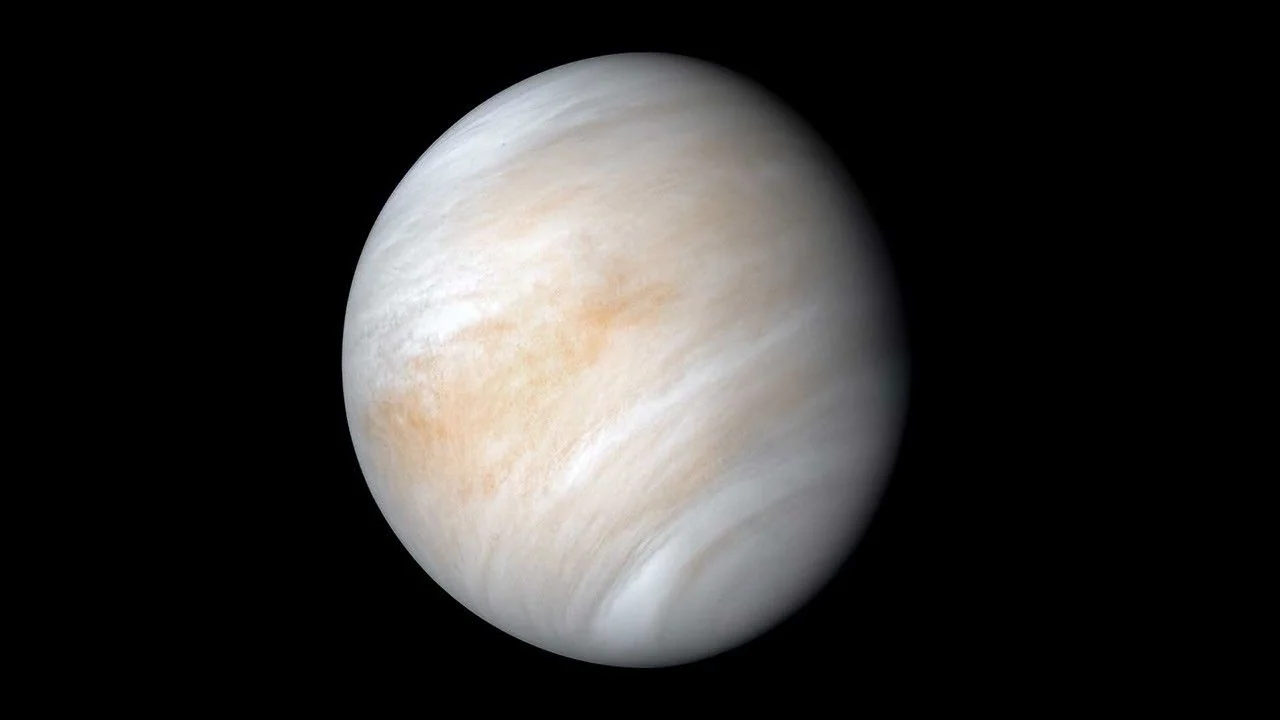
Why Venus's Pale Yellow Clouds Might Hide a Nearly Black Liquid
A new model finds Venus's cloud liquid must absorb UV light as strongly as concentrated pigments, narrowing the century-old 'unknown absorber' mystery.
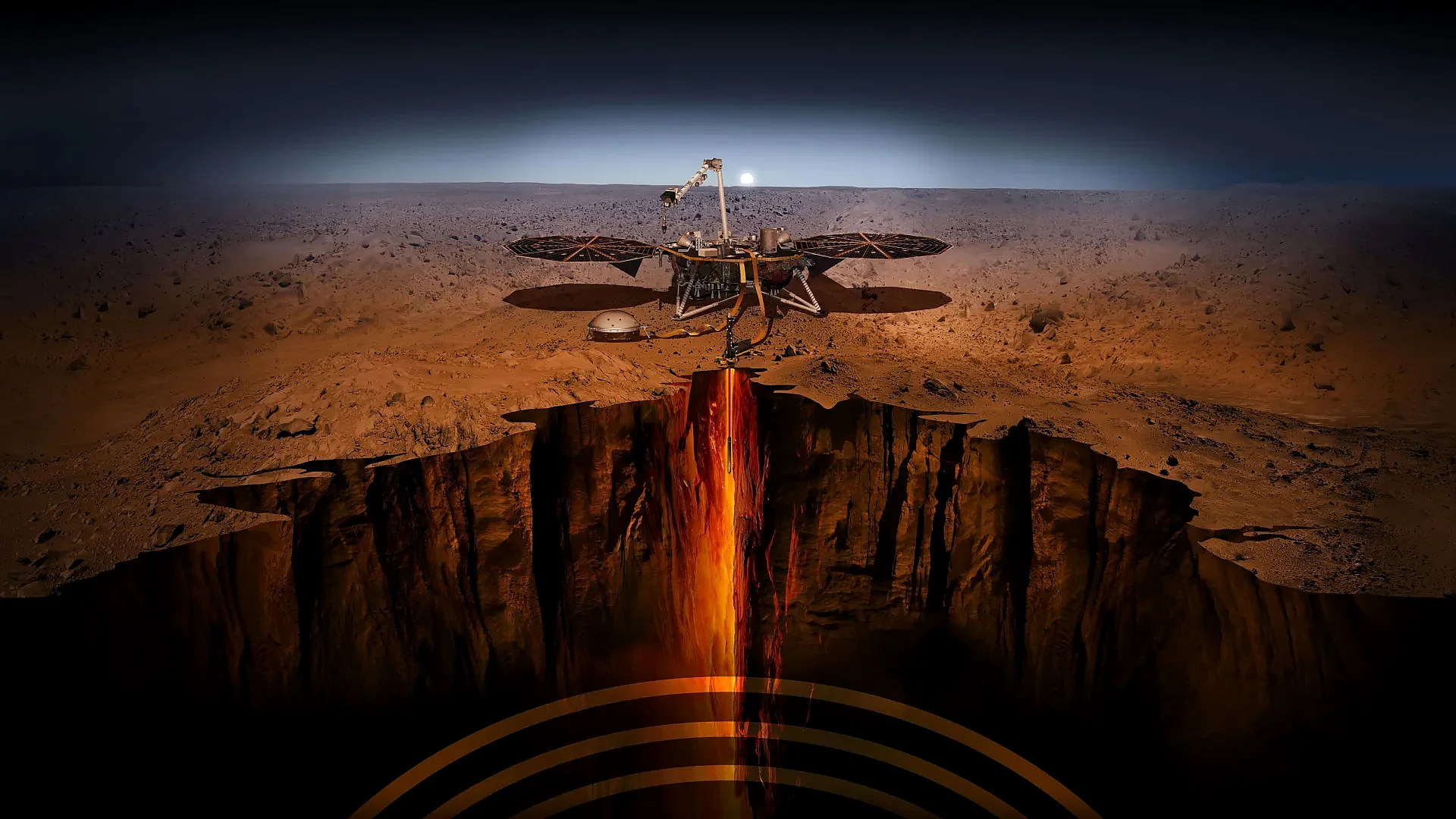
A Buried Ultramafic Layer Points to a Whole-Crust Magma System on Mars
NASA InSight data show a melt-depleted ultramafic layer 24–38 km down in Mars's crust, evidence of a magma system that once ran through the entire crust.
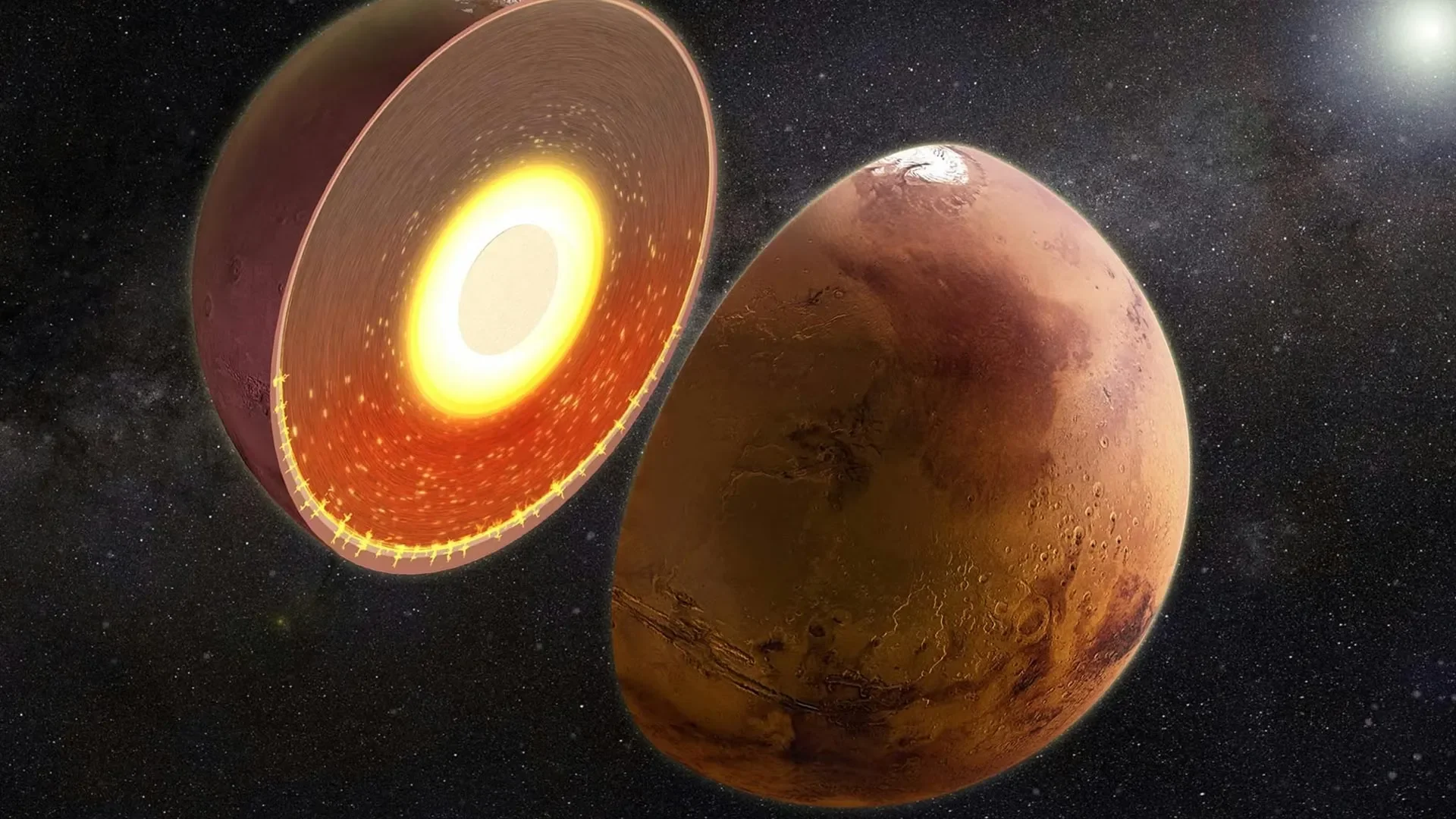
Mars's Southern Mantle Is Hundreds of Degrees Hotter Than Its North, New Gravity Study Finds
New tidal-tomography analysis of Mars orbiter data finds its southern mantle runs 200–400°C hotter than the north, tied to the ancient crustal dichotomy.
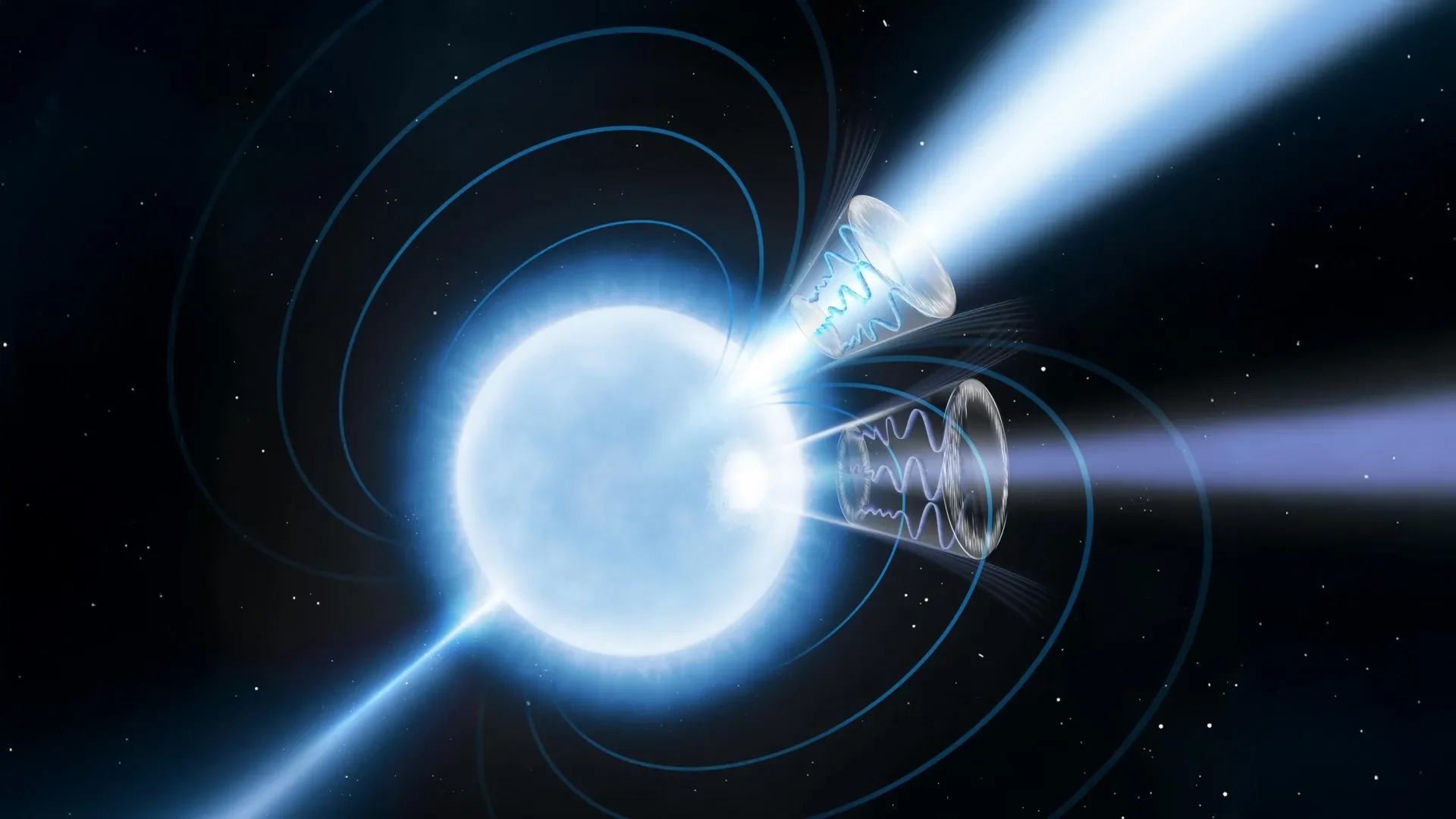
NASA's IXPE Measures 80% X-Ray Polarization From a Magnetar, Testing a 90-Year-Old Quantum Prediction
NASA's IXPE recorded up to 80% X-ray polarization from magnetar 1E 1547.0−5408, the strongest evidence yet for vacuum birefringence, a 1936 QED prediction.
Comments (0)
Please sign in to join the discussion.
No comments yet.
Be the first to share your perspective on this topic.