
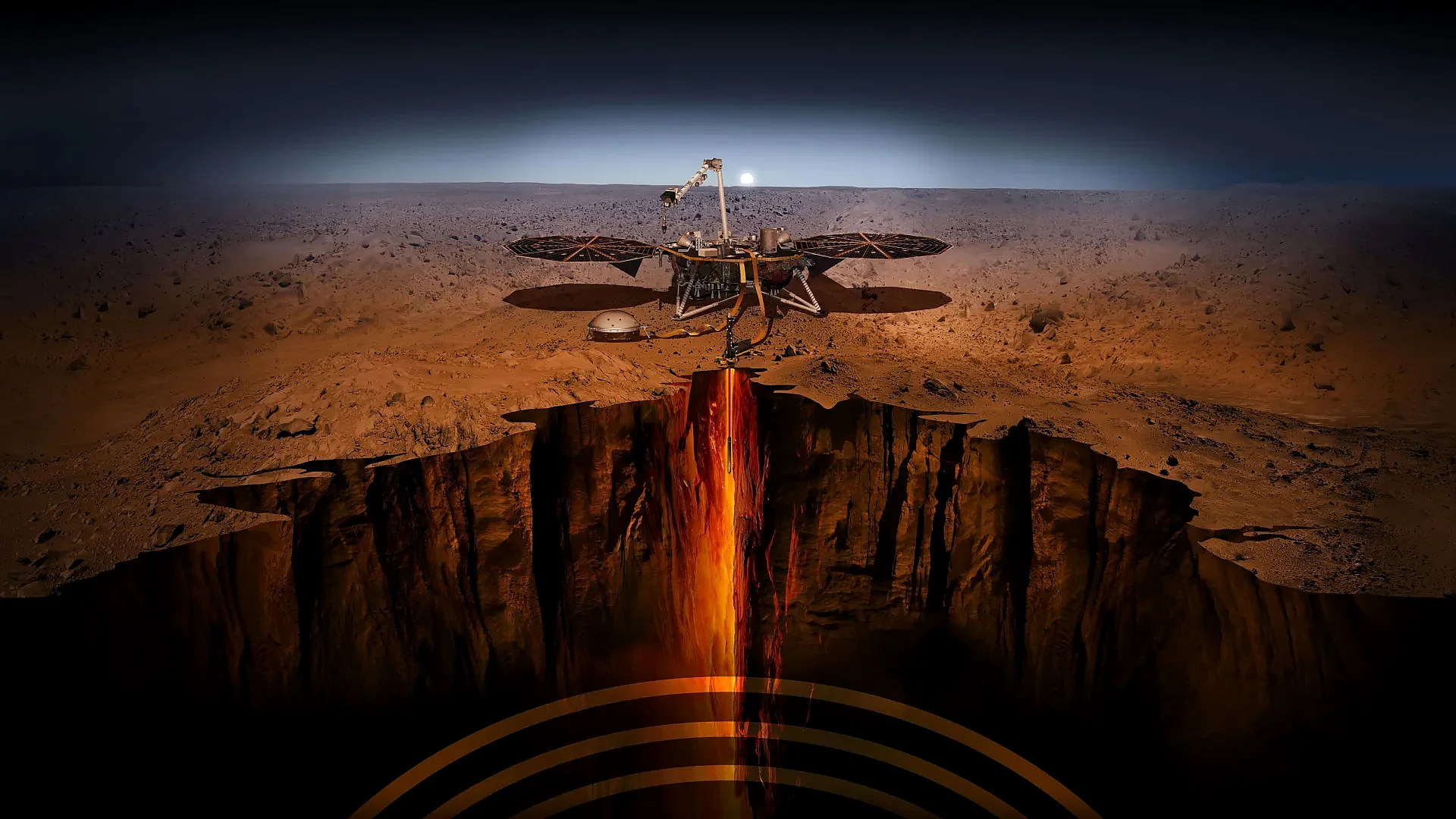
For nearly five years, a sharp jump in seismic velocity roughly 24 kilometers beneath NASA's InSight lander sat unexplained. Some researchers read it as an ancient, buried crust-mantle boundary. Others treated it as ordinary layering inside an otherwise uniform basaltic crust. A new analysis in Nature Astronomy, led by researchers at the University of Oxford, argues the boundary marks something more specific: the top of a 14-kilometer band of melt-depleted rock, left behind by a magma system that once ran through the planet's entire crust.
Bayesian Modeling Splits Mars's Crust Into Two Rock Types
The team combined phase-equilibrium modeling with a curated database of 883 measured and calculated Martian rock compositions, then used Bayesian classification to test which rock type, mafic (basaltic) or ultramafic, best explains the seismic velocities recorded on either side of the boundary. They anchored the comparison to a well-established InSight velocity model built from meteoroid-impact seismic waves and receiver functions.
Under uniform priors, the crust directly above the boundary, roughly 11 to 24.5 kilometers down, matches mafic compositions with 85.9% posterior probability. The layer below, extending to the true crust-mantle boundary near 38 kilometers, matches ultramafic compositions, mineralogically similar to terrestrial lherzolite, wehrlite, and dunite, with 90.8% probability. That makes the 24.5-kilometer break what the authors call the local "seismic Moho," distinct from the deeper "petrologic Moho" at 38 kilometers where the actual mantle begins.
The resulting picture divides the crust beneath InSight into four layers, each with its own depth range, composition, and confidence level, laid out below.
Why Ordinary Heat Flow Can't Explain the Melt-Depleted Layer
A melt-depleted layer forms when magma intrudes into rock, releases its lighter, more evolved melt upward, and leaves a denser, refractory residue behind. For that to happen at 24 to 38 kilometers on Mars, the local temperature gradient needed to cross the melting point of lower-crustal rock at some point in the planet's history.
The study models Noachian-era crustal heat flow at 5 to 45 milliwatts per square meter, roughly 6 to 22 degrees Celsius per kilometer across a 38-kilometer-thick crust. Across most of that range, the modeled Martian geotherm never reaches even the water-saturated melting point between 24 and 38 kilometers. Only the top end, 45 milliwatts per square meter, gets hot enough to melt rock at 24 kilometers, and only if that rock already contained water. Ordinary background heat flow, in other words, falls short of what the melt-depleted layer requires.
The authors conclude the extra heat probably came from mantle upwelling, paired with the intrusion of mantle-derived magma into the base of the crust. That framing lines up with a separate, deeper seismic interface at 52 kilometers beneath InSight, previously interpreted as the base of an underplated magmatic layer, and it mirrors a well-documented process on Earth: deep crustal "hot zones" where repeated basaltic injections supply both the raw material for differentiation and the heat that drives it.
Independent Evidence From Jezero Crater and Terra Cimmeria
The seismic case doesn't stand alone. NASA's Perseverance rover has documented an olivine cumulate outcrop on the floor of Jezero crater, a rock type that typically forms through shallow magma intrusion. Orbital spectroscopy has separately identified feldspar-rich, silica-enhanced rock in Terra Cimmeria, in the southern highlands, the kind of evolved composition expected to rise from a melt-depleted lower crust. Nakhlite and chassignite Martian meteorites add a third line of evidence, recording multi-stage crystallization histories that span the lower to upper crust.
InSight sits in the northern lowlands, while Terra Cimmeria lies in the southern highlands, and the origin of that hemispheric divide remains an open question in Mars science. The paper argues there's no strong reason to assume the differentiation processes seen in the south didn't also operate in the north, particularly since the same 20-to-24-kilometer discontinuity has been detected independently across much of the northern hemisphere, suggesting the melt-depleted layer isn't confined to the ground beneath the lander.
Set against Earth, the scale is comparable rather than identical. Seismic surveys of the Aleutian volcanic arc have found a roughly 10-kilometer-thick band of ultramafic cumulates sitting beneath the local seismic Moho. The Martian layer inferred from InSight data, at about 14 kilometers, is thicker, built without any plate boundary driving it.
What the Confidence Numbers Actually Say
The headline probabilities, 85.9% and 90.8%, come from Bayesian classification under uniform priors and a Gaussian likelihood function. When the authors re-ran the analysis with a broader likelihood function, one that penalizes outlying compositions less harshly, the numbers dropped: 64.0% for the mafic classification of the shallow layer, and 60.7% for the ultramafic classification of the deep one. The interpretation still holds under that more conservative test, but the margin shrinks considerably.
A second limitation comes from the layer's expected effect on gravity. A denser ultramafic cumulate zone should raise the crust's average bulk density enough to show up in planet-wide gravity measurements. It doesn't, at least not cleanly: seismic velocities averaged along great-circle paths spanning much of the planet run lower than what's measured locally beneath InSight. The authors read this as a sign that the melt-depleted layer is regionally variable rather than a uniform sheet wrapping the whole planet.
Both caveats point to the same underlying limit. InSight is a single seismometer at a single site in the northern lowlands. The evidence for a transcrustal magma system there is layered and largely consistent, seismic, thermal, and petrological, but it describes one location on a planet that has never been surveyed this closely anywhere else.
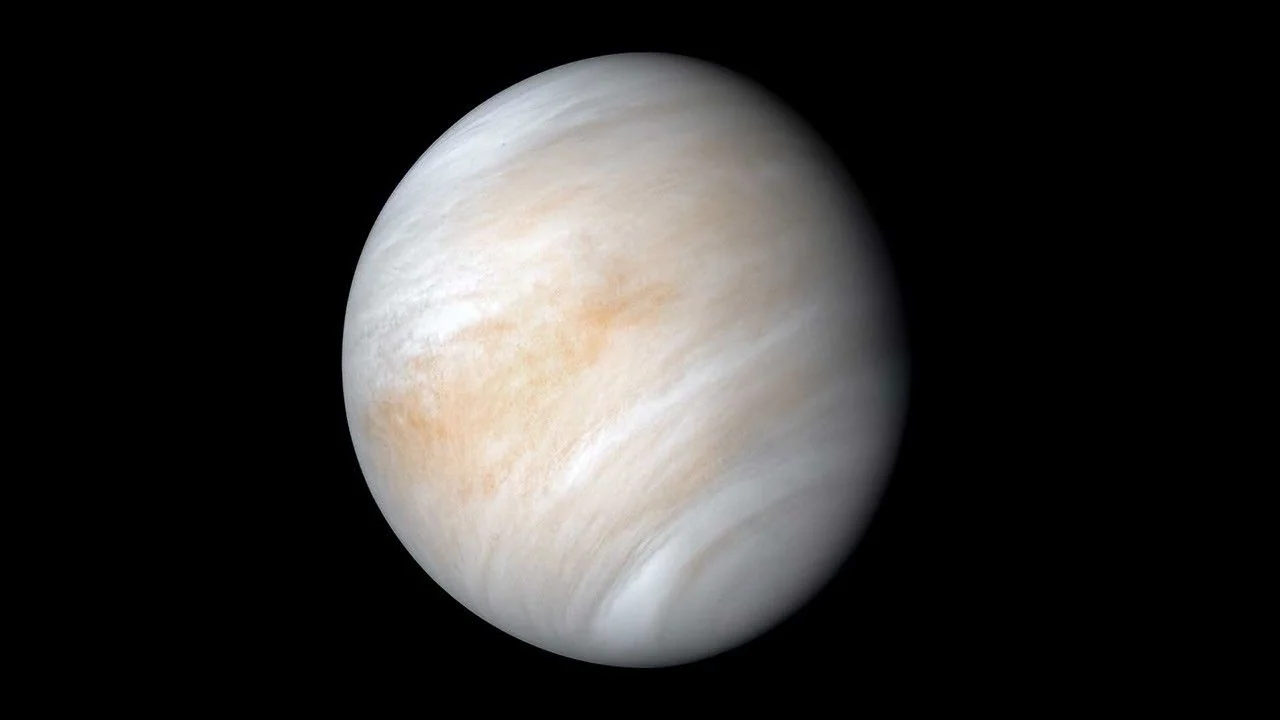
Why Venus's Pale Yellow Clouds Might Hide a Nearly Black Liquid
A new model finds Venus's cloud liquid must absorb UV light as strongly as concentrated pigments, narrowing the century-old 'unknown absorber' mystery.
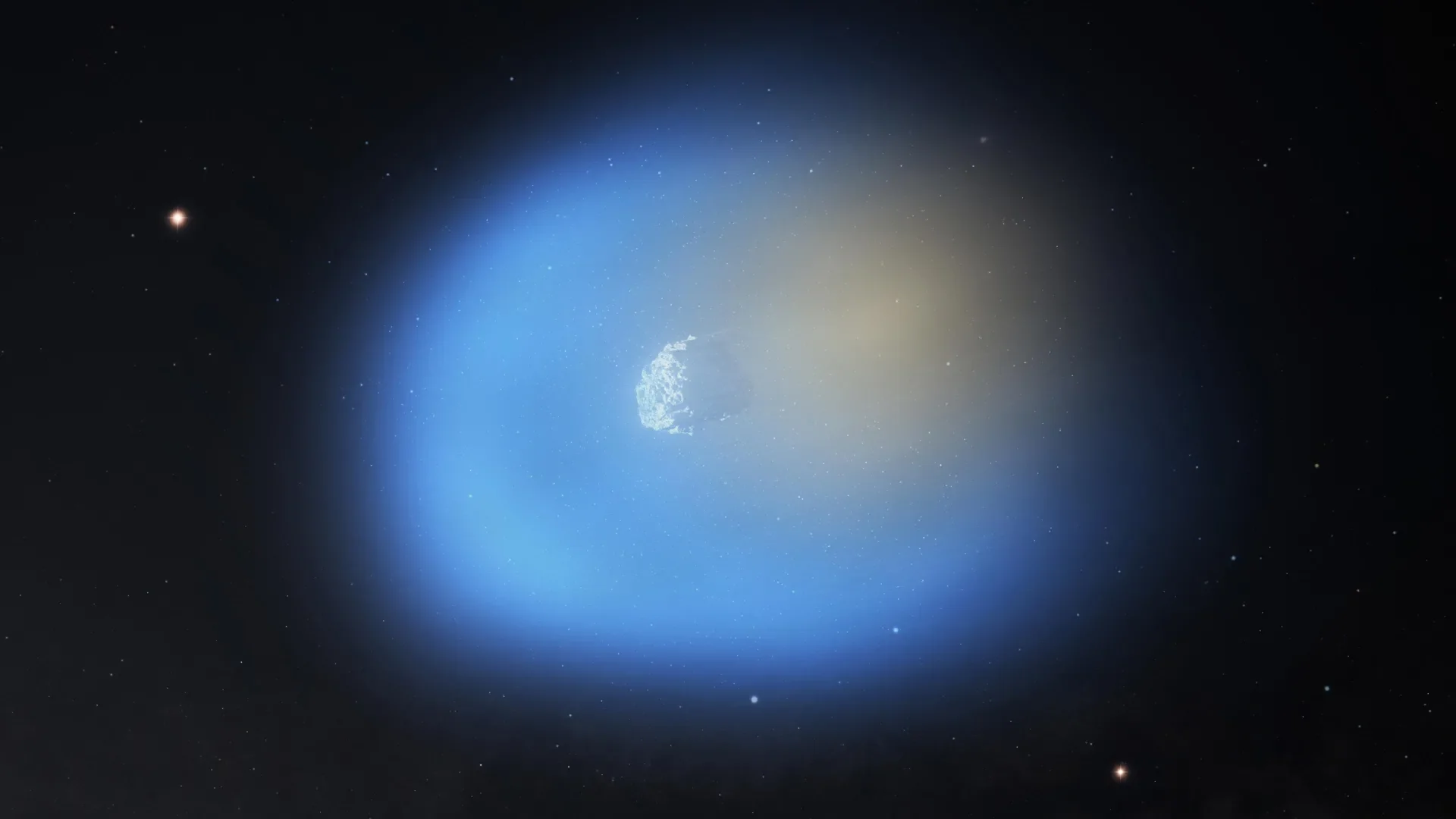
3I/ATLAS's Methanol-to-Hydrogen-Cyanide Ratio Reaches 124, ALMA Data Show
ALMA's Atacama Compact Array measured interstellar comet 3I/ATLAS's methanol-to-HCN ratio at 124 and 79 on two dates, among the highest recorded in a comet.
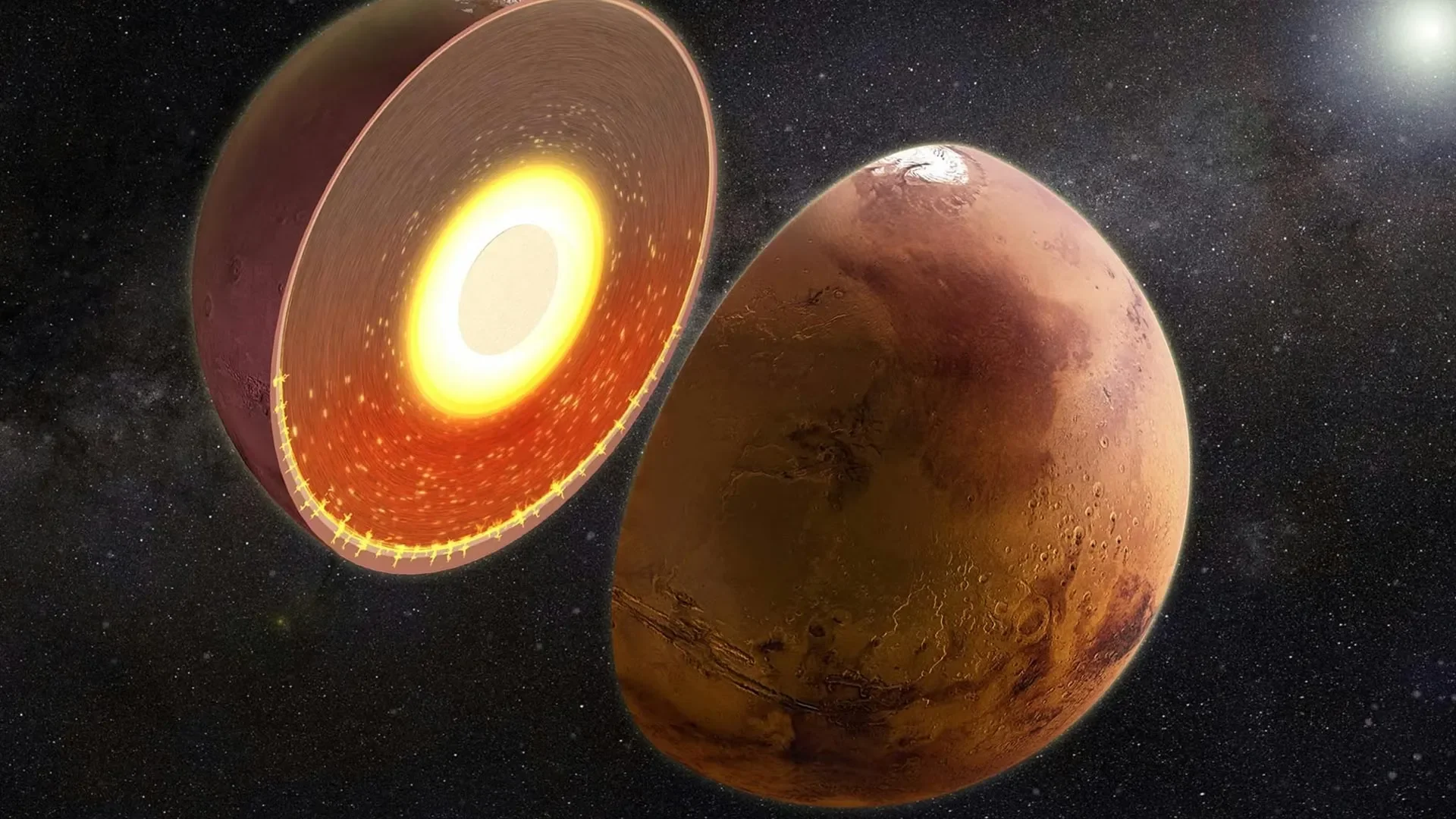
Mars's Southern Mantle Is Hundreds of Degrees Hotter Than Its North, New Gravity Study Finds
New tidal-tomography analysis of Mars orbiter data finds its southern mantle runs 200–400°C hotter than the north, tied to the ancient crustal dichotomy.
NASA's IXPE Measures 80% X-Ray Polarization From a Magnetar, Testing a 90-Year-Old Quantum Prediction
NASA's IXPE recorded up to 80% X-ray polarization from magnetar 1E 1547.0−5408, the strongest evidence yet for vacuum birefringence, a 1936 QED prediction.
Comments (0)
Please sign in to join the discussion.
No comments yet.
Be the first to share your perspective on this topic.