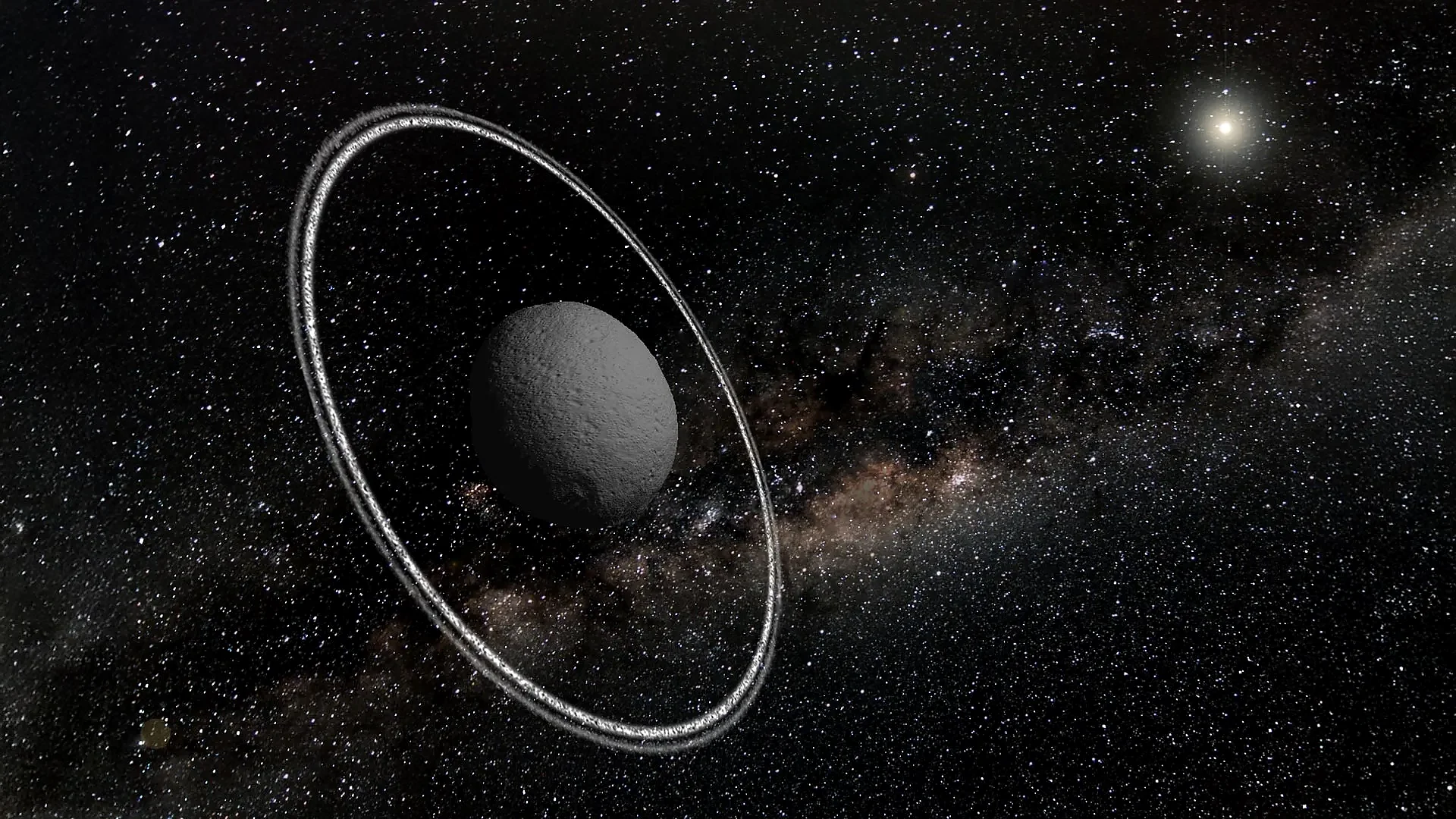
On 18 October 2022, the James Webb Space Telescope watched a star dim twice as the rings around (10199) Chariklo passed in front of it, the first stellar occultation ever both predicted and observed from a space telescope beyond Earth orbit. Comparing that data with a decade of ground-based measurements, researchers led by the Instituto de Astrofísica de Andalucía (IAA-CSIC) now report that Chariklo's inner ring has grown markedly denser while its outer ring has nearly disappeared, in the study published in Science Advances.
A Decade of Ground-Based Occultations Set the Baseline
Chariklo, an icy Centaur orbiting between Saturn and Uranus, was the first small Solar System body ever found to carry a ring system. The rings were detected on 3 June 2013 through a ground-based occultation campaign in South America and described in the original discovery paper. They turned out to be two narrow, sharply confined bands: C1R, the denser inner ring, and C2R, the fainter outer ring, orbiting roughly 390 and 405 kilometres from Chariklo's centre.
Between 2014 and 2022, roughly twenty occultation campaigns across South America, Europe and Africa refined the rings' geometry and built up a baseline for C1R's opacity, the fraction of starlight the ring blocks. Six well-resolved pre-2022 measurements averaged a normal opacity of 0.303, with an uncertainty of 0.028. Across that stretch the rings appeared stable: narrow, confined and consistent from one occultation to the next, the same behavior astronomers had come to expect of small-body rings generally.
The 2022 JWST Occultation Pushed Opacity Measurements Into Uncharted Territory
Predicting an occultation from JWST is a different problem than predicting one from the ground. The telescope orbits near the second Sun-Earth Lagrange point, an unstable position that requires station-keeping manoeuvres two to three times a month, so its predicted position can drift. In this case, successive ephemeris updates disagreed by as much as 10,000 kilometres within six months, and the predicted occultation path itself shifted 110 kilometres and 1.5 minutes in timing between the team's first identification of the event, in August 2022, and their final update hours before it happened. Pinning the prediction down required Gaia DR3 astrometry for both Chariklo and the target star.
The team succeeded: on 18 October 2022, JWST's NIRCam instrument tracked the star Gaia DR3 6873519665992128512 through simultaneous near-infrared filters centred at 1.5 and 3.2 microns, sampling at roughly 3.3 times per second over a 75-minute window. The star's path passed just 7 kilometres beyond Chariklo's edge, close enough to cross both rings but not the main body itself, so only the rings dimmed the starlight.
C1R showed up clearly in both filters, with sharp diffraction spikes at its edges reminiscent of Uranus's confined rings. Its measured opacity, though, was substantially higher than anything seen before: 0.431 on average, against the 0.303 pre-JWST baseline. The statistical team behind the paper puts the significance of that jump at a z-score of 4.2, meaning a chance fluctuation of this size would be expected roughly three times in 100,000 comparable measurements. C2R told the opposite story. It was only marginally detected in the shorter-wavelength filter and not detected at all in the longer one, despite both filters sampling the same stretch of ring at the same moment. Measured against 2017 data, its equivalent width, a measure that combines opacity and ring width into a single proxy for the amount of material present, had fallen by roughly 60%.
Why the Inner Ring Gained Material While the Outer Ring Faded
Before treating the shift as real, the team tested whether it could be an illusion of sampling. Rings are not necessarily uniform around their circumference, so a single occultation chord could, in principle, cross an unusually dense or sparse patch by chance. Using a Monte Carlo simulation of an azimuthally variable ring, the researchers estimated the odds of randomly hitting values this extreme at roughly 0.4% for C1R and 0.2% or lower for C2R, low enough that patchy sampling alone is an unlikely explanation for either ring.
A second possibility was that the rings had not changed at all, and that the apparent shift was really a property of the light itself: JWST observed in the near-infrared, while most prior ground-based occultations were in visible light, and grain optics can genuinely differ by wavelength. To test this, the team modelled the rings as mixtures of water ice, carbon and silicate grains of varying sizes, using the same tool astronomers use for interstellar dust. A mixture dominated by micron-sized water ice grains with a small silicate component fit the pre-2022 data well, including a 2017 near-infrared measurement from the Very Large Telescope. But no combination of two materials could fit that 2017 point alongside both JWST filters at once. The best available fit was still a poor one. That result argues against wavelength dependence as the full explanation and leaves a genuine physical change in the ring material as the more likely cause, whether through an overall increase in C1R's material or through collisions grinding larger particles into a finer, more light-blocking dust.
The case for C2R actively dispersing gets support from a separate calculation. Using Chariklo's estimated mass and the ring's own measured width, the team calculated how quickly an unconfined C2R would spread and thin out. The answer: a median of just 0.34 years, with a plausible range of roughly four months to a year. Left with no stabilizing mechanism, a ring that narrow should have spread apart within a year of its 2013 discovery, yet it persisted for most of a decade. That gap between calculated lifetime and observed persistence is itself evidence that something has been actively confining or replenishing C2R, at least until recently.
The two changes are not simply mirror images of each other. C1R's gain in equivalent width is roughly ten times larger than C2R's loss, so the material missing from the outer ring cannot by itself account for what showed up in the inner one. Whatever added density to C1R, whether new material or finer collisional debris, came from somewhere beyond a straightforward transfer between the two rings.
What Remains Unconfirmed About Chariklo's Shepherd Mechanism
The leading explanation for how C1R stays confined at all is a 1:3 spin-orbit resonance with Chariklo's own rotation, a configuration in which a ring particle completes one orbit for every three times the body spins. On its own, that resonance would push the ring slowly outward and eventually out of resonance entirely, so researchers have proposed a small, as-yet-undetected shepherd moon that could hold C1R in place and, if it shares an orbit with C2R, supply the outer ring with fresh material, much as small moons help maintain some of Saturn's and Uranus's rings. No such moon has been directly observed around Chariklo.
It is also possible that JWST simply caught C2R in an unusually sparse stretch, even though the team's own statistics make that a low-probability explanation. Sorting out which is right will likely require another dedicated occultation, this time in visible light rather than JWST's near-infrared bands, to see whether the inner ring's strengthening and the outer ring's fading hold up under a different set of eyes. Dusty rings elsewhere in the Solar System, including Saturn's D and F rings, Neptune's faint arcs and Uranus's λ ring, are known to shift in brightness and structure over months to decades, so rapid change is not unheard of around larger bodies. What is new here is seeing it clearly around an object as small as Chariklo, using a technique and a telescope not built with this kind of measurement in mind.
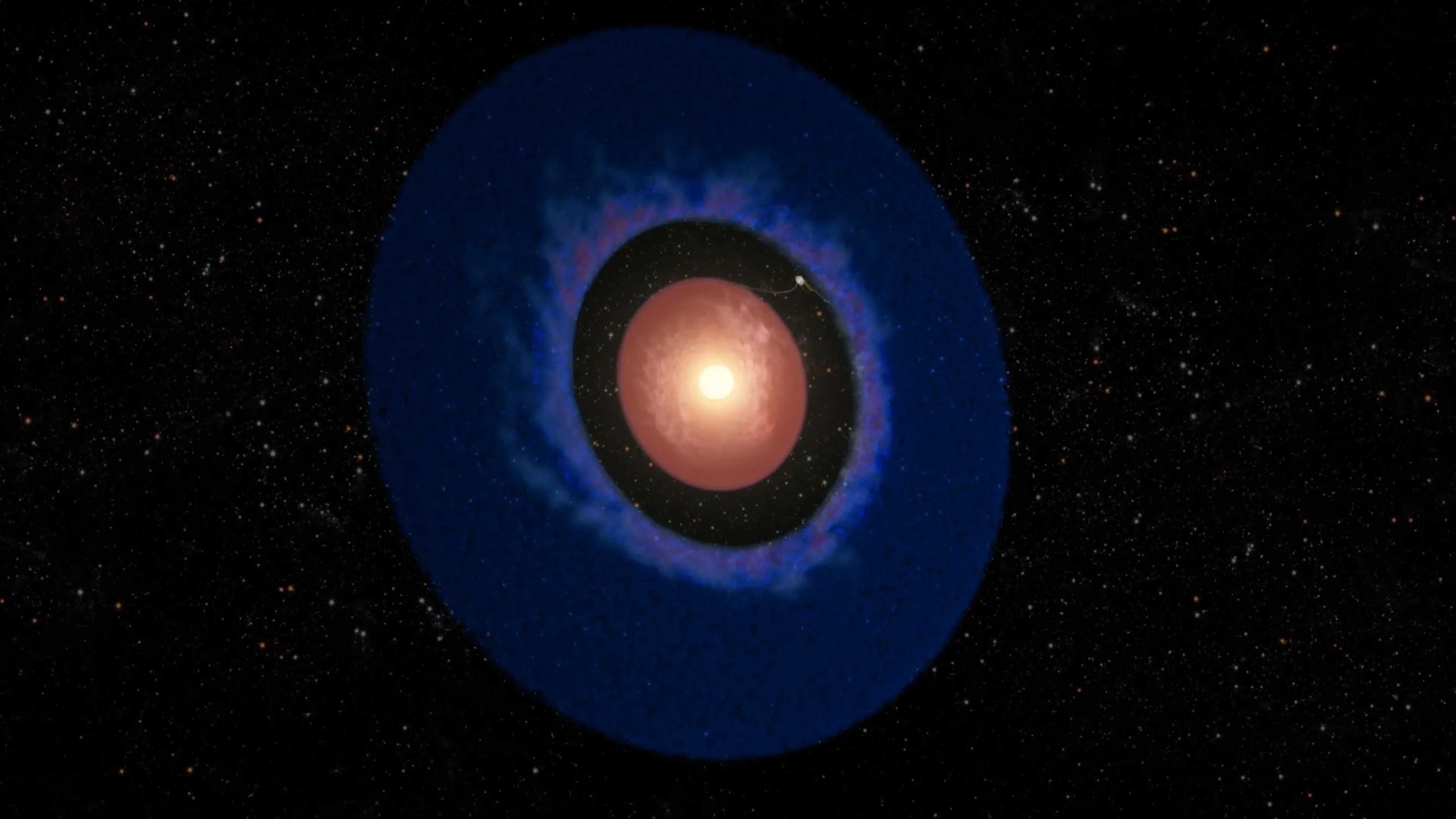
Elias 2-24 b Confirmed as the Youngest Known Exoplanet
Elias 2-24 b, confirmed via Keck, ALMA and VLT data, is under 1 million years old, roughly five times younger than the previous exoplanet age record.
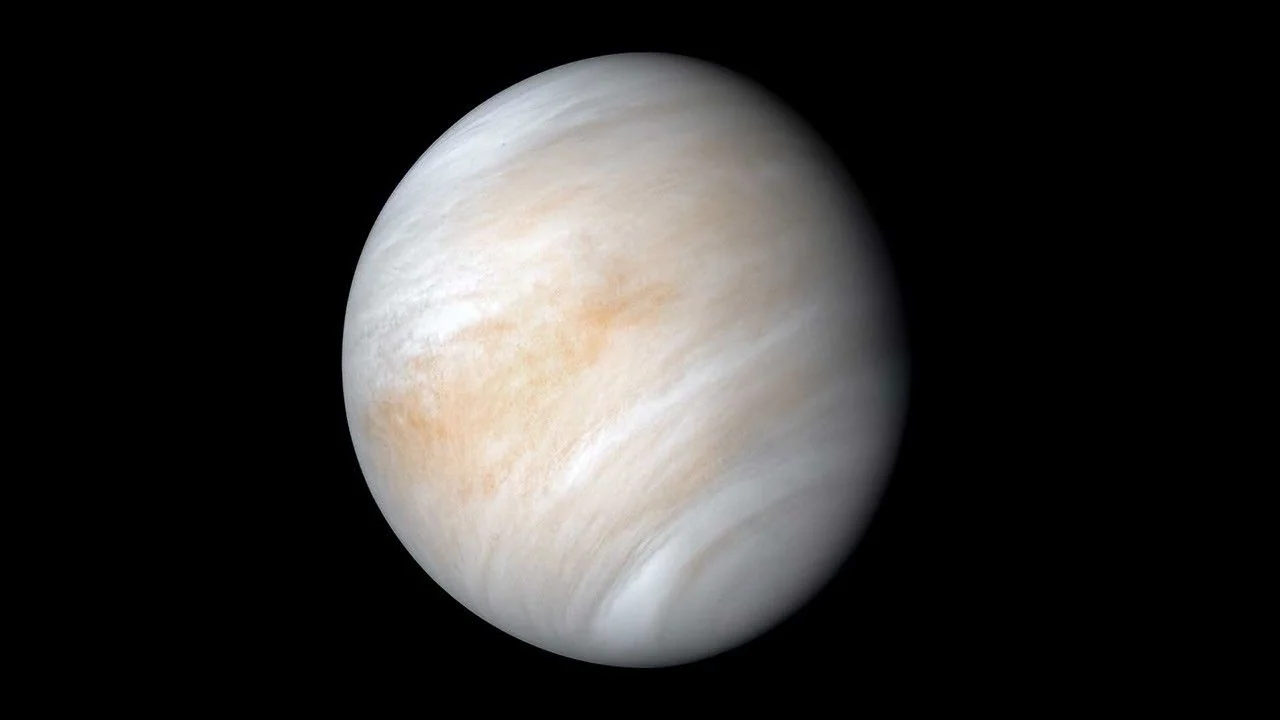
Why Venus's Pale Yellow Clouds Might Hide a Nearly Black Liquid
A new model finds Venus's cloud liquid must absorb UV light as strongly as concentrated pigments, narrowing the century-old 'unknown absorber' mystery.
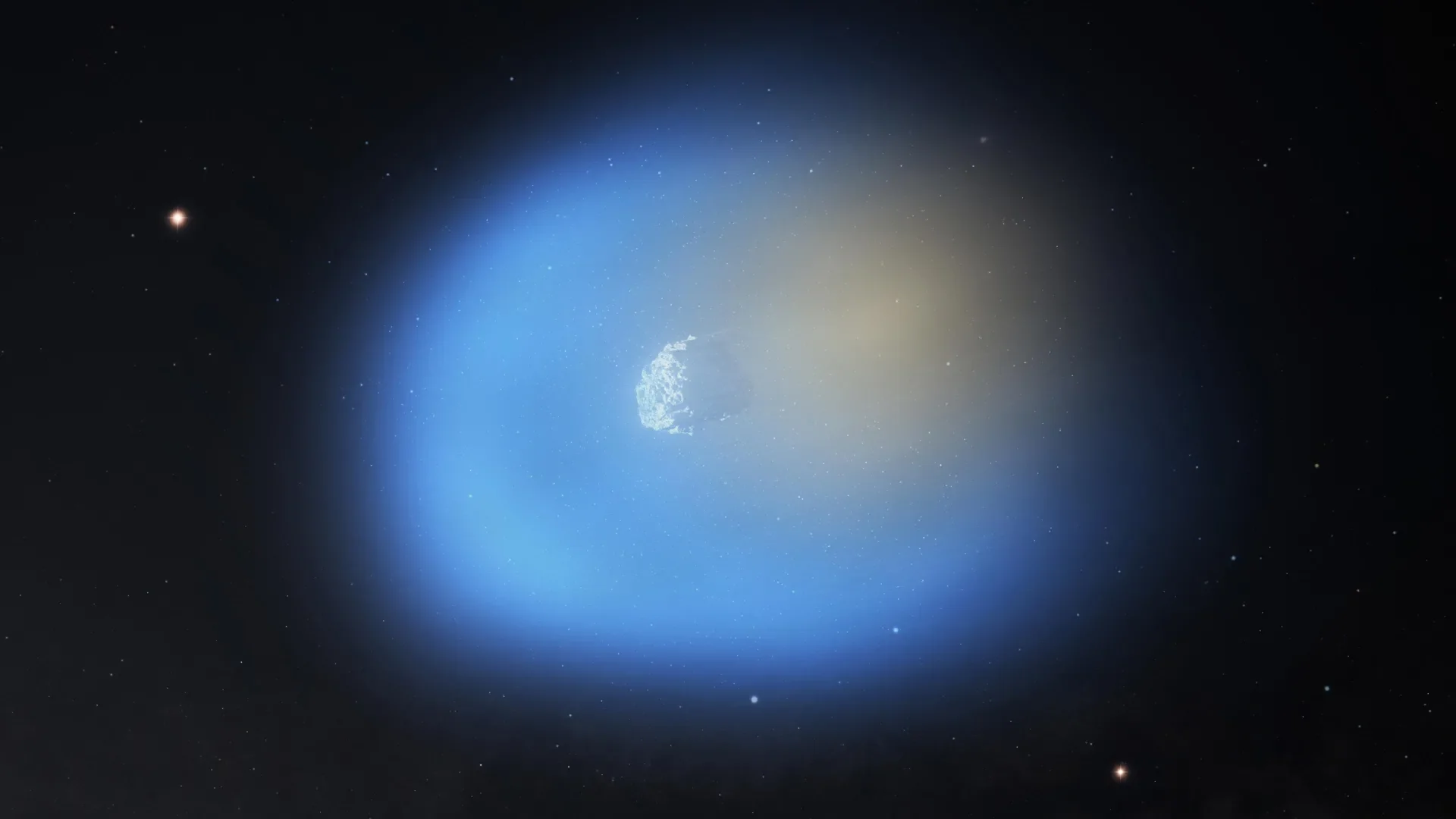
3I/ATLAS's Methanol-to-Hydrogen-Cyanide Ratio Reaches 124, ALMA Data Show
ALMA's Atacama Compact Array measured interstellar comet 3I/ATLAS's methanol-to-HCN ratio at 124 and 79 on two dates, among the highest recorded in a comet.
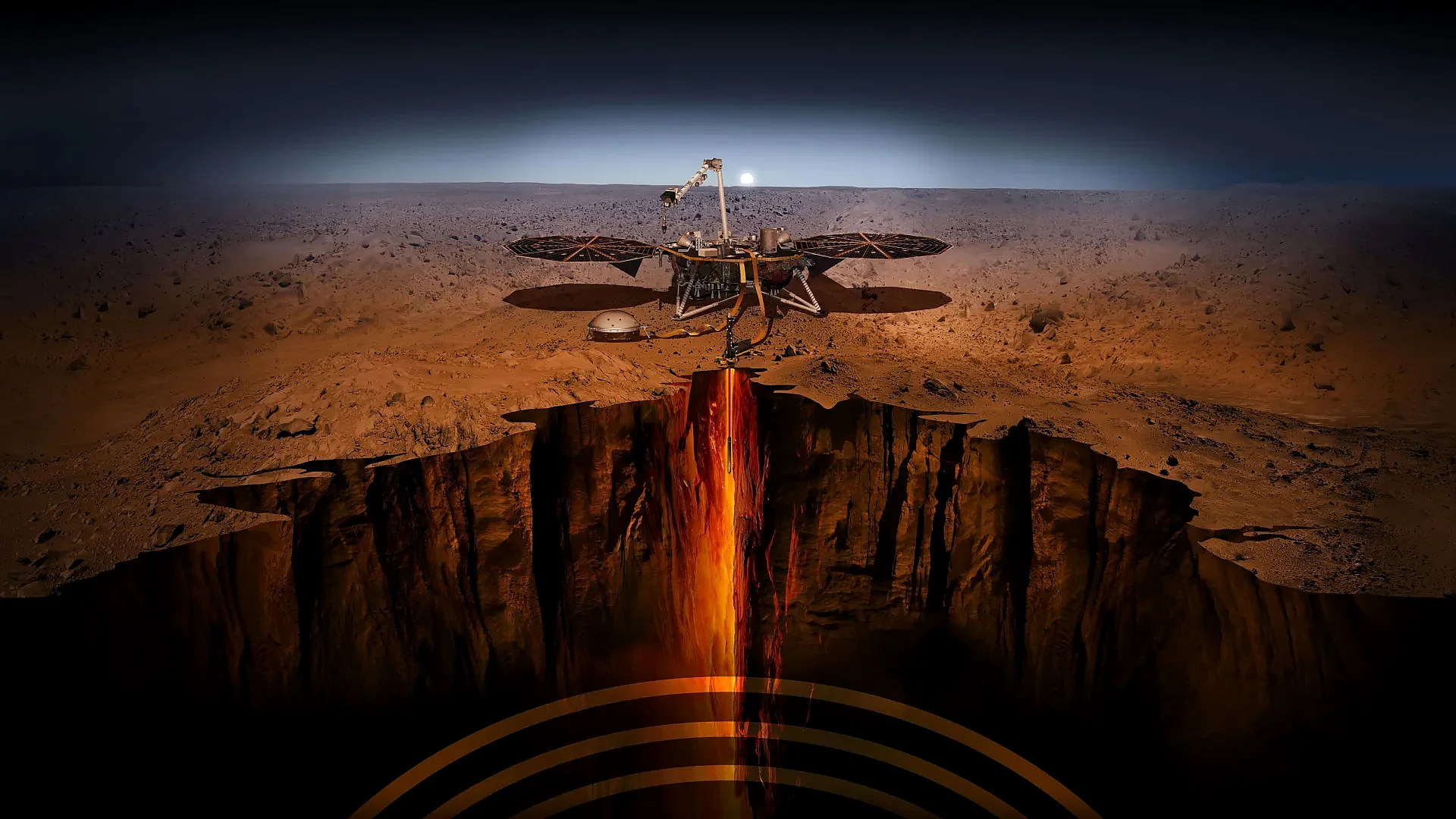
A Buried Ultramafic Layer Points to a Whole-Crust Magma System on Mars
NASA InSight data show a melt-depleted ultramafic layer 24–38 km down in Mars's crust, evidence of a magma system that once ran through the entire crust.
Comments (0)
Please sign in to join the discussion.
No comments yet.
Be the first to share your perspective on this topic.