
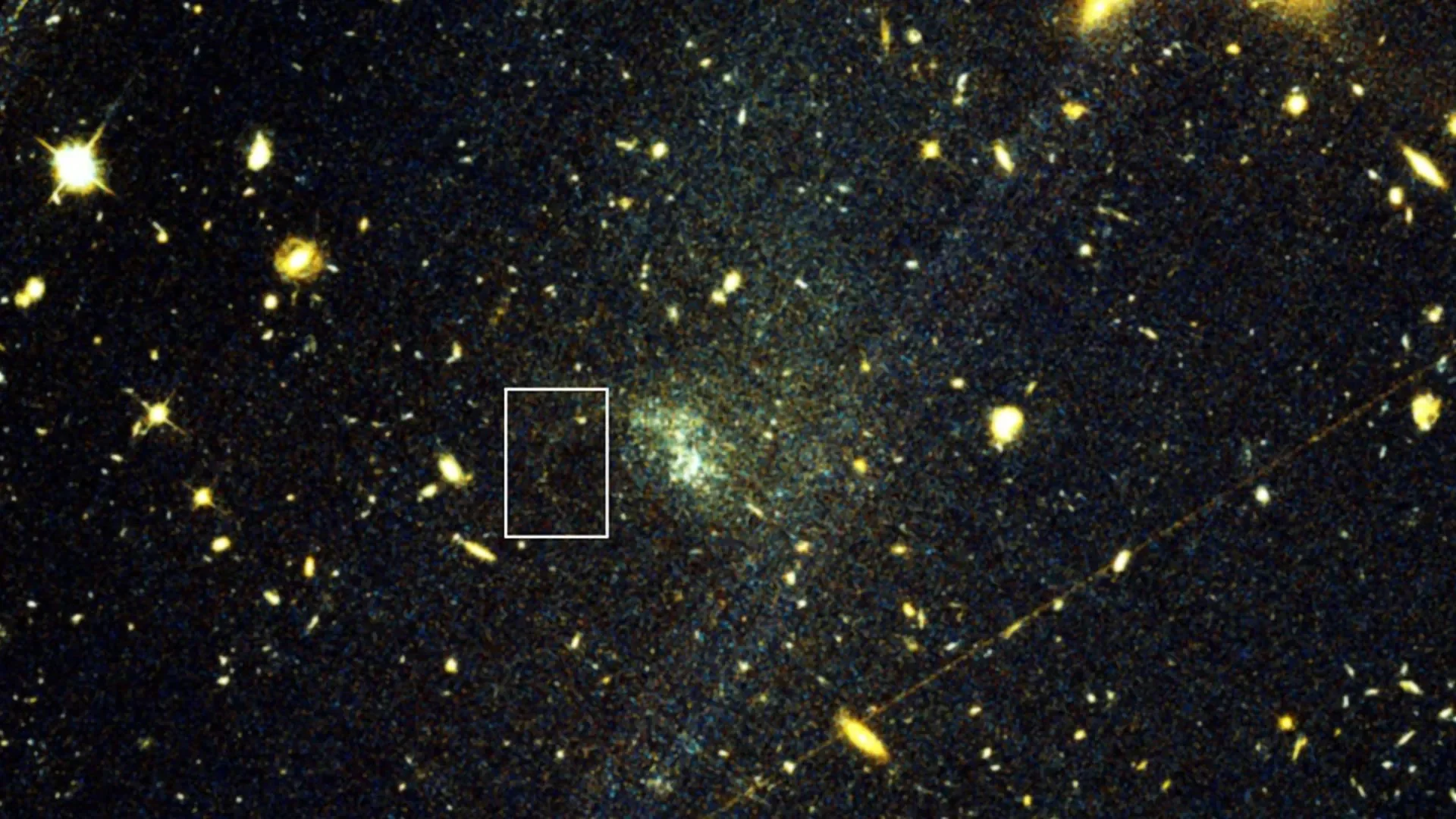
A faint, curved band of stars in the ultra-diffuse galaxy UGC 9050-Dw1, about 35.2 Mpc away, may be the first globular cluster stellar stream identified outside the Milky Way. The authors of a Nature paper published on 12 August 2026 named it Oyashio. Their models cap the parent cluster's initial mass at 2.5 million solar masses (95% confidence) and place the host in a dark matter halo whose mass is only loosely bounded. The paper calls this evidence for a stream, and it lists a chance alignment of unrelated stars among the explanations that cannot be fully excluded.
A 72-parsec-wide arc from a compact source, seen by two telescopes
The feature appears in Hubble Space Telescope ACS/WFC images taken in September 2022 and, independently, in Canada–France–Hawaii Telescope MegaCam data from 2005. Because two instruments recorded it, the authors rule out an imaging or processing artefact. Co-author David Hendel spotted the arc by eye in the galaxy's Hubble images, according to the team's institutional account of the discovery. A rolling Hough transform run across a range of settings then returned the same position and curvature.
Signal prominence in the combined Hubble image is 7.34 times the background scatter, and a Gaussian fit to the arc's cross-section gives a signal-to-noise ratio of 5.2. The same fit yields 2.3 to 3.9 in the CFHT g, r and i bands, and the arc is undetectable in the u and z bands. The authors add that the significance they quote covers only one of three questions: how strongly the signal rises above the background. The other two are whether the structure is a stream and whether they would have found it.
The fitted width is 72.3 ± 8.9 pc. The paper sets that against Milky Way globular cluster streams, which span tens to a few hundred parsecs, and against the Orphan–Chenab stream, whose dwarf-galaxy progenitor produced a width above 200 pc. The visible arm runs about 2 kpc by the authors' by-eye estimate and lies roughly 2.5 kpc, in projection, from the host's centre.
Colour supports the cluster reading. The compact source has an integrated F555W–F814W colour of 1.1 ± 0.1 and the stream 1.0 ± 0.2, and both fall inside the box used to select globular cluster candidates in the 2023 census of this galaxy's clusters. That census left the source out. The authors trace its exclusion to roundness, sharpness or magnitude-uncertainty cuts that an elongated, disrupting cluster would be expected to fail.
Surface brightness brackets the parent cluster between 165,000 and 2.5 million solar masses
The stream's surface brightness is 27.0 ± 0.1 mag arcsec⁻² in F555W and 26.1 ± 0.1 in F814W. To turn that into a mass, the authors filled the arc with stars drawn from PARSEC stellar-evolution tracks and compared the simulated brightness with the measured one. A stream with the age (11.3 Gyr), metallicity ([M/H] = −1.3) and degree of disruption of the Milky Way's Palomar 5 needs a progenitor about 20 times Pal 5's mass, near 2 × 10⁶ solar masses, to match. A younger 8 Gyr population with [M/H] = −1.0 reaches the same brightness with as little as 1.65 × 10⁵ solar masses. The host's clusters are relatively blue and consistent with younger ages than Pal 5, which keeps the low end in play.
Both estimates depend on one stated assumption: the brightness ratio between cluster and stream stands in for the mass ratio, giving a stream fraction of about 0.75 if the two arms are identical.
X-Stream turns one arm's shape into a halo mass and slope range
The dynamical step uses X-Stream, the generative sampler described by Nibauer and Pearson. It releases stars from a trial progenitor along an orbit in a trial halo, builds a density estimate of the resulting stream, and scores it against control points laid along the observed arc with a Kullback–Leibler divergence. Ten parameters float with flat priors, and only the progenitor's position on the sky is fixed. The fiducial runs assume a halo concentration of 5. A concentration of 2 and a wider 185 pc mask made no material difference, the authors report. Only the arm on the progenitor's left enters the fit. The analysis code is public, while X-Stream itself is available on request.
Whether a cluster can shed a stream at all depends on its tidal radius, which scales as r_t ∝ R_gal (M_p / M_h)^(1/3). Here R_gal is the cluster's distance from the galaxy's centre, M_p the progenitor mass and M_h the halo mass. If r_t sits far outside the cluster, no stream forms. For the model drawn at the posterior peak, the present-day r_t is 133 pc with a minimum of 95 pc, against roughly 145 pc for Pal 5.
The fit returns a halo scale mass of log₁₀(M_h/M☉) = 11.31 (+0.67, −0.71 at 68%) and a virial mass of log₁₀(M₂₀₀/M☉) = 11.63 (+0.71, −0.83). The inner density slope comes out at γ = 0.92 (+0.57, −0.58 at 68%; +0.92, −0.87 at 95%). The halo's scale radius and outer slope are unconstrained, while the progenitor's line-of-sight position and orbit are strongly constrained.
The table converts those results into ratios against benchmarks the paper cites. The ratios and ranges are BytePith arithmetic on the published figures and do not appear in the paper.
| Oyashio results against the paper's own benchmarks | |||
|---|---|---|---|
| Quantity | Oyashio result | Benchmark in the paper | Derived comparison |
| Stream width | 72.3 ± 8.9 pc | Orphan–Chenab stream, above 200 pc | Under 0.36 of the dwarf-progenitor width |
| Initial progenitor mass | 1.65 × 10⁵ to below 2.5 × 10⁶ M☉ | Omega Centauri, 3.55 × 10⁶ M☉ | Upper limit is about 70% of Omega Centauri; the window spans a factor of about 15 |
| Tidal radius (model) | 133 pc now, 95 pc minimum | Palomar 5, about 145 pc | About 92% of Pal 5 today, about 66% at minimum |
| Halo mass M₂₀₀ | Central value about 4.3 × 10¹¹ M☉; 68% range about 6 × 10¹⁰ to 2 × 10¹² | Globular-cluster-count estimates, 1.5 ± 0.3 and 1.8 ± 0.3 × 10¹¹ M☉ | Both earlier estimates fall inside the 68% range, which is itself about 35 times wide |
The halo-mass row needs one clarification. The illustrative model the paper draws at the posterior peak has M₂₀₀ = 1.56 × 10¹¹ M☉, similar to published estimates for the Large Magellanic Cloud. The central value converts to about 4.3 × 10¹¹. Both lie inside the same 68% range. The host's stellar mass within its half-light radius is only about 10⁷ M☉, so either figure implies a halo far heavier than the visible stars.
The chart shows the slope constraint against the three comparison values the paper quotes. At 68%, the range of 0.34 to 1.49 excludes the typical low-surface-brightness dwarf (about 0.2) and Dragonfly 44 (0.3), and it contains AGC 242019 (about 0.54). At 95% the range widens to 0.05 to 1.84 and contains all three. The paper's wording, that this galaxy is slightly less cored than the first two, matches the 68% reading. The 95% range shows that the stream alone cannot yet separate a cored profile from a cuspy one.
Merger tails, shells, lensing and dust each fail a specific test
The paper checks five alternatives. Tidal tails from cluster mergers, reported recently in dwarf galaxies, should sit near the host's centre, and Oyashio lies more than 2 kpc out. A tidal shell would curve around the host's centre, and Oyashio's centre of curvature is offset from it. A lensed background galaxy would need companion arcs or a visible lens, and the authors see neither. A dust patch would leave one side of the arc redder than the other, and they find no such trend. A stream from a small dwarf galaxy would look wider and would need about five times more stellar mass than the progenitor upper limit to be visible.
Chance alignment of unresolved stars is the one explanation left standing. The authors argue that the matching colours, the agreement with the earlier halo mass from cluster counts, and their mock observations favour a stream, but they say a coincidence cannot be entirely ruled out.
One arm, ten free parameters: what follow-up has to settle
The fit rests on a single arm. In the models, the counter-arm wraps behind the galaxy's bright centre, which would explain why only one side shows, yet that arm sits outside the fit and has not been observed. The stream models also depend on the escape conditions assumed for stripped stars, and the authors describe their mock observations as a zeroth-order test of what Hubble could see.
The paper names the next steps: deeper Hubble or James Webb Space Telescope imaging to separate the arc from the background, and Keck spectroscopy to compare the stream's stars with the presumed parent cluster. If globular cluster streams turn out as common in ultra-diffuse galaxies as extrapolated Milky Way counts suggest, the authors expect the Euclid and Roman space telescopes to find more, which would test whether the wide halo range narrows once several streams constrain the same class of galaxy.
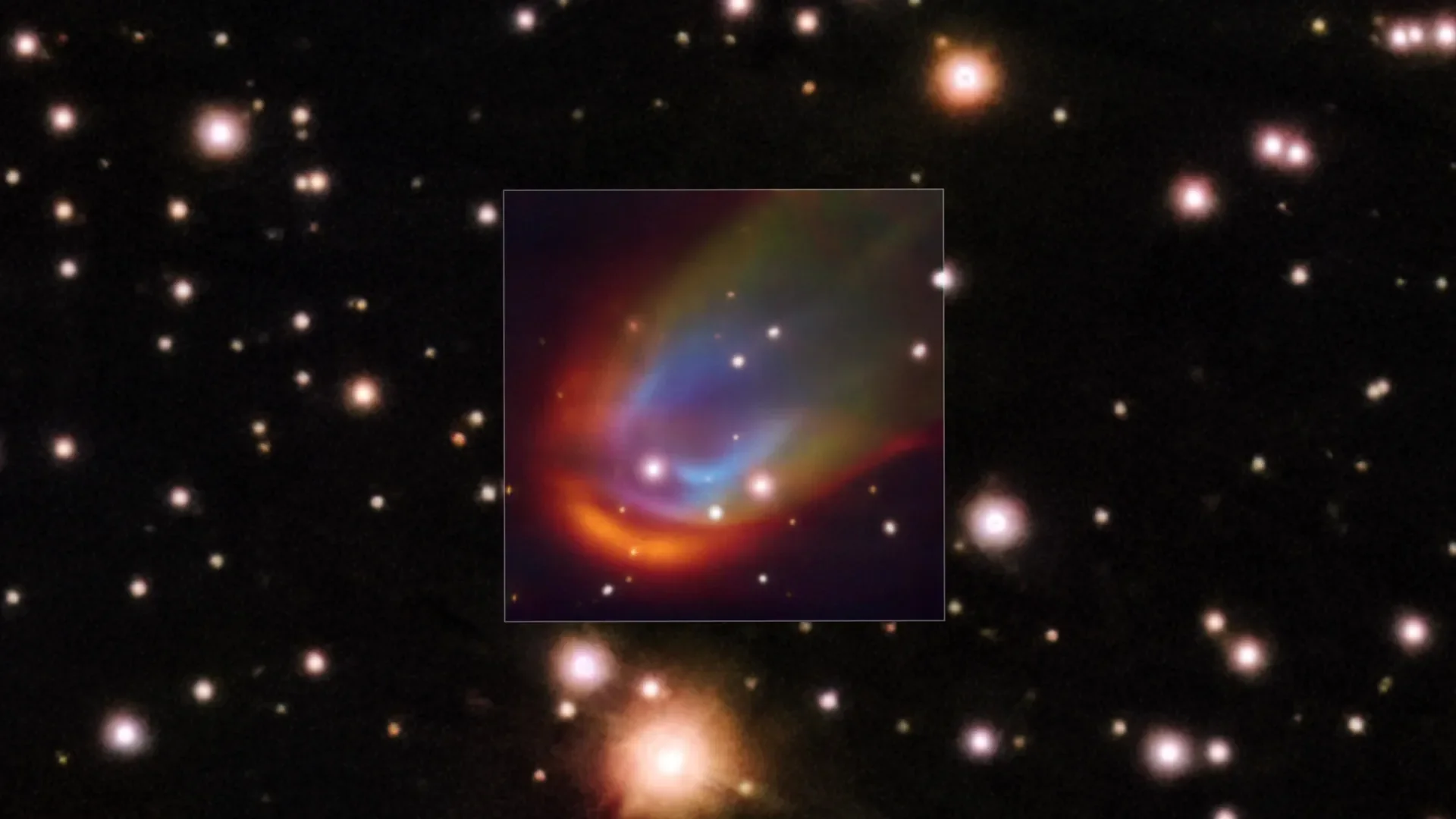
A Diskless White Dwarf's 1,000-Year Bow Shock Has No Known Power Source
Astronomers found a bow shock around white dwarf RXJ0528+2838 that no known mechanism explains: not a nova, not a disk wind, and not even its own 42-45 MG magnetic field.
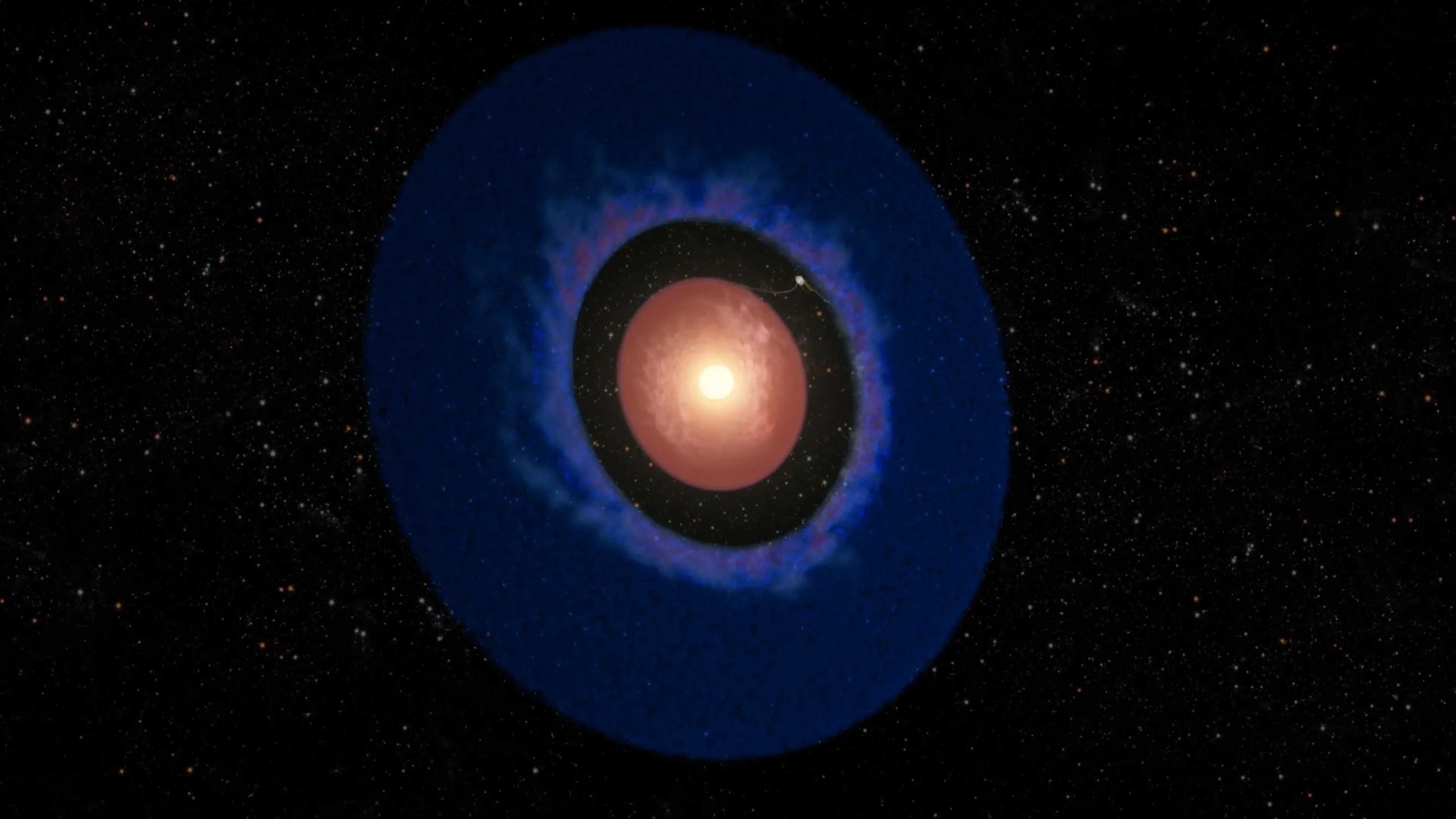
Elias 2-24 b Confirmed as the Youngest Known Exoplanet
Elias 2-24 b, confirmed via Keck, ALMA and VLT data, is under 1 million years old, roughly five times younger than the previous exoplanet age record.
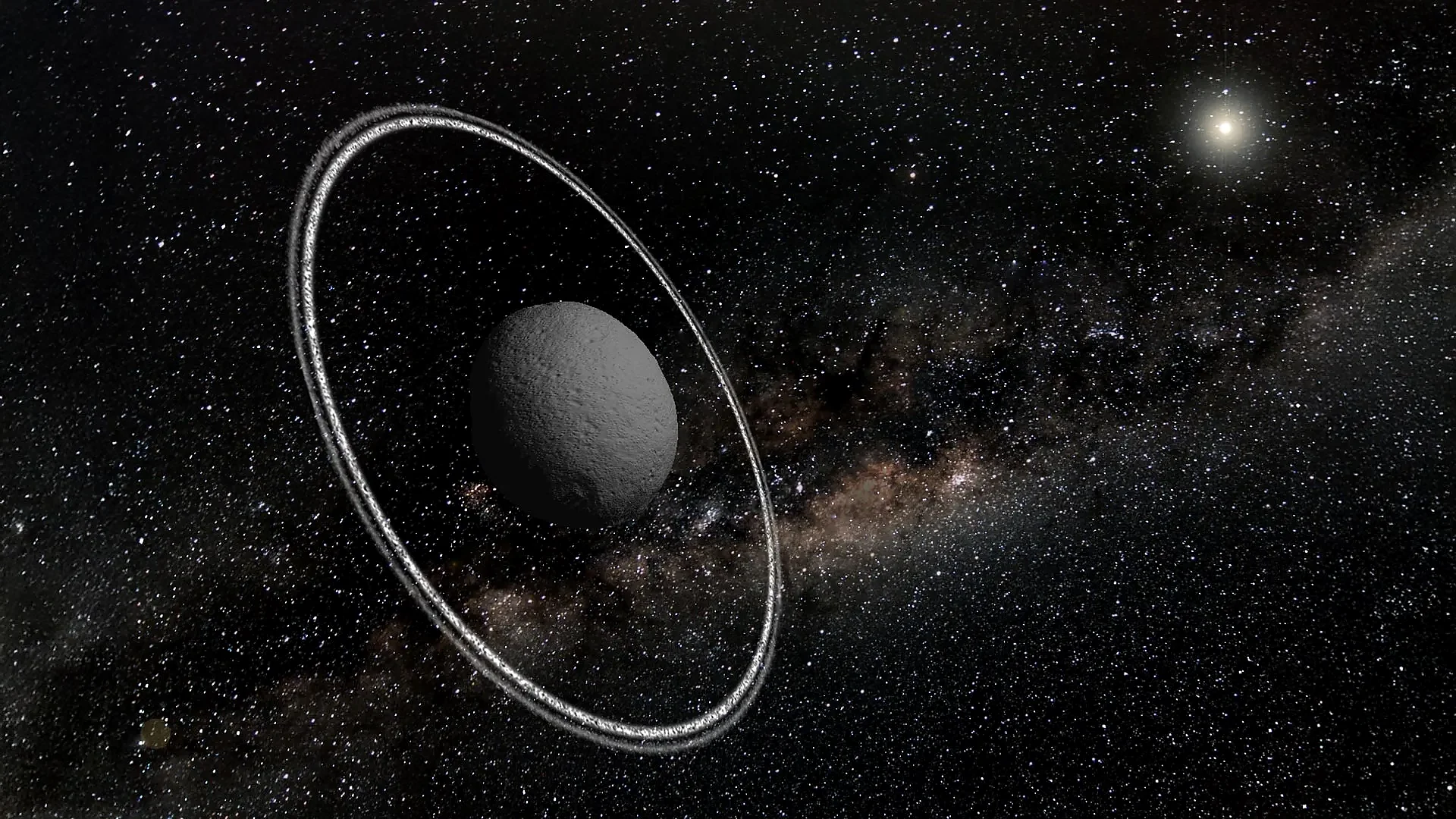
JWST Occultation Shows Chariklo's Two Rings Evolving in Opposite Directions
JWST's first predicted-and-observed stellar occultation reveals Chariklo's two rings changing in opposite directions within less than a decade.
Why Venus's Pale Yellow Clouds Might Hide a Nearly Black Liquid
A new model finds Venus's cloud liquid must absorb UV light as strongly as concentrated pigments, narrowing the century-old 'unknown absorber' mystery.
Comments (0)
Please sign in to join the discussion.
No comments yet.
Be the first to share your perspective on this topic.